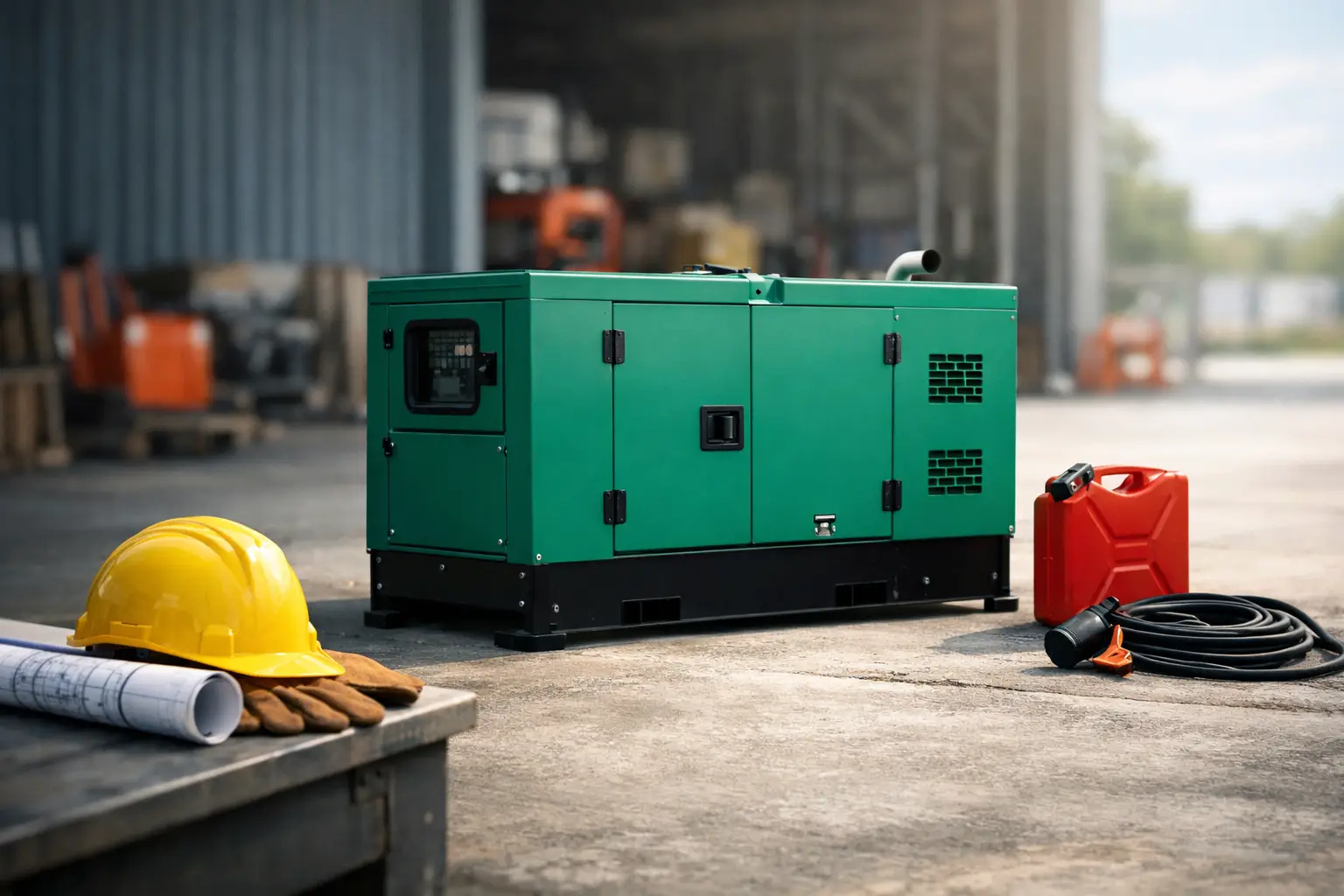
A 10kVA diesel generator is often the point where backup power moves from domestic contingency into serious commercial use. It is a practical size for small sites, critical single-load support, mobile welfare setups, light industrial duties, telecoms applications, and facilities that cannot afford an outage but do not need a large plantroom installation. The key is not simply finding a generator labelled 10kVA. It is specifying the right duty, configuration, and electrical output for the job.
For buyers responsible for uptime, a poor match at this size can be costly. An underspecified set will struggle with motor starting or sustained demand. An overspecified set may carry unnecessary capital cost, higher fuel burn at low load, and avoidable installation complexity. The value sits in getting the operating profile right from the outset.
What a 10kVA diesel generator is really suited to
In practical terms, a 10kVA set is commonly used where the load is important but relatively contained. That may include site cabins, small workshops, security systems, pumps, refrigeration support, telecoms equipment, lighting circuits, agricultural loads, or essential services within a commercial building.
Whether it is the correct size depends on the load type rather than the site type. A small premises with heavy motor starting can present a more demanding generator application than a larger office with stable, resistive loads. That is why serious procurement decisions start with load assessment, not just floor area or headcount.
A 10kVA unit may also suit planned operational use as prime power in remote or temporary locations, but that changes the specification requirement. Standby and prime ratings are not interchangeable, and treating them as such leads to shortened equipment life and unreliable performance.
Standby vs prime rating on a 10kVA diesel generator
This is one of the first points to settle. A standby-rated 10kVA diesel generator is intended for emergency use during mains failure. It is designed to run intermittently and typically has no overload allowance in the same way a prime-rated machine may be specified.
A prime-rated generator is built for longer and more regular operating hours where utility power is unavailable or unreliable. If the set is expected to carry the site routinely, the prime rating is the one that matters. Buyers sometimes focus on the headline kVA figure and miss this distinction, but for operations teams it is central to durability, servicing intervals, and warranty alignment.
If your application involves daily running, remote deployment, or prolonged utility instability, prime power should be assessed first. If the generator will only protect against occasional outages, standby may be the more commercially efficient route.
Single phase or 3 phase
Another common specification issue is output phase. A 10kVA generator may be available as single phase or 3 phase, and the correct option depends entirely on the load profile.
Single phase is usually appropriate for conventional smaller building services, welfare units, lighting, sockets, and simpler equipment. A 3 phase set is more suitable where motors, pumps, compressors, workshop machinery, or mixed commercial and industrial loads are involved.
The trade-off is straightforward. A 3 phase generator offers broader application flexibility, but if most of the connected demand is single phase, load balancing becomes important. Poor load distribution across phases can reduce performance and create unnecessary operating issues. If your site has predominantly single phase demand, a single phase set may be the cleaner answer.
Open or silent canopy
At 10kVA, enclosure format has a direct effect on usability. An open generator may suit internal plant areas, protected compounds, or projects where acoustic performance is not a major concern. It can offer simpler service access and sometimes a lower purchase cost.
A silent or super-silent enclosed set is often the better option for commercial sites, public-facing environments, urban installations, and any application where noise restrictions apply. For contractors and facilities teams, acoustic performance is not a cosmetic issue. It can determine whether the set is acceptable for the site at all.
The right decision depends on location, operating hours, and planning constraints. If the generator will run near occupied areas, noise attenuation should be considered early rather than added as an afterthought.
Fuel consumption and running efficiency
Buyers often ask how much diesel a 10kVA generator uses, but there is no useful single figure without load context. Fuel consumption varies according to engine design, load percentage, ambient conditions, and operating duty.
A generator running lightly loaded for long periods is not necessarily operating efficiently. Diesel engines generally perform best within an appropriate load band, and chronic underloading can lead to poor combustion and long-term maintenance issues. Equally, running too close to maximum capacity leaves little headroom for start-up currents or load growth.
For this reason, a proper specification exercise looks at average load, peak demand, and future expansion. The best commercial outcome is usually a set that carries the expected duty comfortably rather than one chosen solely on minimum upfront cost.
Starting loads matter more than many buyers expect
A 10kVA set may appear suitable when based on running watts alone, then fail in service because of motor starting demand. Pumps, compressors, air conditioning systems, and refrigeration equipment can draw significantly higher current at start-up than during normal operation.
This is where alternator performance, engine response, and control system quality become relevant. A generator is not just an engine with sockets. It is a coordinated power system. If the application includes inductive loads, the starting method and inrush characteristics need to be reviewed before purchase.
This is particularly important for contractors and engineers buying for mixed-use sites. A modest continuous load can still require a more capable set if the starting sequence is aggressive.
Installation considerations that affect performance
A 10kVA diesel generator is compact compared with larger industrial sets, but it still needs correct installation conditions. Ventilation, exhaust routing, fuel storage, access for service, and safe cable termination all affect reliability.
If the unit is installed externally, weather protection, security, and noise breakout should be assessed. If it is installed internally, airflow and heat rejection are critical. A generator that cannot breathe properly will not deliver rated performance consistently.
Automatic transfer switching may also be necessary if the set is intended for true standby protection. For critical applications, the generator itself is only part of the solution. Control logic, changeover arrangements, and maintenance access all contribute to uptime.
Compliance, servicing and long-term ownership
At this power level, it is easy to treat the purchase as straightforward. In reality, long-term reliability depends on aftersales discipline as much as initial specification. Service intervals, parts support, controller functionality, and engine provenance should all be considered before procurement approval.
Recognised engine platforms matter because they support predictable maintenance and parts availability. For buyers managing operational risk, that matters more than a nominal saving on an unknown platform. Downtime rarely comes from the brochure specification. It comes later, when support is required quickly and the supply chain is weak.
A professionally specified 10kVA set should also be considered in the context of testing routines. If the generator protects a critical load, periodic load testing and maintenance planning are part of the ownership case, not optional extras.
How to choose the right 10kVA diesel generator
The fastest route to the right unit is to define five points clearly: standby or prime duty, single phase or 3 phase output, the actual running and starting load, acoustic requirements, and installation environment. Once those are known, the field narrows quickly.
For example, a quiet standby set protecting office comms and essential lighting has very different requirements from an open 3 phase machine supporting pumps on a remote site. Both may fall within the 10kVA class, but they are not the same buying decision.
This is why enquiry-led procurement remains effective in the generator sector. The specification is usually less about browsing broad categories and more about matching a known operational need to a dependable configuration. Suppliers such as Global Generators work best when given the actual duty rather than just a target kVA.
Price is part of the decision, not the whole decision
Commercial buyers are right to compare pricing, but headline cost should be weighed against engine quality, enclosure specification, control panel standard, lead time, and support. The lowest-priced 10kVA set is not always the lowest-cost option over its service life.
Availability can also be commercially significant. If a project programme, outage risk, or temporary deployment deadline is driving the purchase, stock position and delivery speed may matter as much as minor variations in purchase price. For many sites, delayed power protection is simply another form of exposure.
A 10kVA diesel generator is a compact but serious piece of infrastructure. If the load is properly assessed and the set is chosen around duty, phase, acoustic needs, and installation conditions, it will do exactly what it is there to do - keep the site running when interruption is not acceptable.