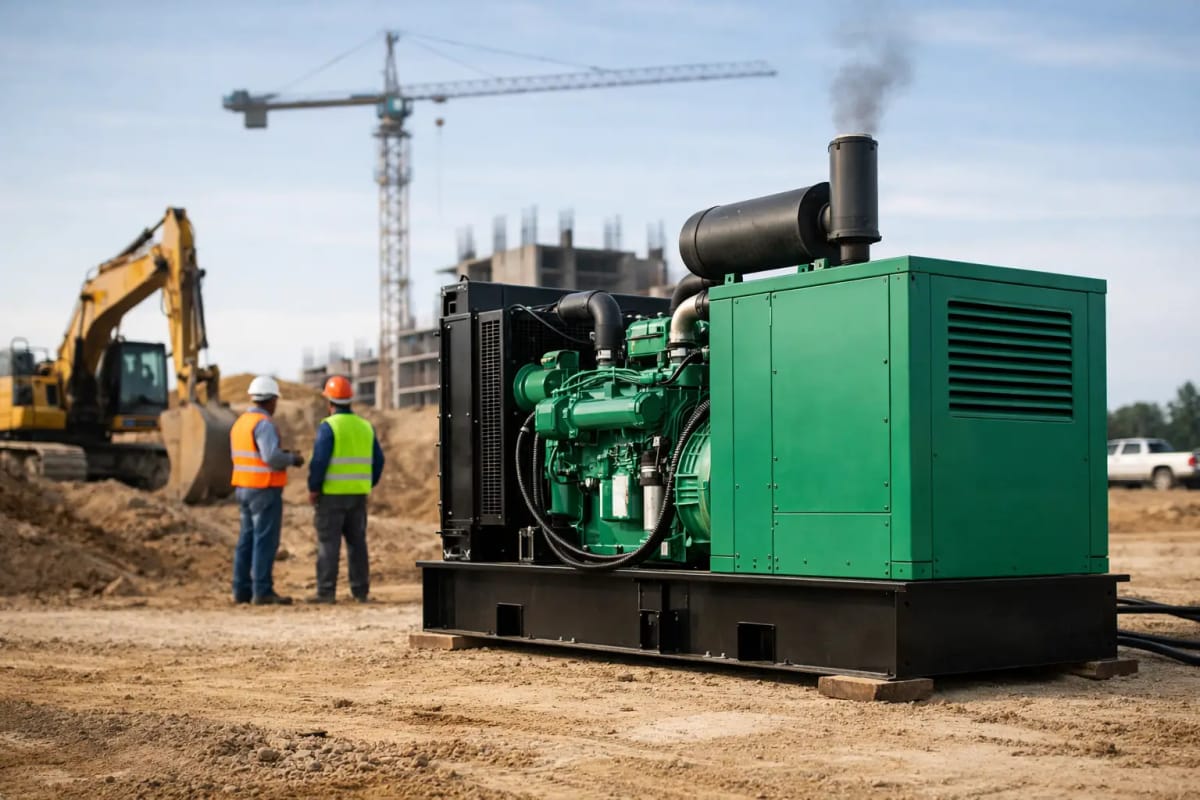
When a site loses mains power, there is no time for guesswork. Facilities teams need to know how diesel generators work because the answer affects sizing, load acceptance, maintenance planning and, ultimately, uptime.
For most commercial and industrial applications, a diesel generator is not a single machine doing one job. It is an integrated power system made up of an engine, alternator, control panel, fuel system, cooling arrangement, exhaust system and protection devices. Each part has a clear role, and the set only performs properly when those parts are correctly matched to the duty.
How diesel generators work in simple terms
At the most basic level, a diesel generator converts the chemical energy stored in diesel fuel into electrical energy. The diesel engine burns fuel to create mechanical rotation. That rotation drives the alternator, which produces electricity for the connected load.
The principle is simple, but the detail matters. Generator performance depends on how efficiently the engine responds to changing demand, how well the alternator maintains voltage, and how effectively the controls manage frequency, protection and transfer.
In standby use, the set remains ready until mains failure occurs. In prime power use, it may operate for long periods as the main power source. The way the generator works is the same in both cases, but the specification, duty cycle and operating expectations are different.
The main components of a diesel generator
The engine is the starting point. It provides the mechanical power needed to turn the alternator rotor. In industrial generator sets, diesel engines are favoured for their fuel efficiency, durability and strong torque characteristics under load.
The alternator converts rotational energy into electrical output. As the rotor spins within a magnetic field, it induces an alternating current in the stator windings. This is the electricity supplied to the site, whether as single phase or 3 phase power depending on the application.
The control panel acts as the generator’s operating centre. It manages start and stop functions, monitors voltage and frequency, tracks engine conditions such as oil pressure and coolant temperature, and initiates shutdowns if a fault is detected.
The fuel system stores and delivers diesel at the correct pressure and volume for combustion. The cooling system removes heat from the engine. The exhaust system carries combustion gases away safely. The starting system, usually battery-based, provides the initial crank needed to bring the engine up to speed.
Then there is the frame or enclosure. An open generator may suit plant rooms or controlled environments, while a silent generator is often specified where noise control and weather protection are priorities.
What happens when the generator starts
A diesel generator start sequence is controlled and deliberate. When the system receives a start signal, either manually or from an automatic transfer switch, the starter motor turns the engine crankshaft. Air is drawn into the cylinders and compressed to a high temperature.
Diesel fuel is then injected into that hot compressed air. Unlike petrol engines, diesel engines do not rely on spark plugs for ignition. The heat generated by compression is enough to ignite the fuel. This combustion forces the pistons downward, turning the crankshaft and creating continuous rotational energy.
Once the engine reaches its rated speed, typically linked to the frequency requirement of the alternator, the generator is ready to produce stable power. In the UK, this usually means maintaining output suitable for 50 Hz operation. If engine speed drifts, frequency drifts with it, which is why governor control is critical.
How the alternator produces electricity
The alternator is where mechanical energy becomes electrical output. As the engine turns the rotor, a magnetic field rotates within the stationary stator windings. That moving magnetic field induces alternating current.
Voltage regulation is managed by the automatic voltage regulator, often referred to as the AVR. Its job is to maintain consistent output voltage as site demand changes. Without proper regulation, sensitive equipment can be exposed to unstable supply conditions.
This is one reason specification matters. A generator supplying basic resistive loads has a different operating profile from a set supporting motors, pumps, HVAC systems or mixed commercial loads. The alternator and AVR must be suited to the expected load step, starting current and harmonic profile.
Load, frequency and why response time matters
Generators do not produce power in isolation. They respond to demand placed on them. When a site load increases, the engine must inject more fuel quickly enough to maintain speed. If it cannot respond fast enough, frequency can dip. If the alternator and voltage regulation are not properly matched, voltage can dip as well.
For mission-critical sites, that response is not a minor detail. A hospital, telecoms site, manufacturing line or logistics facility may have little tolerance for poor transient performance. Large motor starts, compressor loads and variable site demand can all affect stability.
This is where the distinction between standby and prime ratings becomes commercially important. A standby-rated set is intended for emergency use during utility outages. A prime-rated set is designed for longer, variable-duty operation where the generator may be the principal power source. Choosing the wrong rating creates avoidable risk.
Cooling, lubrication and continuous operation
A diesel generator also depends on support systems that are easy to overlook until they fail. The lubrication system reduces friction and wear in the engine. Oil quality, pressure and service intervals directly affect reliability.
The cooling system controls engine temperature during operation. Most industrial sets use a radiator and coolant circuit, although remote cooling arrangements are used in some installations. If cooling performance is inadequate, the engine will overheat, reducing output or forcing a shutdown.
Air intake quality matters too. Dusty or aggressive environments can restrict airflow and accelerate wear if filtration is poor. On construction sites, quarries and industrial yards, this can have a noticeable effect on service life.
How automatic operation works during a power failure
In many standby installations, the generator works alongside an automatic transfer switch. When utility power fails, the transfer switch detects the loss and sends a start command to the generator.
The set starts, reaches operating speed, stabilises voltage and frequency, and then the transfer switch moves the load from mains supply to generator supply. When utility power returns and remains stable for a preset period, the switch transfers the load back and the generator enters a cool-down cycle before stopping.
That sequence is what many buyers actually need when they ask how diesel generators work. They are not only asking about combustion and alternators. They are asking how a complete backup power system protects operations when the grid fails.
Why generator sizing affects how well it works
A diesel generator can be mechanically sound and still perform poorly if it is badly sized. Undersizing can lead to overloads, poor motor starting and unstable voltage or frequency under step load. Oversizing is not always harmless either. Light loading over extended periods can contribute to inefficient running and engine issues such as wet stacking.
The right set depends on the actual site load, starting characteristics, duty cycle, ambient conditions and any future expansion plans. Silent or open configuration, fuel tank size, voltage requirement and phase type all need to be aligned with the operating environment.
For that reason, industrial buyers rarely make a sound decision on kVA alone. The practical question is whether the set can support the site reliably under real operating conditions, not only under a theoretical headline rating.
Common misconceptions about diesel generator operation
One common assumption is that all generators respond the same way under load. They do not. Engine quality, alternator design, control sophistication and overall package engineering all influence performance.
Another misconception is that runtime depends only on tank size. In reality, fuel consumption varies with load factor, engine efficiency and operating conditions. A set running at 50 per cent load behaves differently from one running near its upper working range.
There is also a tendency to treat enclosure type as a cosmetic choice. It is not. Silent generators can be essential where planning constraints, site proximity or workplace conditions make noise control a requirement. Open sets may be suitable in protected environments where access and ventilation are already engineered into the installation.
What buyers should look for beyond the basic principle
Understanding the operating principle is useful, but procurement decisions need more than that. Buyers should look closely at standby and prime ratings, engine brand, alternator quality, controller capability, fuel autonomy, service access and parts support. Delivery times and stock availability also matter when the requirement is urgent.
For many applications, proven engine platforms such as Cummins-powered units remain popular because they offer a known service network and predictable performance across a broad power range. That matters when the equipment is protecting revenue, safety or operational continuity rather than serving as a convenience.
A supplier such as Global Generators is often brought into the process not just to provide a generator, but to help match the right configuration to the duty. That is especially relevant when buyers are comparing silent and open sets, single phase and 3 phase supply, or standby against prime use.
A diesel generator works by turning fuel into controlled, usable electrical output. What matters in practice is how reliably it does that on your site, under your load, for the duration your operation demands. If the consequence of failure is serious, the right question is not simply how it works, but whether the specification is strong enough for the job.