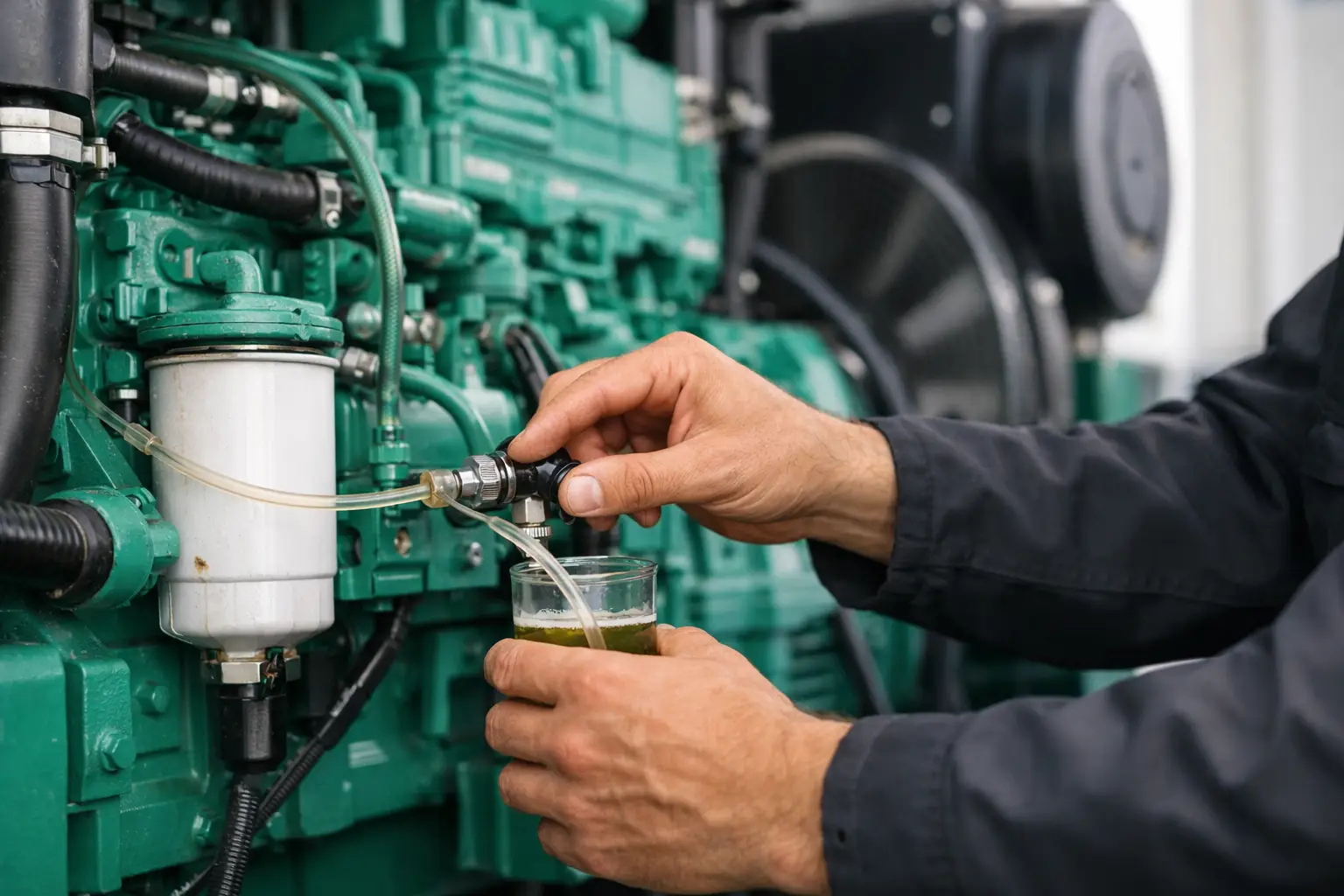
A diesel generator that cranks but will not fire, starts and dies, or runs unevenly after a filter change usually has the same underlying fault - air in the fuel system. If you need to know how to bleed diesel generator fuel systems properly, the priority is not speed. It is restoring clean, uninterrupted fuel delivery without creating a second fault through poor procedure.
On a standby or prime power installation, this matters because a generator with trapped air is not just inconvenient. It is unavailable. For facilities teams and site operators responsible for uptime, fuel bleeding is a basic maintenance task that needs to be done correctly, safely, and in line with the engine manufacturer's instructions.
When a diesel generator needs bleeding
Most diesel generators need bleeding after any event that allows air into the low-pressure fuel side. The common triggers are straightforward: running the tank too low, changing fuel filters, draining water separators, replacing fuel lines, carrying out fuel system repairs, or commissioning a set that has been standing for a long period.
Some modern engines are more tolerant than older mechanical systems. Certain models include self-priming electric lift pumps or automated purge routines that reduce manual intervention. Others still require a hands-on process at the filter housing, lift pump, injection pump, or injector lines. That difference matters. The correct method depends on the engine design, not just the symptom.
Before you bleed a diesel generator
Start with the obvious checks. Confirm there is clean diesel in the tank, the fuel isolation valve is open if fitted, and any recent service work has been completed correctly. A loose filter seal or a cracked hose can keep drawing air into the line no matter how many times the system is bled.
Work with the generator isolated, on stable ground, and with good ventilation. Keep ignition sources away from fuel. Wear suitable PPE and have absorbent materials ready for spills. If the set is installed in an acoustic enclosure, make sure access is clear and lighting is adequate before opening fuel system components.
You should also identify the engine's priming arrangement. On many industrial sets, you will find a manual priming lever on the lift pump and bleed screws on the fuel filter head. On others, an electric priming pump may be activated through the control panel or key switch. If the engine uses common rail injection, high-pressure side intervention is often restricted and should only be carried out as specified by the manufacturer.
How to bleed diesel generator systems safely
The standard approach is to bleed from the low-pressure side first and only move further downstream if the engine maker requires it. In most cases, that means priming fuel through the filter assembly until diesel flows without bubbles.
Begin by filling new fuel filters with clean diesel if the manufacturer permits it. This reduces the volume of air introduced during service. Fit the filters correctly, lubricate seals where required, and tighten to specification. Then loosen the primary bleed screw on the filter housing or fuel filter head.
Operate the manual primer or energise the electric lift pump. At first, you will usually see a mixture of fuel and air escaping. Continue until the flow becomes solid and free of bubbles, then tighten that bleed point. If there is a second bleed screw further downstream, repeat the process there.
On engines with a mechanical injection pump, there may be a further bleed point on the pump body. Again, open it slightly, prime until bubble-free fuel appears, and close it securely. The sequence matters because opening everything at once can make it harder to clear air efficiently.
At this stage, many generators will start normally. Crank the engine in short intervals rather than continuously, allowing the starter to cool between attempts. Once the engine fires, let it idle and stabilise. Check for leaks around filter seals, bleed screws, unions, and pipework.
When injector line bleeding is required
If the engine still will not start after low-pressure bleeding, some older systems may require the injector lines to be loosened slightly at the injector end. This is not a universal step, and it should never be treated as routine on every set.
If the manufacturer approves this method, slacken the line nuts just enough to allow air to purge while cranking. Do not fully remove them. Crank the engine until fuel pulses consistently at the loosened connections, then tighten each line to the correct torque. Keep hands clear of spray and never check for leaks with fingers near pressurised fuel. High-pressure diesel injection can penetrate skin and requires urgent medical treatment.
With modern electronically controlled engines, avoid disturbing high-pressure components unless the service procedure explicitly calls for it. Common rail systems operate at pressures that make improvised methods unsafe and unnecessary.
Signs the bleeding process has worked
A properly bled generator should start without excessive cranking and settle into a stable idle. Exhaust note should even out, throttle response should normalise, and low fuel pressure alarms linked to air ingress should clear if no other fault is present.
What you do not want is a temporary improvement followed by another stall. That usually points to an air leak upstream of the injection system. Typical causes include poorly seated filter gaskets, loose hose clips, split flexible lines, perished seals, blocked tank breathers, or restrictions causing the lift pump to pull air through a weak joint.
Common mistakes that cause repeat faults
The biggest mistake is assuming the issue is only trapped air when the actual problem is a fuel supply defect. If a generator repeatedly loses prime, focus on why air is entering the system. Bleeding alone will not correct a leaking suction line or a damaged filter head.
Another common error is over-tightening bleed screws and fittings. That can distort seals, damage threads, and create the very leaks you are trying to eliminate. Tight enough to seal is not the same as maximum force.
Dirty working practices also create avoidable failures. Introducing contamination while changing filters or opening fuel lines can lead to injector damage, poor combustion, and expensive downtime later. Clean fuel handling is part of the job, not an optional extra.
There is also a practical limit to how long you should keep cranking. Extended starter motor use can flatten batteries, overheat electrical components, and mask the fact that fuel is still not reaching the right point. If repeated correct bleeding does not restore starting, stop and diagnose instead of forcing the issue.
How to bleed diesel generator units with electric priming pumps
On newer generator sets, the process can be simpler but still needs discipline. If the control system activates an electric priming pump, allow it to run for the recommended time before cranking. Some engines need several key cycles or a dedicated priming mode to purge air from the filters and supply lines.
Even with electric priming, manual verification may still be necessary. A blocked filter, failed lift pump, or leaking suction side connection can prevent full purge. The presence of an electric pump does not remove the need to inspect for leaks, confirm fuel flow, and verify pressure where test points are available.
This is one reason specification matters when selecting a generator for critical applications. Serviceability, parts access, control integration, and fuel system layout all affect how quickly a set can be returned to operation after routine maintenance.
When not to treat bleeding as a simple maintenance task
If the generator has contaminated fuel, microbial growth in the tank, water ingress, or repeated filter blockage, a bleeding procedure may only restore operation briefly. The underlying fuel quality issue will remain. Likewise, if the set has suffered injector pump wear, failed non-return valves, or control-related fuel shut-off faults, the symptom can look similar to air ingress even though the root cause is different.
For commercial and industrial operators, that distinction is important. A hard-starting generator after a scheduled filter change is one thing. A mission-critical standby unit that loses prime repeatedly is a reliability risk and should be investigated properly. On larger installations, the cost of an unresolved fuel fault is usually far higher than the cost of early diagnosis.
A practical standard for uptime
Knowing how to bleed diesel generator fuel systems is useful, but the stronger approach is to make sure the procedure is part of a disciplined maintenance standard. Keep filters, seals, and approved consumables on site. Record when air ingress occurred and after what intervention. If a set repeatedly needs priming, treat that as a defect trend, not routine behaviour.
For buyers specifying new equipment, fuel system access and maintainability deserve the same attention as kVA rating, enclosure type, and standby versus prime duty. A generator that is easier to service is usually a generator that returns to availability faster.
When the set matters to operations, the job is not simply getting it started again. It is making sure the next start is there when the site needs it.