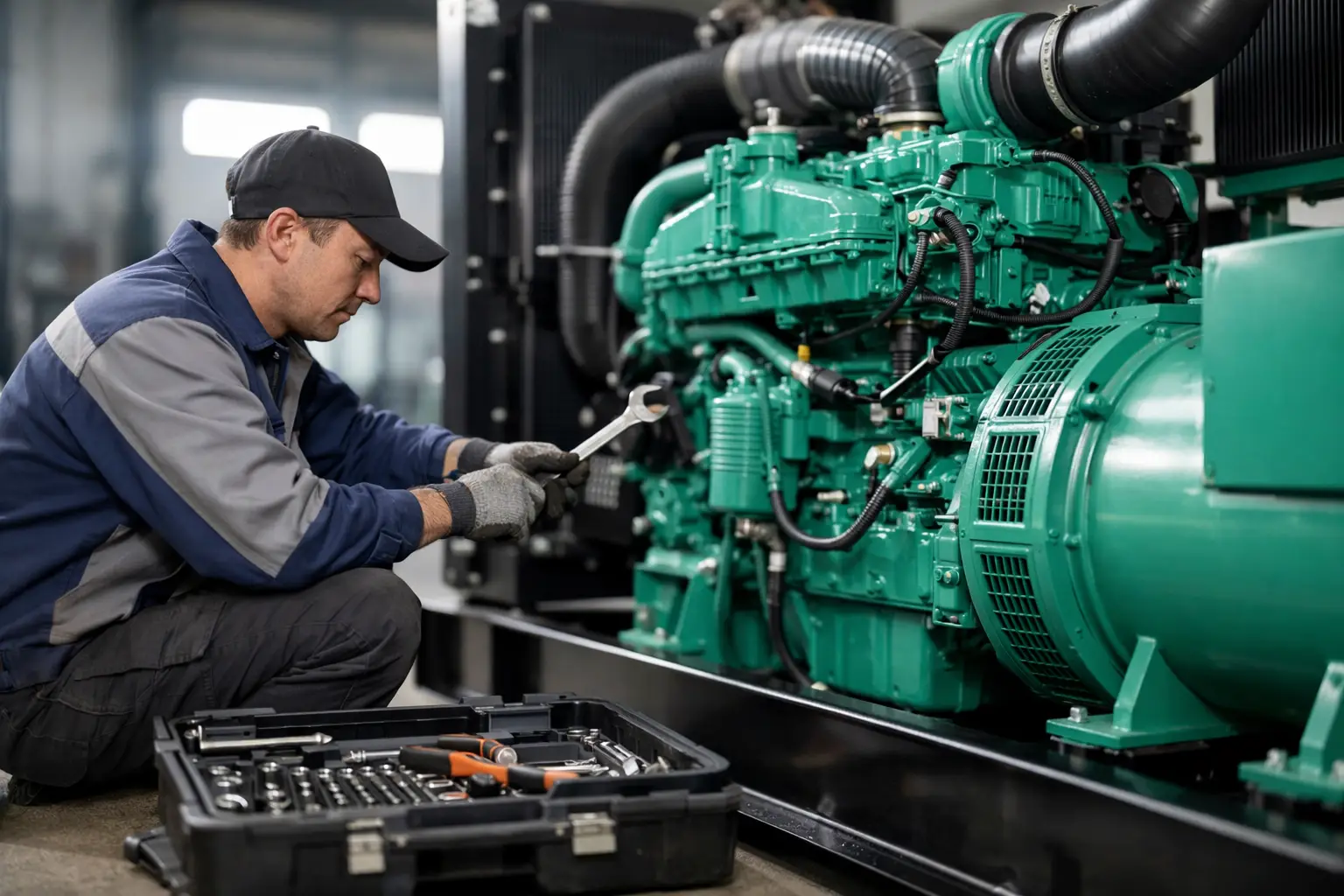
A diesel generator that fails under load rarely gives much warning. One missed start during a mains outage can stop production, disrupt site services, or put critical equipment at risk. That is why knowing how to repair diesel generator faults matters - not as a workshop exercise, but as part of protecting uptime.
For most commercial and industrial operators, repair starts with diagnosis, not parts replacement. A generator is a system made up of the diesel engine, alternator, fuel delivery, starting circuit, controls, cooling package, and protection logic. If you treat every non-start or low-output issue as a major breakdown, costs rise quickly. If you ignore early symptoms, the repair usually becomes more expensive and the outage longer.
How to repair diesel generator issues safely
Before any inspection, isolate the set correctly. Lock out and tag out the generator, disconnect the battery where appropriate, and confirm there is no backfeed risk from automatic transfer equipment or parallel systems. On enclosed silent generators, allow heat to dissipate before working around the exhaust, radiator, or turbocharger.
Safety also affects the quality of the repair. A rushed inspection on a hot engine or energised control panel leads to missed faults. If the unit serves a healthcare site, telecom installation, data room, or any other mission-critical application, the threshold for calling a qualified engineer should be lower. The cost of a wrong repair is not just a service invoice - it can be operational failure at the next outage.
Start with the fault pattern, not the symptom
The same symptom can come from very different causes. A generator that will not start might have flat batteries, fuel starvation, a failed starter motor, an emergency stop left engaged, or a control fault. A set that starts but trips after thirty seconds could be seeing low oil pressure, poor voltage build-up, coolant temperature issues, or sensor failure.
The fastest way to narrow the issue is to identify the pattern. Ask whether the set is a no-start, hard-start, rough-running, low-power, overheating, smoke, charging, or tripping problem. Then check whether the fault appeared suddenly, after service work, during bad weather, after prolonged standby, or only under load. Those details save time because they separate mechanical faults from fuel quality, electrical faults, and control-related issues.
Check the simple causes first
On industrial sites, basic issues are common. Emergency stop buttons get knocked in. Battery isolators are left open. Fuel valves are closed after maintenance. A set in automatic mode may be healthy while the transfer arrangement or remote start signal is not.
Inspect battery voltage, terminal condition, fuse integrity, fuel level, coolant level, and visible leaks before moving into deeper testing. Look for split hoses, loose belts, corroded earth points, and signs of water ingress in the enclosure or control panel. Many failures present as serious but turn out to be poor housekeeping or deferred maintenance.
Fuel system faults and diesel generator repair
Fuel-related issues are among the most frequent causes of poor starting and unstable running. Diesel stored for long periods can suffer from contamination, waxing in low temperatures, microbial growth, or water ingress. If the engine cranks but struggles to fire, or starts and dies, begin with fuel quality and delivery.
Check that fuel reaches the lift pump and primary filter. If filters are blocked, replace them and bleed the system properly. Air trapped in the lines will prevent stable fuel delivery, especially after filter changes or tank work. On common rail engines, be cautious. High-pressure components require the correct procedures and, in many cases, specialist support.
If contaminated fuel is the root cause, replacing filters alone is rarely enough. The tank may need draining and cleaning, and the lines may require flushing. Otherwise the same debris or water returns to the new filters and the fault repeats. For standby sets that sit unused for long periods, fuel polishing and regular test running often prevent this type of repair altogether.
Battery and starting circuit problems
A diesel engine needs strong cranking speed. Weak batteries may still show voltage at rest but collapse under load. If the starter clicks, turns slowly, or the control panel resets during cranking, test battery condition under load rather than relying on a static reading.
Check the charger, battery leads, earth strap, starter solenoid, and cable connections. Corrosion at terminals increases resistance and can mimic a failed starter. On larger sets, a charger fault can go unnoticed until the first mains failure. That is why battery health is not a minor service item - it is central to start reliability.
If the starter motor itself has failed, replacement is often more practical than strip-down on site. The same applies to heavily sulphated batteries. Repair time has value, especially where generator availability is tied directly to business continuity.
Cooling system and overheating faults
An overheating generator should not be forced back into service without finding the cause. Low coolant, blocked radiators, failed thermostats, broken fan belts, water pump issues, and restricted airflow inside the canopy can all raise engine temperature.
Begin with coolant level and visible leaks. Then inspect the radiator core for dust, debris, oil contamination, or damage. On construction, agricultural, and quarry sites, radiator blockage is common because airborne particles reduce airflow quickly. Cleaning the core may solve the issue, but only if the fan, belt tension, and coolant circulation are also confirmed.
If the set overheats only at high load, sizing and ventilation may be part of the problem. A generator installed in a room with poor air movement can appear mechanically sound while still running beyond safe thermal limits. In that case, the repair is not confined to the engine - the installation needs attention too.
Electrical output faults and alternator checks
When the engine runs correctly but the generator produces low voltage, unstable voltage, or no output, the fault may sit with the alternator, automatic voltage regulator, excitation circuit, sensing connections, or output breaker arrangement.
Start by confirming meter accuracy and checking for obvious loose connections. Inspect the AVR and associated wiring for heat damage, moisture, or failed terminals. Brushless alternators reduce routine wear points, but excitation faults still occur. On some sets, loss of residual magnetism can also affect voltage build-up.
If the unit is producing power but trips under load, review load balance, phase currents, cable terminations, and protection settings. A fault that appears to be generator failure may actually be downstream. This is particularly relevant on three phase installations where uneven loading can create apparent performance issues.
Controls, sensors, and nuisance shutdowns
Modern diesel generators rely on control modules and protection inputs to prevent engine damage. That improves asset protection, but it also means faulty sensors can stop a healthy machine. Low oil pressure switches, coolant temperature senders, speed sensors, and wiring faults can all trigger shutdowns.
Use the fault history if the controller provides it. Repeat alarms matter. A single low oil pressure event after a long period of inactivity is different from a recurring shutdown on every test run. Inspect sensor wiring, plug connections, and earthing before condemning the controller itself.
Controller replacement should be approached carefully. Configuration, protection parameters, start logic, and communication settings all need to match the application. On synchronised or AMF systems, casual replacement creates bigger problems than the original fault.
When repair is practical and when replacement is better
Not every fault justifies a full repair. If the generator has high operating hours, repeated cooling or fuel issues, poor parts availability, and an ageing control system, major intervention may not be the best commercial decision. A replacement unit can reduce risk, shorten outage exposure, and improve fuel efficiency and compliance.
The decision depends on duty. A prime power machine in daily service is judged differently from a standby set with low hours. It also depends on lead time, temporary power options, and site criticality. For many operators, the right approach is to repair minor and mid-level faults quickly but avoid sinking cost into a platform that no longer supports reliable uptime.
That is where specification matters. Engine brand support, enclosure type, load profile, standby or prime rating, and service access all affect whether repair remains viable. Buyers responsible for critical power should view maintainability as part of procurement, not just as an afterthought once faults appear.
Preventing the next failure
The most effective diesel generator repair is the one you never need to make during an outage. Routine inspection, scheduled servicing, battery testing, coolant checks, fuel management, and regular load testing all reduce emergency call-outs. Sets that only idle through no-load tests often hide problems until a real demand event arrives.
A disciplined maintenance regime also improves diagnosis. When service history is clear, it becomes easier to spot what has changed. If filters were just replaced, attention shifts elsewhere. If the battery charger has shown instability for months, the starting circuit moves to the top of the list.
For operators managing critical assets, there is value in sourcing equipment that is clearly specified, properly supported, and available without delay. That is one reason buyers working with Global Generators typically focus not just on kVA, but on engine platform, application rating, and long-term serviceability.
If you are dealing with a fault now, be methodical. Start with the simplest checks, confirm the real failure point, and be honest about whether the repair supports dependable operation or only delays a bigger problem. Reliable power is built on good decisions long before the next mains failure arrives.