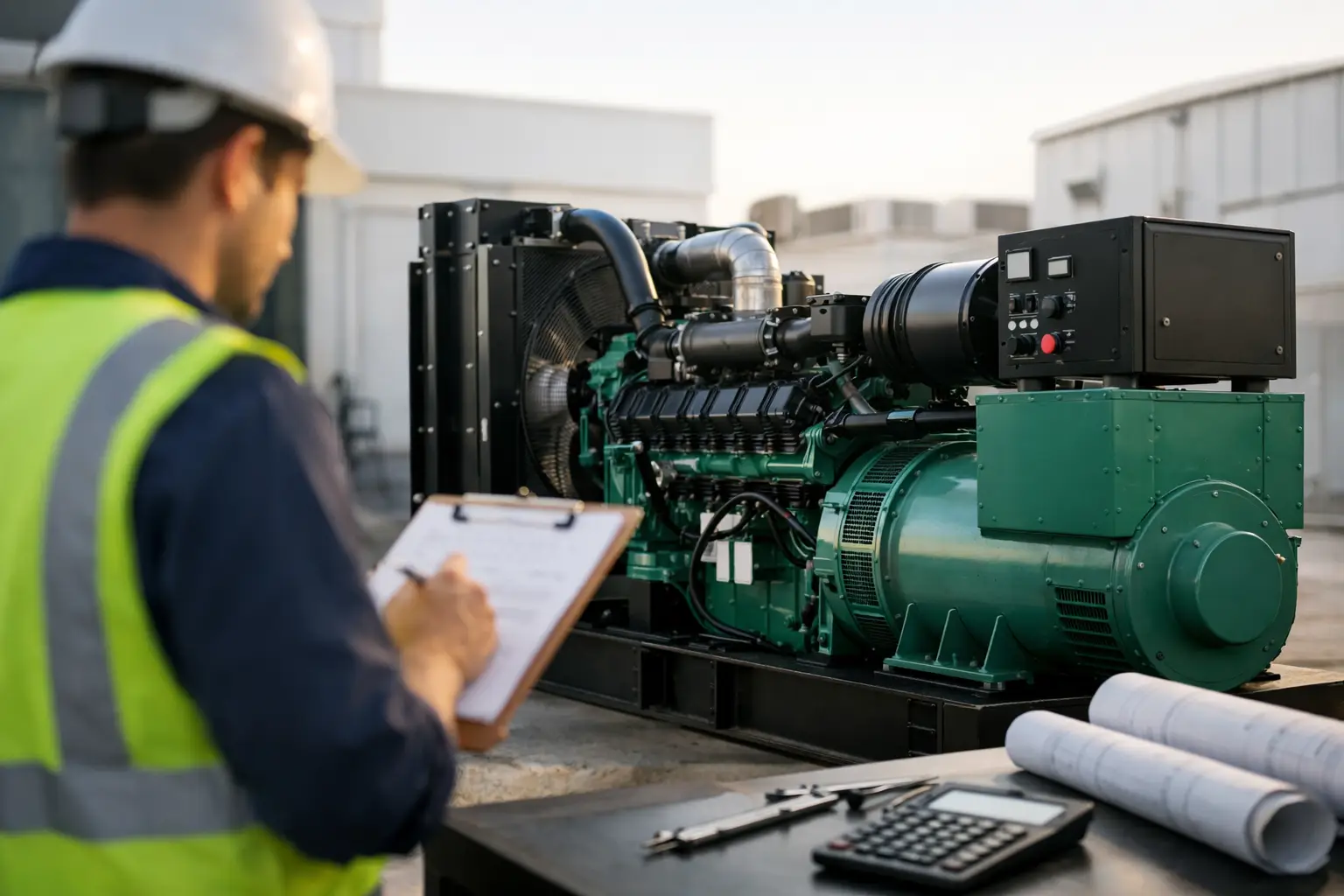
Power failures rarely happen at a convenient moment. When a generator is undersized, the result is usually obvious - stalled motors, nuisance trips, voltage drop and avoidable downtime. If you are working out how to size diesel generator capacity for a site, the correct answer starts with load behaviour, not just a headline kVA figure.
Buying too small creates operational risk. Buying too large is not harmless either, because lightly loaded diesel sets can suffer from poor fuel efficiency, wet stacking and unnecessary capital cost. For commercial and industrial buyers, generator sizing is a specification exercise. The aim is to match the set to real operating conditions, duty type and expansion plans without guessing.
How to size diesel generator load for the real site
The first step is to define what the generator is expected to do. A standby generator that only supports the site during mains failure is sized differently from a prime power generator that carries the load for extended periods. That distinction matters because the rating, loading profile and running hours all affect the final specification.
Start with a complete load schedule. This should list every item that will be connected during generator operation, together with its running power, starting method, voltage, phase and whether it is essential or non-essential. In many facilities, not every load needs backing up. Life safety systems, controls, IT, refrigeration, pumps and selected production equipment may be critical, while comfort cooling or non-essential process loads can be excluded.
A proper load schedule also needs timing. Some equipment starts immediately after changeover. Other loads can be delayed or sequenced. If all motors start at once, the generator has to absorb a much higher transient demand than if the same loads are brought on in stages. This is one of the most common reasons simple kW totals produce the wrong answer.
Start with kW, then convert to kVA correctly
Most site loads are identified in kW, but generators are commonly specified in kVA. The difference is power factor. The basic relationship is straightforward:
kVA = kW / power factor
If your total running load is 160 kW at 0.8 power factor, the apparent power is 200 kVA. That gives you a starting point, not a final selection. You still need to account for motor starting, load steps, ambient conditions and any requirement for future capacity.
Power factor should not be treated as a guess. Some mixed commercial loads may sit around 0.8, but the actual figure depends on the site. Variable speed drives, UPS systems, compressors, pumps and older inductive equipment can all alter the load characteristics seen by the generator. Where the electrical design is complex, use measured or engineer-confirmed values rather than assumptions.
Motor starting often decides generator size
For many industrial applications, running load is not the hardest part of the sizing exercise. Starting current is. Motors can draw several times their full load current on start-up, particularly when started direct-on-line. That short but heavy demand can cause excessive voltage dip if the generator is too small.
This is why a site with a modest running load can still require a comparatively large generator. A pump, fan, compressor or chiller may only consume a limited kW once running, but its starting profile can dictate alternator and engine sizing. Different starting methods change the picture significantly. Soft starters, star-delta arrangements and variable speed drives reduce the starting burden and may allow a smaller, more cost-effective set.
The question is not just whether the generator can keep the load running. It is whether it can accept the largest step load and maintain acceptable voltage and frequency performance. On a critical site, that margin matters.
Check the largest motor first
As a practical rule, review the largest motor or the largest block of motors likely to start together. Then assess whether the generator can carry that transient event while supporting the connected running load. If the system includes fire pumps, lifts, HVAC plant or process equipment with high inrush characteristics, the generator selection should be validated against those events specifically.
Standby, prime and continuous ratings are not interchangeable
A frequent sizing error is selecting the right capacity under the wrong duty rating. Standby power is intended for emergency operation during utility outage, usually with variable load and no overload capability. Prime power is designed for longer use where the generator may be the main power source, again with variable load but within defined average loading limits. Continuous duty is different again.
If the site expects prolonged outage support, remote operation or regular non-utility running, prime rating may be the correct basis. Using a standby figure for a prime application can leave the installation under-specified. In practical terms, two generators with similar headline outputs may not be interchangeable once the duty class is taken into account.
Environmental and installation factors affect output
Generator ratings are based on standard reference conditions. Real sites are not always standard. High ambient temperature, altitude, restricted ventilation and challenging acoustic enclosures can all reduce available performance or require derating.
In the UK this issue is often overlooked because altitude is less extreme than in some export markets, but plantroom temperature and airflow still matter. A poorly ventilated enclosure or container can affect cooling performance and reduce effective output. If the generator is being exported or installed in a high-temperature region, derating becomes even more relevant.
Fuel quality, site maintenance standards and the nature of the connected load also affect how conservative the specification should be. Mission-critical facilities generally size with more discipline than low-priority applications because the cost of failure is materially higher.
Single phase or 3 phase must match the load
If you are deciding how to size diesel generator equipment for a facility rather than a single small building, phase configuration is usually straightforward - most commercial and industrial sites require a 3 phase supply. Even so, load balance still needs checking. Significant phase imbalance can impair generator performance and reduce usable capacity.
Single phase units may suit smaller properties or isolated applications, but once the load includes motors, plant, distribution boards or mixed building services, 3 phase is generally the appropriate route. The point is not just compatibility. It is making sure the available capacity is usable in practice.
Allow for future load, but avoid excessive oversizing
Most buyers want headroom. That is sensible, especially where the site may add equipment later or where the current design is likely to evolve before commissioning. A modest reserve can prevent an early replacement or expensive upgrade.
However, there is a difference between prudent margin and significant oversizing. Diesel generators perform best within a healthy operating range. If a set spends long periods at very light load, efficiency suffers and engine condition can deteriorate over time. This is one reason temporary estimates often turn into poor permanent selections.
The right margin depends on the certainty of the load data. Where expansion is planned and quantified, size for it. Where future demand is vague, it is better to define likely scenarios than to add arbitrary capacity that may never be used.
A practical sizing process
For most projects, the cleanest approach is to move through the sizing process in order. Build the load schedule, separate essential from non-essential demand, identify running kW, convert to kVA using actual power factor, then review motor starting and step loads. After that, confirm duty rating, phase, voltage, site conditions and any growth requirement.
At this point, you are no longer choosing a generator on headline output alone. You are specifying a set against operating reality: standby or prime rating, enclosure type, fuel autonomy, alternator performance and expected transient response.
This is also where brand and package quality start to matter. A correctly rated industrial set built around a proven engine platform will generally outperform a nominally similar unit that looks adequate only on paper. For buyers responsible for uptime, specification accuracy and equipment quality need to be considered together.
When load banks and data logging are worth using
If the site has an uncertain load profile, recorded data is often the quickest way to avoid error. Temporary monitoring can show actual demand, peak behaviour and phase balance. On existing installations, it can also reveal whether previous sizing assumptions were too cautious or too optimistic.
For planned projects with heavy motor content or sensitive electronics, engineering review is worth the time. Generator performance during load acceptance is not just about total kVA. The sequence, waveform quality and transient characteristics can all influence whether the installation performs properly under outage conditions.
For that reason, serious buyers usually treat generator sizing as part of the wider power continuity design rather than a late-stage purchasing task. A supplier with stock availability is useful. A supplier that can assess ratings, application type and configuration is more useful when the consequences of being wrong are expensive.
The best generator size is not the biggest one you can fit in the yard. It is the one that starts the site, carries the load, and keeps doing its job when the mains does not.