A mains failure at a hospital plant room, a distribution hub or a live construction site is not an inconvenience. It is an operational event with direct cost, safety and service implications. That is why the question what is diesel generator set equipment is usually asked by buyers who need a clear answer before specifying backup or prime power.
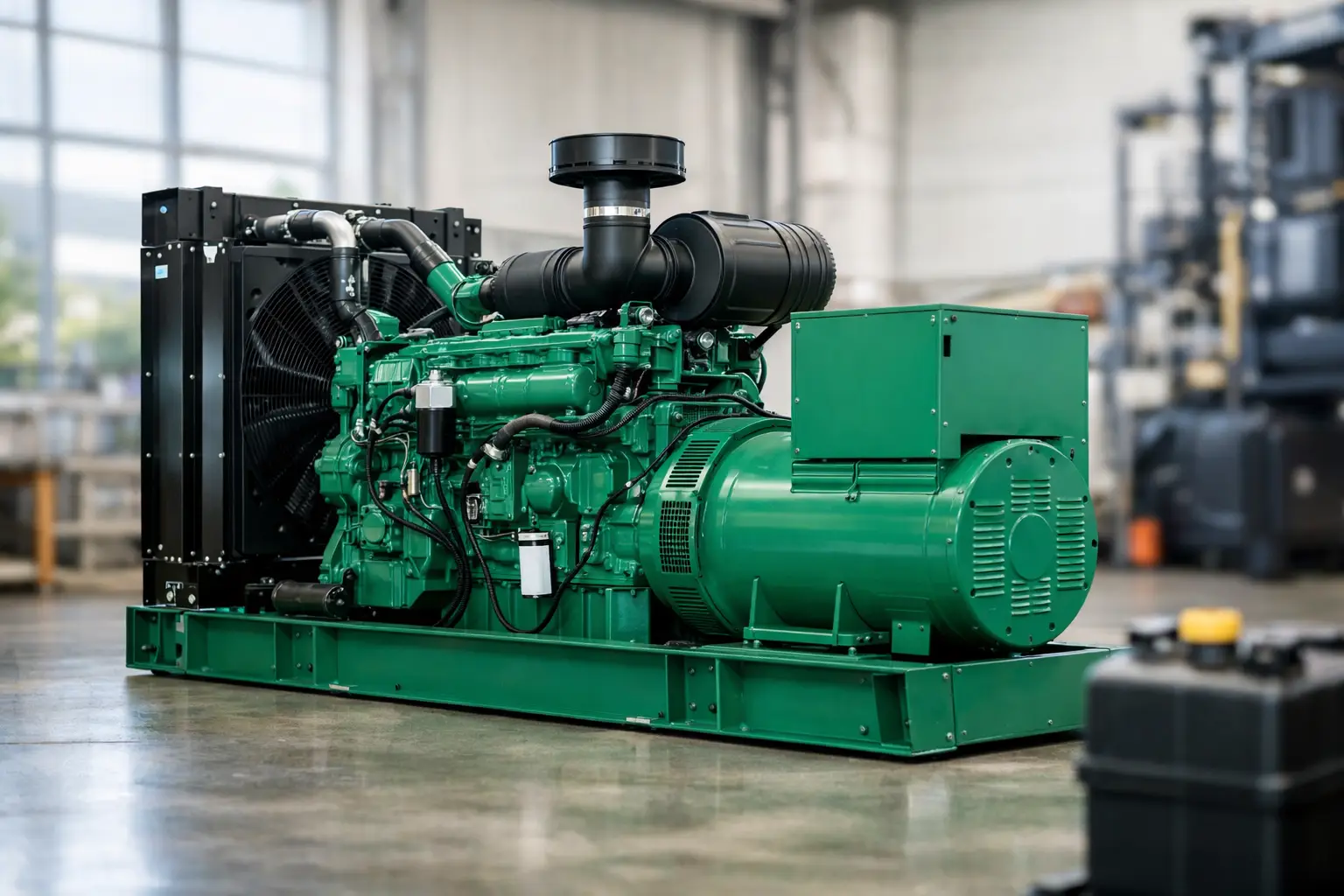
A diesel generator set, often shortened to diesel genset, is a self-contained power system that converts the energy in diesel fuel into electrical power. It combines a diesel engine, an alternator and a control system on a common base frame, with supporting components such as a fuel tank, cooling system, exhaust arrangement and battery starting system. In simple terms, it is a complete unit designed to supply electricity when grid power is unavailable, unreliable or not present at all.
For commercial and industrial buyers, that definition matters because a generator set is not just an engine with sockets. It is rated equipment built for a duty profile, a site load and a particular application, whether standby protection for a building or continuous prime power for an off-grid operation.
What is a diesel generator set made up of?
The core of a diesel generator set is the diesel engine. This provides the mechanical input by burning fuel and driving the rotating assembly. Engine quality has a direct effect on reliability, fuel consumption, service intervals and load acceptance, which is why recognised engine platforms are often prioritised in specification.
The alternator is the component that converts that mechanical energy into electrical output. Its design affects voltage stability, efficiency and suitability for different load types. For sites running sensitive electrical systems, the alternator specification is not a minor detail.
The control panel manages starting, stopping, monitoring and protection. On modern industrial sets, the controller will usually display voltage, current, frequency, engine temperature, oil pressure and fault conditions. In standby applications, it is commonly integrated with an automatic transfer arrangement so the set starts when mains supply fails and stops once utility power returns.
Beyond those three main elements, a diesel generator set also includes a cooling system, exhaust system, starting batteries, charging circuit, vibration isolation and a structural base frame. Some sets are supplied in acoustic canopies for reduced noise, while others are open-type units intended for plant rooms or containerised packages.
How a diesel generator set works
The operating principle is straightforward. The diesel engine burns fuel and turns a shaft. That shaft drives the alternator rotor, creating electromagnetic induction and producing electricity. The control system regulates operation and protects the machine against abnormal conditions.
In practice, the performance of the set depends on matching engine speed and alternator design to the required electrical output. In the UK and many export markets, diesel generators are commonly configured to deliver stable 50 Hz power. For industrial users, maintaining that frequency and voltage under varying load is essential.
This is where the difference between a basic generator and a properly specified genset becomes clear. A generator set is engineered to start under load, respond to step changes in demand and operate within defined tolerances. If the application includes lifts, compressors, pumps, telecoms equipment or critical building services, transient response and control quality matter as much as headline kVA.
Why diesel is still widely used
Diesel remains a common choice for standby and prime power because it offers high energy density, strong engine durability and well-established service support. For many industrial applications, diesel sets are also better suited to rapid starting and heavier load acceptance than some alternative technologies.
That does not mean diesel is always the right answer. It depends on runtime, emissions requirements, fuel logistics, site planning constraints and the nature of the load. For occasional standby duty, diesel is often a practical and commercially sound option. For continuous use in emissions-sensitive environments, the decision requires a closer review of operating hours, after-treatment requirements and long-term fuel costs.
Buyers should also separate fuel preference from equipment quality. A poorly specified diesel generator will not become suitable simply because diesel is widely available. Correct sizing, enclosure type, control integration and maintenance planning still determine whether the set performs when needed.
Standby, prime and continuous ratings
One of the most important parts of understanding what is diesel generator set specification is knowing the rating. Not all kVA figures mean the same thing.
Standby power
A standby-rated diesel generator is intended to supply emergency power during a utility outage. It is not normally the site's main power source. This is the usual choice for offices, healthcare facilities, commercial premises and industrial buildings that have grid supply but cannot tolerate interruption.
Prime power
A prime-rated set is built for applications where the generator is the principal source of electricity, often with variable load over extended periods. This is common on construction projects, remote sites, temporary infrastructure and off-grid operations.
Continuous power
A continuous rating applies where the generator runs at a constant load for long durations. This is more specialised and should not be confused with prime duty. If the load profile or runtime does not match the rating, engine life and warranty position may be affected.
For procurement teams, the lesson is simple. Do not compare sets on headline output alone. Compare the correct duty rating, because standby kVA and prime kVA are not interchangeable.
What size diesel generator set is needed?
Sizing depends on the actual site load, starting characteristics of connected equipment, future expansion and whether the set is supporting single phase or three phase demand. A small retail unit with basic lighting and refrigeration has very different requirements from a manufacturing line, data room or pumping station.
Undersizing is the obvious risk. The set may struggle with motor starting, voltage dip or overload trips. Oversizing has its own drawbacks. Capital cost increases, fuel performance can suffer at low load, and prolonged light loading can create engine issues if not properly managed.
This is why serious buyers work from a load schedule rather than a rough estimate. The correct approach is to review running load, peak load, motor starting demand, power factor, altitude, ambient conditions and any requirement for N+1 resilience or synchronisation.
Open or silent diesel generator set?
Enclosure format affects installation, noise control and maintenance access. Open generators are commonly selected for indoor plant rooms or packaged systems where the surrounding installation already provides weather protection and acoustic treatment.
Silent generators, more accurately acoustic canopy sets, are designed to reduce sound levels while protecting the equipment from outdoor conditions. They are often preferred on commercial sites, residential-adjacent locations and temporary works where noise limits apply.
Neither format is universally better. An open set may offer easier access and lower initial cost in the right environment. A silent set may simplify external installation and planning compliance. The correct choice depends on where the generator will sit and what restrictions the site imposes.
Single phase or 3 phase output
Output configuration must match the electrical system. Single phase sets are suited to lighter domestic or small commercial applications. Most industrial and larger commercial sites require 3 phase generators to support heavier equipment and balanced power distribution.
Specifying the wrong output type can create avoidable installation problems. It is also worth checking voltage requirements, especially for export projects or sites with non-standard electrical arrangements.
What buyers should check before purchasing
A diesel generator set should be assessed as a complete package, not just a power figure on a datasheet. Engine brand, alternator quality, controller capability, fuel tank capacity, enclosure type, emissions compliance and physical dimensions all affect suitability.
Availability matters as well. For mission-critical applications, lead time can be as important as specification. A correctly rated set that arrives too late does not protect uptime. Buyers should also confirm service access, spare parts support and the practicalities of delivery, siting and commissioning.
Where the application is business-critical, ask direct questions about standby or prime rating, load acceptance, noise level, tank autonomy and whether the set is designed for the intended operating cycle. Global Generators, for example, focuses on clearly segmented industrial sets so buyers can match output, format and duty with less ambiguity.
When a diesel generator set is the right fit
A diesel generator set is typically the right fit where dependable power continuity is non-negotiable, where runtime requirements are significant, or where load characteristics demand a proven mechanical platform. That includes hospitals, factories, telecoms sites, logistics facilities, utilities infrastructure and major construction projects.
It may be less suitable where noise, emissions or low annual running hours point towards a different technical or commercial solution. The answer depends on the site, the risk of downtime and how the generator will actually be used rather than how it is described in procurement shorthand.
The useful way to think about a diesel generator set is not as a generic backup machine, but as a rated power asset. If the load is critical, the set should be specified with the same care as any other piece of plant that protects operations, revenue and safety.