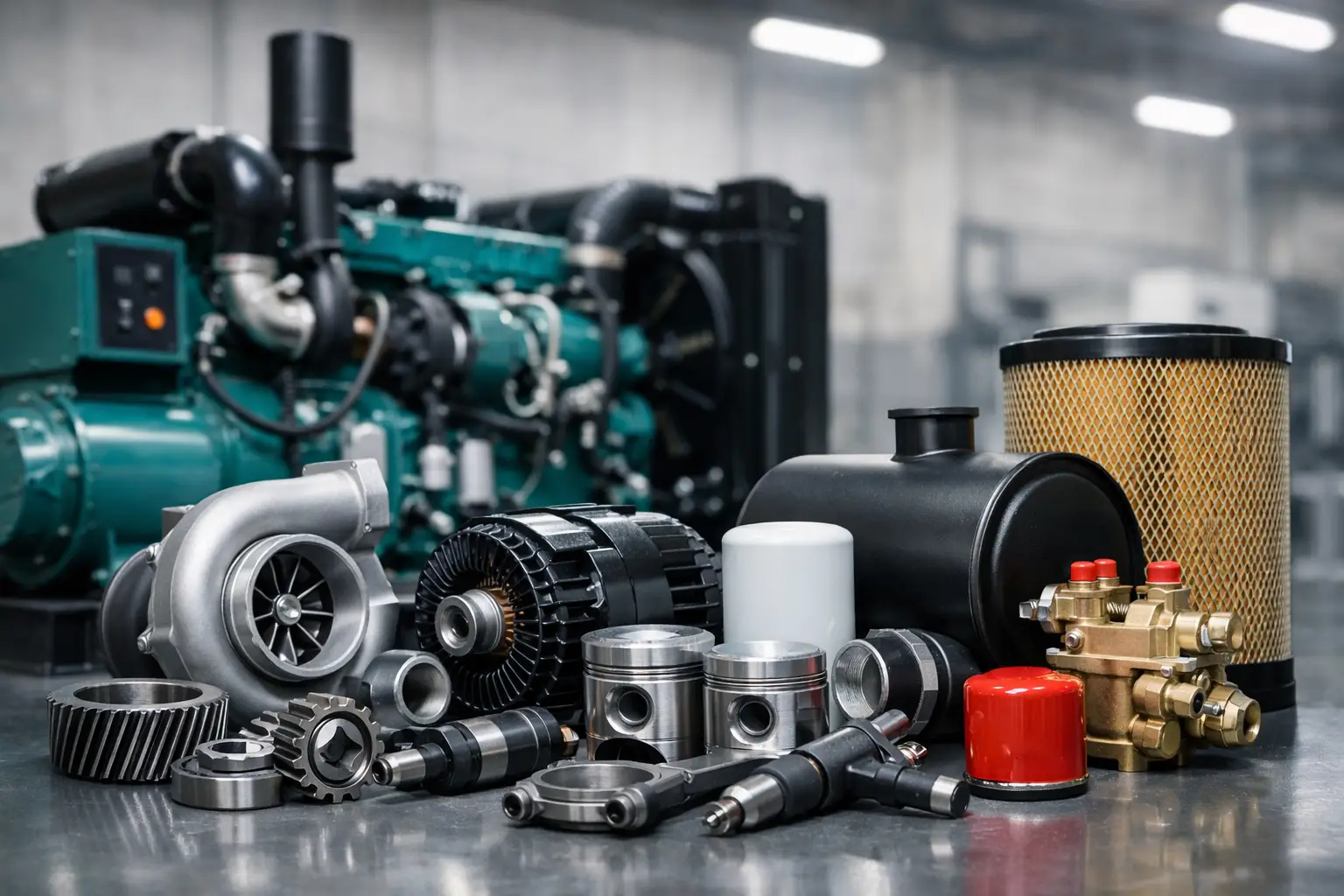
When a generator fails under load, the issue is rarely “the generator” as a whole. It is usually one component - a fuel system fault, a control panel issue, a worn AVR, a blocked filter, or a cooling problem. That is why understanding what is diesel generator parts matters for anyone buying, operating, or maintaining standby and prime power equipment. If uptime is critical, knowing the job of each part helps you specify correctly, service at the right interval, and avoid expensive downtime.
What are diesel generator parts?
Strictly put, “diesel generator parts” refers to the individual components that make up a diesel generating set and allow it to produce electrical power reliably. A diesel generator is not just an engine with an alternator bolted on. It is an integrated package made up of mechanical, electrical, fuel, cooling, exhaust, structural, and control systems.
For buyers and operators, the term can mean two slightly different things depending on context. It may refer to the core assemblies that form the generator set at build stage, or it may refer to replacement and service parts used during maintenance and repair. Both meanings are relevant in practice because the quality and compatibility of those parts directly affect performance, emissions, load acceptance, noise level, and service life.
The main diesel generator parts and what they do
At the centre of the set is the diesel engine. This is the prime mover that converts fuel into mechanical energy. In industrial applications, engine quality is central because it influences fuel consumption, load response, durability, and parts support. Engine selection also affects whether the set is suitable for standby duty, prime duty, or more demanding operating cycles.
Connected to the engine is the alternator. The alternator converts the engine’s mechanical rotation into electrical output. Its specification determines voltage stability, insulation class, efficiency, and the generator’s ability to deal with varying loads. For sites with sensitive equipment, alternator quality is not a minor detail. Poor voltage regulation can cause operational issues well beyond the generator itself.
The control panel acts as the operating interface and monitoring point. This is where the set is started, stopped, and supervised. Modern panels typically display voltage, frequency, current, oil pressure, coolant temperature, running hours, alarms, and fault conditions. In automatic standby systems, the controls work alongside an automatic transfer switch so that the generator starts when mains supply fails.
The fuel system includes the tank, lift pump, injection pump, injectors, fuel lines, and fuel filters. Each part has a straightforward role, but the system only works well when the whole fuel path remains clean and correctly pressurised. Contaminated fuel, blocked filters, air ingress, and poor storage conditions are common causes of failure, especially on standby sets that sit idle for long periods.
The cooling system controls engine temperature. This usually includes a radiator, fan, water pump, thermostat, coolant hoses, and coolant itself. Diesel engines generate substantial heat, and a generator running at constant load can quickly overheat if cooling performance drops. Ambient temperature, enclosure design, and site ventilation all affect how much margin the system really has.
The lubrication system protects internal engine components from wear. Its main parts include the oil pump, oil filter, sump, and lubrication galleries within the engine. Without stable oil pressure and clean oil, bearing and piston damage can develop rapidly. In practical terms, service items such as oil and filters are small costs compared with the impact of engine damage.
The exhaust system carries combustion gases safely away from the engine and helps manage noise. This part of the set includes the exhaust manifold, flexible connections, pipework, and silencer. For indoor installations or enclosed plant areas, exhaust design must also account for heat rejection, back pressure, and safe routing.
The starting system is usually battery based. It includes the starter motor, starter solenoid, batteries, and battery charger. Standby generators often fail to start because of battery neglect rather than engine defect. That is one reason serious operators treat battery condition as a priority rather than a routine afterthought.
The base frame and enclosure also count as diesel generator parts, even though they are sometimes overlooked. The frame supports the full assembly and often integrates the fuel tank. The enclosure, where fitted, provides weather protection and sound attenuation. For outdoor or urban installations, enclosure quality can be just as important as engine specification.
Service parts versus major components
When people ask what is diesel generator parts, they are often really asking about replacement parts. In service terms, it helps to separate consumables from major components.
Service parts are the items changed at planned intervals. These usually include oil filters, fuel filters, air filters, belts, coolant, oil, and sometimes batteries. They are predictable, relatively low cost, and essential for preserving reliability. If a maintenance plan is weak, these are typically the first areas where performance starts to decline.
Major components include the engine, alternator, turbocharger, control module, radiator, fuel injection equipment, and AVR. These parts tend to be more expensive and less frequently replaced, but when they fail the consequences are more serious. Lead times also matter. In a critical application, a low-cost part with poor availability can create more operational disruption than a high-value component held in stock.
Why part quality and compatibility matter
Not all diesel generator parts are equal. On paper, two filters or two control modules may appear interchangeable. In operation, the difference can be substantial.
Correctly specified parts protect the generator’s rated performance. That includes output stability, cooling efficiency, fuel delivery, starting reliability, and emissions compliance where applicable. Poor-quality or mismatched parts can lead to nuisance alarms, hard starting, excess smoke, overheating, or shortened engine life.
Compatibility also matters across the full set, not just the individual part number. A generator is a matched package. If one component is changed without regard to the rest of the system, the result can be reduced efficiency or unstable operation. This is particularly relevant with alternator regulation, electronic controls, sensors, and fuel system components.
For that reason, buyers should not treat parts procurement as a generic exercise. Engine brand, model, serial number, kVA rating, duty classification, enclosure type, and site conditions all influence what the correct replacement part actually is.
What parts fail most often?
In day-to-day operation, the most common issues are usually found in service and support systems rather than catastrophic engine failure. Filters clog, belts wear, batteries lose capacity, chargers fail, coolant hoses deteriorate, and sensors drift out of tolerance. Fuel contamination is another frequent issue, especially where diesel is stored for extended periods.
Control-side faults are also common on newer sets because modern generator packages rely heavily on monitoring and protection logic. A failed sensor or wiring issue can shut a healthy set down to protect it. That is the right outcome from a protection standpoint, but it means diagnostics matter just as much as the physical replacement part.
It also depends on duty cycle. A standby generator that runs infrequently may suffer from battery issues, stale fuel, and wet stacking if load management is poor. A prime power generator is more likely to show wear in cooling, lubrication, and rotating components because it accumulates hours much faster.
How diesel generator parts affect purchasing decisions
For procurement teams and plant managers, parts should be considered before the generator is bought, not after it breaks down. Parts support is a genuine commercial factor. A competitively priced set with limited parts availability can become expensive once downtime, engineer callouts, and delayed operations are factored in.
This is where established engine platforms and clear product specification tend to reduce risk. Buyers need confidence that service parts are straightforward to source and that major components have dependable support. That is especially relevant for healthcare, telecoms, manufacturing, logistics, and infrastructure sites where a failed start or prolonged outage can have immediate operational consequences.
A practical purchasing approach is to look beyond the headline kVA figure. Ask what engine is fitted, what alternator is used, what control system is supplied, what service intervals apply, and how quickly critical parts can be obtained. For many industrial buyers, that matters as much as the initial capital cost.
What is diesel generator parts in maintenance planning?
In maintenance planning, diesel generator parts are the basis of reliability management. Every planned service, every inspection schedule, and every spares strategy is built around them. The point is not simply replacing worn items. It is preserving readiness so the set performs the moment mains power fails or site demand requires it.
That usually means keeping the right service parts on hand, monitoring condition, and aligning maintenance intervals with actual operating hours and site risk. A data centre, a hospital, and a construction compound may all use diesel generators, but their spares priorities will not be identical.
For buyers operating mission-critical equipment, the best approach is straightforward: treat generator parts as part of the power strategy, not just the maintenance budget. When the specification is right and the support is in place, the generator is far more likely to do the only job that really matters - start, carry load, and keep the site running.