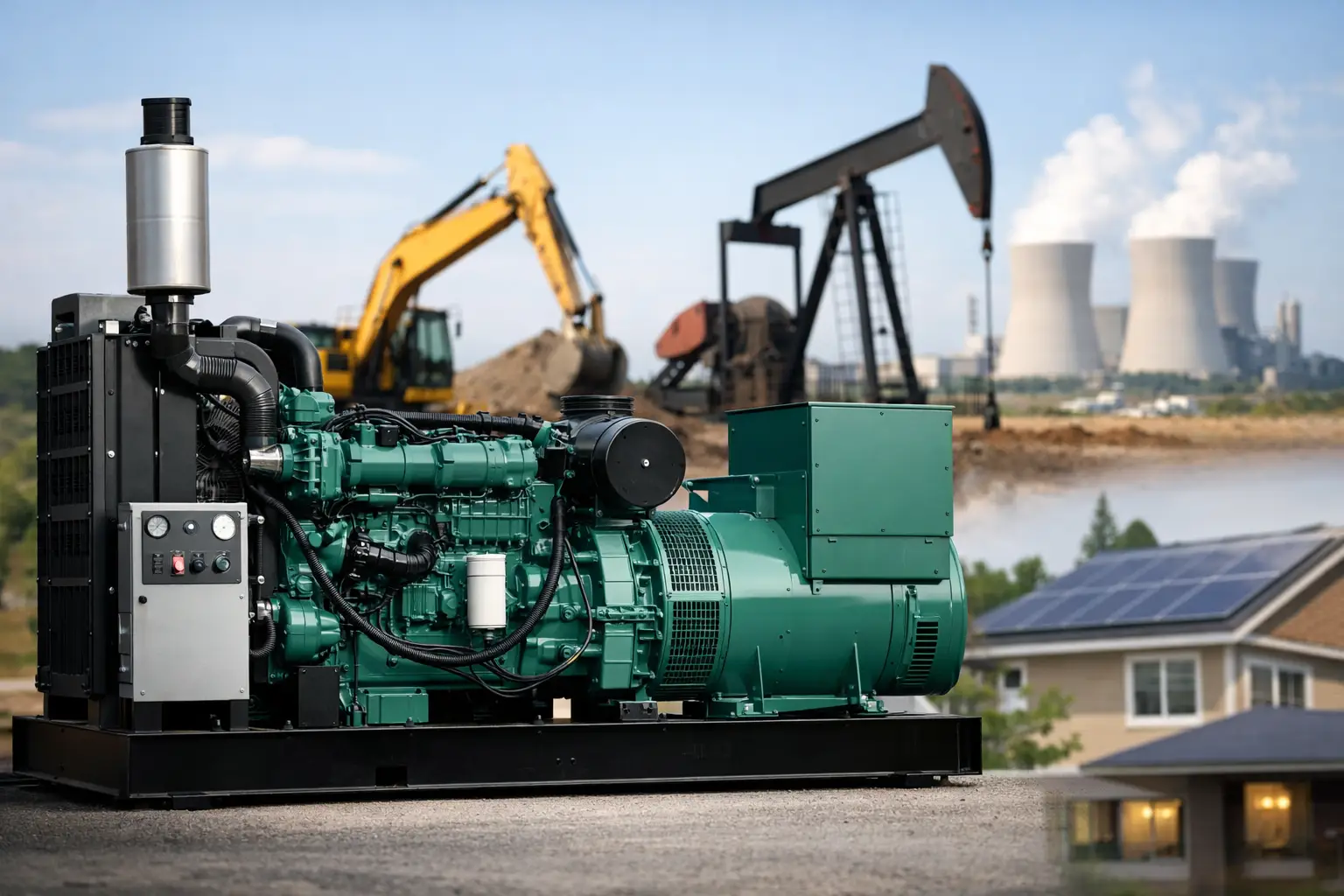
When a site loses mains power, the question is rarely theoretical. Production stops, alarms trigger, cold storage starts warming, and critical systems move onto limited battery reserve. That is why buyers asking what a diesel generator is used for are usually trying to protect uptime, not satisfy curiosity.
A diesel generator is used to supply electrical power where the grid is unavailable, unstable, or unsuitable for the load profile on site. In practice, that covers far more than emergency backup. Diesel gensets support standby power for buildings and infrastructure, prime power for off-grid operations, peak support in high-demand periods, and temporary power during planned works, shutdowns, and construction phases.
What is a diesel generator used for in practice?
The short answer is dependable power. The more useful answer is that diesel generators are used in any environment where a power interruption carries operational, financial, or safety consequences.
For many commercial buildings, the generator is a standby asset. It sits ready to start automatically if the mains supply fails, then carries essential circuits such as fire systems, lifts, lighting, security, HVAC controls, data rooms, and refrigeration. In healthcare, telecoms, utilities, and logistics, the same principle applies, but the consequences of failure are more serious and the specification is usually tighter.
In other settings, the generator is not waiting for an outage. It is the main source of power. Construction compounds, remote plants, quarries, agricultural operations, events infrastructure, and temporary facilities often require prime power because no viable grid connection exists yet, or because connection costs are disproportionate to the project.
There is also a middle ground. Some sites use diesel generation to cover planned outages, support expansion works before permanent electrical upgrades are complete, or provide resilience for periods of poor grid reliability. This is common where operations cannot tolerate even short interruptions.
Standby power for critical buildings and facilities
Standby duty is one of the most common uses for diesel generators. Here, the generator is sized to start quickly and carry either the full building load or a defined essential load when the utility supply drops.
This is particularly relevant for hospitals, care facilities, warehouses, manufacturing plants, commercial offices, hotels, schools, and retail centres. Not every circuit needs generator support. In many projects, only mission-critical systems are backed up, which affects both kVA selection and transfer arrangements.
The key distinction is that standby sets are designed for intermittent operation during mains failure. That usually means fewer annual running hours than a prime-rated machine, but higher expectations around immediate start-up and dependable load acceptance. If a site needs life safety support, food preservation, IT continuity, or regulated environmental control, standby generation is often a basic requirement rather than an optional extra.
Prime power where there is no reliable grid
If standby is about protection, prime power is about daily operation. A diesel generator used for prime duty is expected to run as the main energy source for extended periods. That changes the buying criteria. Fuel efficiency, service intervals, load profile, engine quality, and site logistics become central.
This is why specification matters. A set that performs well in standby mode for a warehouse may not be the right choice for a quarry, a remote pumping station, or a long-duration construction project. Prime-rated generators are selected to carry variable loads over time, and buyers need to be realistic about average demand, motor starting requirements, and future site changes.
For remote industrial sites, diesel remains a practical option because fuel is transportable, refuelling is straightforward, and the equipment is proven across demanding environments. That does not mean it is always the lowest running-cost solution, but it is often the most dependable where continuity matters more than theory.
Common sectors that use diesel generators
The sectors that rely on diesel generation tend to have one thing in common: downtime is expensive.
Construction firms use generators for site cabins, tools, tower cranes, dewatering systems, temporary lighting, and welfare units before a permanent supply is available. Manufacturers use them to protect production lines, automation, compressed air systems, and process-critical machinery. Logistics operators depend on backup power for loading systems, refrigeration, and warehouse operations.
Healthcare facilities need assured continuity for essential clinical systems and building services. Telecom operators use generator sets to keep networks live during outages. Utilities and water infrastructure depend on standby and prime power for pumping stations, control equipment, and remote assets. Large commercial sites use diesel generators to maintain tenant services, fire protection, and business continuity.
The use case changes, but the commercial logic is consistent. If power loss interrupts revenue, safety, compliance, or public service, diesel generation remains a serious option.
Why diesel is still widely used for backup and prime power
Buyers do not choose diesel generators because they are fashionable. They choose them because the technology is established, available across a wide capacity range, and suited to demanding duty cycles.
Diesel engines offer strong torque characteristics, which helps with starting certain loads. Fuel storage on site gives operators a degree of control during wider network disruption. The equipment is available from compact single-phase units through to large 3-phase industrial sets in the multi-megawatt range. Silent generators are often preferred where noise control matters, while open sets may suit plant rooms or controlled installations where enclosure design is less critical.
There are trade-offs. Diesel generators require maintenance, fuel management, and correct installation. Emissions, acoustic treatment, and local operating conditions all affect the final specification. For some applications, hybrid systems or alternative fuels may be worth reviewing. Even so, diesel remains a dependable benchmark for standby and prime power because it is proven in the field and understood by engineers, contractors, and maintenance teams.
What a diesel generator can power
A diesel generator can power almost any electrical load if it is correctly specified, but that does not mean every generator can power every site. The actual application depends on voltage, phase, starting currents, load step, power factor, environmental conditions, and whether the duty is standby or prime.
On smaller installations, a generator may support office essentials, lighting, domestic-type circuits, or light commercial loads. At higher outputs, it may carry chillers, pumps, compressors, conveyors, server rooms, medical systems, manufacturing equipment, or full-building essential services.
Motor loads deserve particular attention. Pumps, fans, lifts, and compressors can create high inrush currents at start-up, which means the generator may need additional headroom beyond the running load. This is one of the most common reasons undersized sets disappoint on site. A load list is useful, but understanding how and when that load starts is what makes the specification work.
Choosing the right generator for the job
If you are assessing what a diesel generator is used for on your site, the real buying question is not whether a genset can produce electricity. It is whether the selected machine can support your exact operating conditions with acceptable risk.
Start with the application. Is the set covering an emergency standby role, acting as prime power, or supporting a temporary project? Then look at the load profile. What is the running demand, what are the peak loads, and which items start under generator power? After that, consider format and installation constraints. A silent generator may be essential for noise-sensitive locations, while an open generator may be suitable in a dedicated acoustic plant area. Likewise, 3-phase units are standard for most commercial and industrial applications, while single-phase models serve smaller or more basic loads.
Capacity range matters as well. Smaller sets can support localised backup requirements, while large industrial units can cover substantial facilities or infrastructure assets. The right answer is not simply the biggest generator within budget. Oversizing can affect efficiency and operating performance, while undersizing creates the more obvious risk of failed starts, overload trips, and poor resilience.
This is where a specification-led approach pays off. Buyers should look closely at standby and prime ratings, engine platform, alternator quality, fuel tank arrangement, control panel, acoustic configuration, and delivery requirements. Availability also matters. When an outage risk is immediate or a project programme is fixed, stock position and lead time become commercial factors, not just procurement details.
A practical way to think about diesel generator use
The simplest way to frame it is this: diesel generators are used wherever power continuity has a value greater than the cost of providing it. Sometimes that value is measured in safety and compliance. Sometimes it is measured in production output, tenant service, or avoided downtime. Often it is all of those at once.
For buyers responsible for critical loads, the generator is not a generic product. It is a piece of operational insurance and, in some cases, core site infrastructure. If the application is clear and the specification is right, diesel generation remains one of the most dependable ways to keep a site running when the grid cannot.