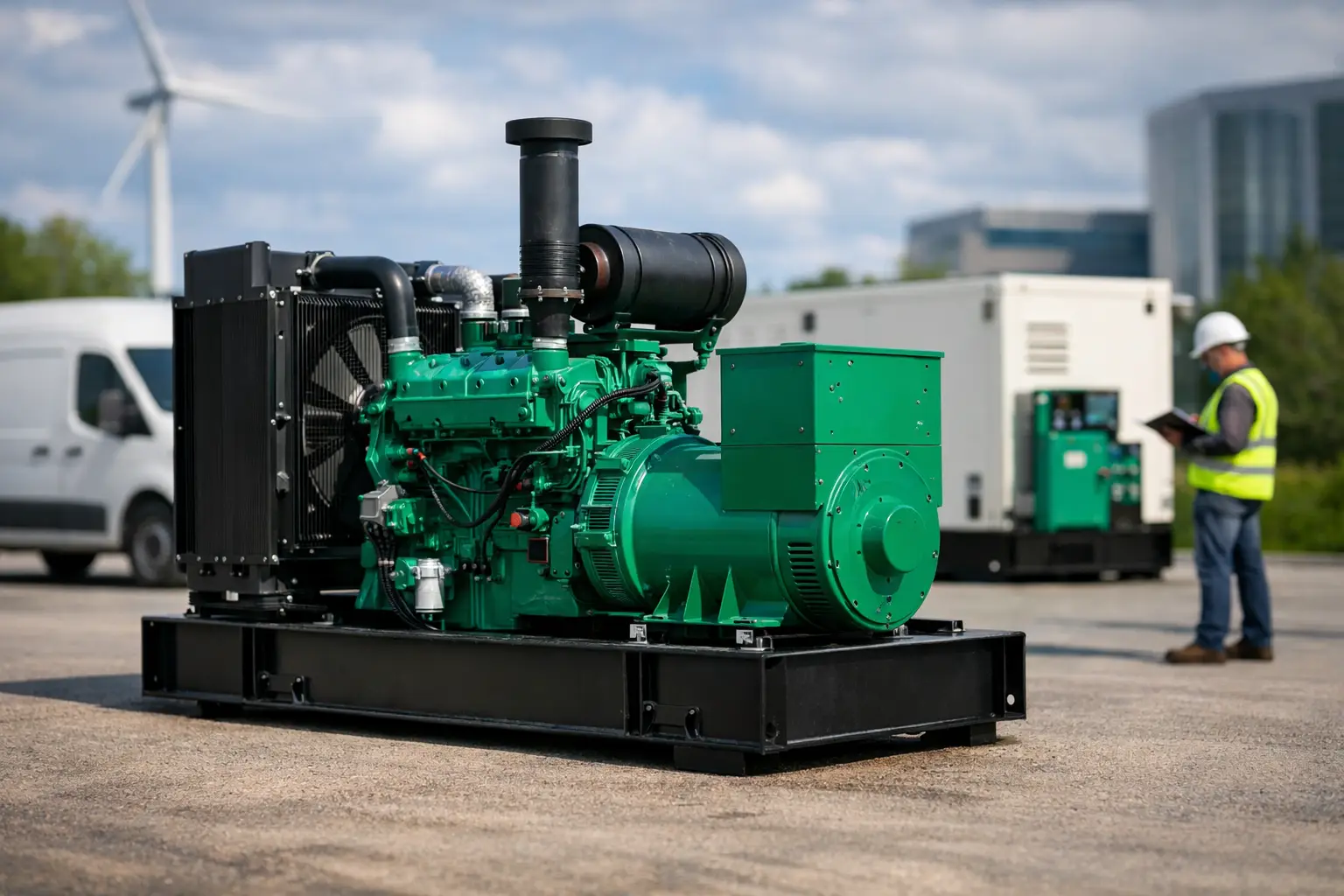
A generator usually gets judged on its worst day, not its best. When a site loses mains power, nobody cares how attractive the enclosure looks or how low the list price seemed at procurement stage. What matters is whether the unit starts, carries the load, and keeps operations moving. That is why the search for the best diesel generators UK buyers can specify is less about broad consumer rankings and more about matching the right machine to the real duty.
For commercial and industrial users, the right choice depends on load profile, site conditions, noise limits, delivery lead time, and the consequences of failure. A warehouse with occasional standby requirements does not need the same set-up as a telecoms installation, a healthcare facility, or a construction project running prime power. The best buying decisions start with application, not branding alone.
What defines the best diesel generators UK buyers should shortlist
In this market, “best” means dependable under pressure. That starts with engine quality, alternator performance, control system capability, and a package built for the intended environment. Proven engine platforms matter because serviceability, parts availability, and known performance records reduce operational risk over the life of the equipment.
Buyers should also look closely at the rating. Standby-rated generators are designed for emergency use during mains failure. Prime-rated sets are intended for variable load over extended periods and are the better fit where utility power is unavailable or unreliable. Confusing the two leads to poor performance, reduced lifespan, and avoidable cost.
Availability is another practical consideration. A technically suitable generator with an uncertain lead time may not be the best option for a project with a hard programme or an existing site exposure. In many cases, stock position and fast delivery are part of the specification, even if they are not written into it.
Standby or prime power is the first decision
Before comparing kVA bands or enclosure styles, define the duty. For standby use, the generator needs to start quickly, accept the essential load, and operate reliably for outage duration. Typical examples include offices, manufacturing sites, schools, healthcare buildings, and commercial premises protecting against grid interruption.
Prime power is a different purchase. Here, the generator may be the main source of electricity for a site, often on construction compounds, remote infrastructure works, temporary installations, and off-grid operations. This changes everything from fuel planning to maintenance intervals and engine loading strategy. A unit that is excellent for standby may be the wrong answer for daily running.
This is where many specifications either become efficient or expensive. If the load is genuinely intermittent and emergency-based, overspending on a prime-capable package may not be necessary. If the load is regular and extended, buying a standby set to save capital cost usually creates larger costs later.
Choosing the right size without creating problems
Generator sizing is one of the main reasons some installations perform well and others do not. Too small, and the unit struggles with starting currents, voltage dip, and nuisance trips. Too large, and the engine can spend long periods underloaded, which is inefficient and can contribute to wet stacking on some duty cycles.
The correct size depends on both total load and load behaviour. Motor starting, HVAC plant, pumps, compressors, lifts, and other inductive loads can create significant inrush demands. A site with a modest running load but high starting peaks may need a larger generator than headline kW figures suggest.
For that reason, serious buyers assess more than the connected load list. They review what must run, what can be sequenced, and whether non-essential circuits should be excluded. A properly staged load acceptance strategy can often reduce the required generator size without reducing resilience.
In broad terms, smaller sets in the lower kVA range suit residential, agricultural, retail, and small commercial duties. Mid-range units commonly support larger buildings, depots, workshops, telecoms, and light industrial applications. High-capacity sets are typically specified for major industrial processes, healthcare infrastructure, data environments, utilities, and large site-wide backup schemes.
Silent or open generator - which is better?
The best diesel generators UK users buy are not all built in the same format. Silent generators, housed in acoustic canopies, are usually the preferred choice for outdoor use where noise control, weather protection, and a cleaner site presentation are important. They are common across commercial estates, public-facing sites, healthcare, education, and urban projects.
Open generators are often selected for plant rooms, dedicated compounds, or containerised installations where the surrounding environment already provides the necessary protection or acoustic treatment. They can be a practical option where access for servicing is a priority and site design has already accounted for ventilation and attenuation.
Neither format is automatically better. It depends on the installation. A silent set may simplify external deployment and compliance on a noise-sensitive site. An open set may be entirely suitable in a controlled industrial environment. What matters is whether the package fits the project, not whether one format sounds more premium than the other.
3 phase, single phase, and site compatibility
Most industrial and commercial applications in the UK will require a 3 phase generator. This is the standard for larger plant, motors, machinery, and building services. Single phase units have their place, particularly in smaller premises or specific temporary applications, but they are not a default option for serious facility backup.
Voltage, frequency, and distribution arrangements need checking early. It is not enough for a generator to have the right output rating on paper. It must integrate with the site’s switchgear, transfer equipment, and load characteristics. If the installation includes automatic transfer switching, load banks, synchronisation requirements, or future expansion plans, those factors should influence selection from the outset.
Why engine pedigree matters
When procurement teams compare the best diesel generators UK suppliers offer, engine brand is often a deciding factor, and for good reason. Recognised engine manufacturers bring confidence in reliability, service support, and long-term parts supply. In critical power, that history matters.
Cummins-powered sets are regularly specified because they are proven across standby and prime applications, with a wide output range and strong acceptance in commercial and industrial environments. That does not remove the need to assess the full generator package, but it does give buyers a solid foundation when uptime is non-negotiable.
The alternator, controller, fuel system, and enclosure quality still deserve scrutiny. A strong engine in a poorly matched or weakly assembled package does not create a strong power solution. Buyers should review the generator as a complete system.
The role of uptime, service access, and stock availability
A low purchase price can look attractive until a critical part is delayed, a service point is awkward to reach, or commissioning slips because the preferred unit is not available. For many buyers, the best diesel generator is the one that can be delivered quickly, installed properly, and supported through its operating life.
That is especially true in sectors where outages carry immediate financial or safety consequences. Manufacturing lines, logistics centres, medical facilities, utility assets, and telecoms sites do not have much tolerance for procurement mistakes. Stock-backed supply and specification-led support are commercially valuable because they reduce project risk.
This is where a specialist supplier adds more value than a simple catalogue. Buyers often need guidance on whether a 150 kVA set is genuinely sufficient, whether a silent canopy is necessary, or whether prime power classification is being overlooked. A straightforward enquiry process is often more useful than a generic online ranking table.
How to compare options without wasting time
A practical comparison starts with five points: duty rating, kVA requirement, phase, enclosure type, and engine platform. Once those are confirmed, buyers can assess dimensions, fuel tank capacity, control features, transport constraints, and any site-specific requirements such as bunding, remote monitoring, or extended runtime.
It also helps to ask what failure would cost. If an outage stops production, breaches a service commitment, affects safety systems, or disrupts public services, the cheapest option is rarely the best option. The stronger approach is to buy for resilience first and cost second, while still keeping specification disciplined.
For buyers who need dependable standby or prime power across a wide output range, a stock-led specialist such as Global Generators can simplify that process by aligning availability with application rather than forcing a one-size-fits-all recommendation.
The right generator is not the one with the loudest marketing claim. It is the one sized correctly, rated correctly, and built around the operating reality of your site. If you are assessing the best diesel generators UK suppliers can provide, start with load, duty, and consequence of failure. The shortlist becomes much clearer from there.