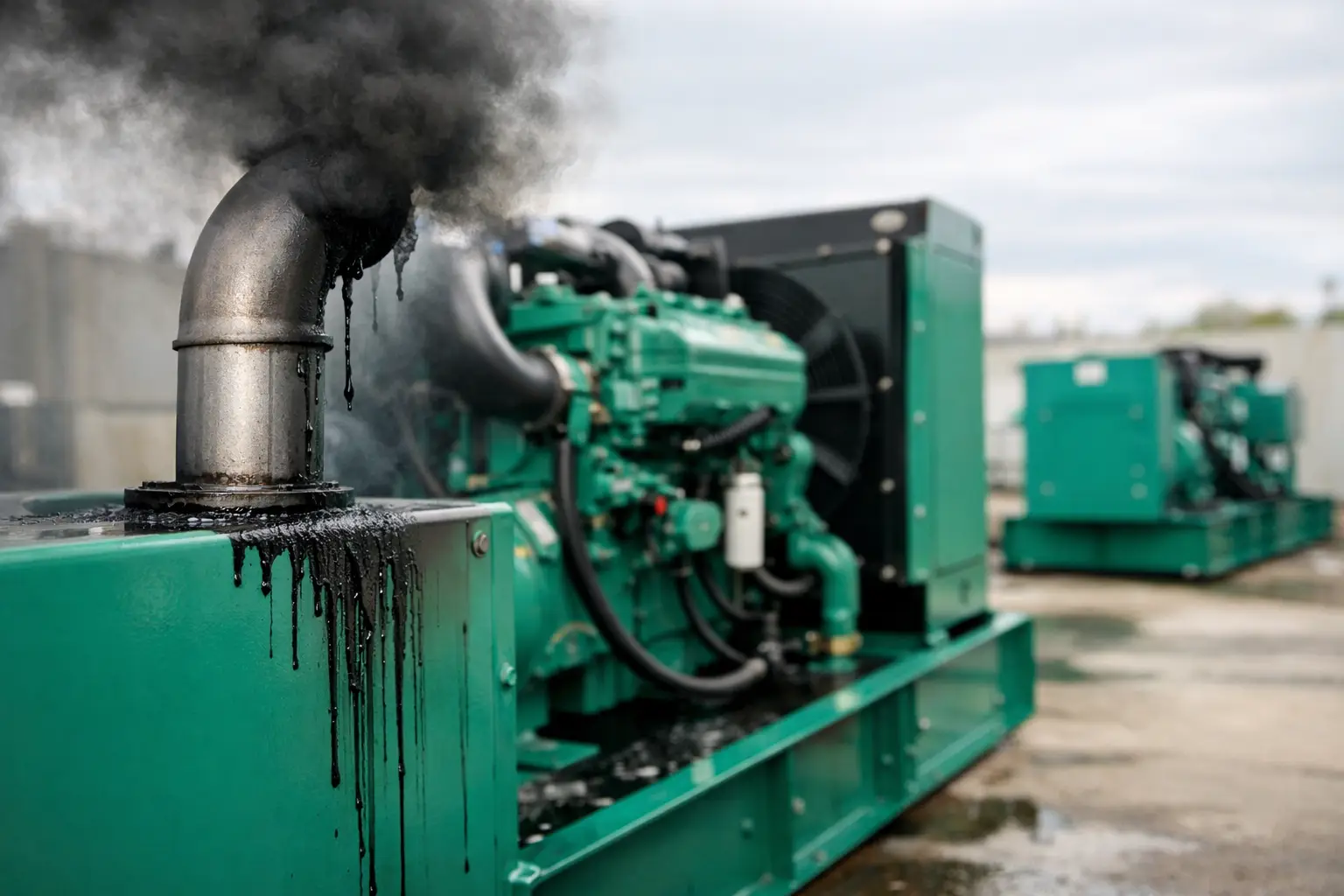
A diesel generator that smokes excessively, leaves dark residue around the exhaust, and starts showing reduced performance is rarely suffering from a mystery fault. In most cases, the question is straightforward: what causes generator wet stacking? The answer usually comes back to one operating condition - prolonged running at too light a load.
For sites that depend on standby or prime power, wet stacking is not a cosmetic issue. It is a sign that the engine is not reaching the combustion temperatures needed to burn fuel cleanly and efficiently. Left unchecked, it can lead to carbon deposits, injector fouling, reduced engine responsiveness, higher maintenance demands, and avoidable downtime.
What generator wet stacking actually is
Wet stacking happens when unburnt fuel, soot, condensed vapour, and carbon build-up collect in the exhaust system of a diesel generator. The term comes from the wet, oily residue that can appear around the exhaust manifold, turbocharger, or exhaust outlet.
In normal operation, a diesel engine should run hot enough and under enough load to achieve efficient combustion. When that does not happen, some of the injected fuel does not fully burn. Instead, it passes through the engine and exhaust system as deposits and residue.
This is most common on larger generator sets that are oversized for the actual demand placed on them. It can also occur on standby sets that spend long periods idling during testing or are only ever exposed to very light building loads.
What causes generator wet stacking in practice
The most common cause is sustained low-load operation. Diesel generators are designed to work. If a set rated for substantial site demand is only supplying a small fraction of its available output, cylinder temperatures stay too low for complete combustion.
As a general rule, many diesel generators perform best when regularly operated at a meaningful percentage of their rated load. Exact thresholds vary by engine manufacturer and model, but persistent operation below roughly 30 per cent of rated capacity is where wet stacking risk tends to increase. Some engines will tolerate light loading better than others, especially newer units with refined fuel systems, but the principle remains the same.
Low exhaust temperature is part of the problem. Incomplete combustion is the other part. Together, they create the conditions for fuel residue, soot, and carbon accumulation.
There are several real-world reasons this happens.
Oversized generator selection
A generator chosen with too much spare capacity for the actual site load is one of the biggest contributors. Buyers often build in a large safety margin to cover future expansion or motor starting demands. That can be sensible, but if the set spends most of its life serving a very small running load, it may never operate in its efficient range.
This is especially relevant in standby applications where the connected load profile has changed over time. A building may once have had higher base demand, but later moved to more efficient HVAC, LED lighting, or altered occupancy patterns. The generator size remains the same while the real load falls away.
Extended idling and no-load testing
Routine testing is necessary, but no-load exercise runs can create their own problems if used too often or for too long. Running a diesel generator without sufficient electrical demand does little to bring engine temperatures up to proper operating conditions.
A short test now and then may not create immediate issues, but repeated no-load running over months can contribute to wet stacking. This is one reason loaded testing is generally a better practice for critical power assets.
Light building loads on standby systems
Some standby generators start correctly during a mains failure but only pick up a modest share of the expected building load. This can happen where non-essential loads are shed, where occupancy is low, or where the load bank provision has been overlooked during maintenance planning.
The generator is technically doing its job, but not under enough demand to burn fuel cleanly. On hospitals, telecom sites, commercial facilities, and infrastructure assets, that mismatch can remain unnoticed until smoke, fouling, or service issues begin to appear.
Signs that wet stacking is developing
Wet stacking usually shows up in a few repeatable ways. Black, grey, or dark exhaust smoke is common. So is oily residue or liquid staining around exhaust components. Operators may also notice carbon deposits on injectors, sluggish engine response, poor fuel efficiency, and more frequent maintenance interventions.
In more advanced cases, turbochargers and exhaust paths can become contaminated, and the engine may struggle to deliver rated performance when full load is finally required. That is where a standby issue becomes an uptime risk.
Why it matters for reliability and operating cost
The main concern is reliability under load. A generator that has spent long periods wet stacking may still start, but it may not transition cleanly into heavy duty operation when a genuine outage occurs. Deposits interfere with efficient combustion and can affect injector spray pattern, exhaust flow, and turbocharger performance.
There is also a cost issue. Wet stacking increases service requirements because components need cleaning, inspection, or earlier replacement. Fuel is being used inefficiently, and operators may need additional engineer visits or load bank testing to correct conditions that could have been avoided through better sizing and operating practice.
For commercial and industrial users, that means avoidable lifecycle cost as well as increased risk during a live power event.
How to prevent generator wet stacking
The first control measure is correct generator sizing. The set should be matched to the real load profile, not just the highest theoretical demand. That means assessing starting loads, continuous running loads, future expansion, and any duty-specific requirements, then selecting a unit that can carry the application without spending its life underloaded.
There is a trade-off here. Too little capacity creates a different problem, particularly where large motors, transient loads, or future site growth are involved. The answer is not simply to size down aggressively. It is to specify the generator around actual operating conditions, using realistic load data rather than broad assumptions.
The second measure is to avoid prolonged no-load or very light-load running. Where routine testing is required, exercising the generator on load is far more effective. If the site cannot provide enough natural demand during test periods, a load bank can be used to bring the engine up to proper operating temperature and maintain healthier combustion conditions.
The role of load bank testing
Load bank testing is often the most practical corrective and preventative measure for standby generators. It applies an artificial electrical load so the engine reaches the temperatures and pressures needed for cleaner combustion.
For sets that have already begun wet stacking, a controlled load bank test may help burn off accumulated deposits, although severe cases may still require mechanical cleaning or service intervention. More importantly, scheduled loaded exercise runs reduce the chance of the issue developing in the first place.
For critical facilities, this is not an optional extra. It is part of reliability management.
Maintenance and monitoring matter too
Wet stacking should be treated as an operating condition, not just a maintenance fault. Service technicians can clean injectors, inspect turbochargers, and remove carbon deposits, but if the generator returns to the same low-load pattern, the issue will recur.
It helps to monitor actual running load, exhaust condition, service history, and changes in site demand over time. If a generator has been specified for a site that now carries a very different load profile, it may be worth reviewing whether that set is still the right fit.
Does wet stacking affect every diesel generator in the same way?
No. Engine design, fuel system type, control strategy, duty cycle, and the quality of maintenance all influence how quickly wet stacking appears and how severe it becomes. Modern diesel engines may manage light load conditions better than older designs, but none are immune to the effects of prolonged underloading.
Application also matters. A prime power generator on a construction or industrial site often sees healthier load levels than a standby set in a highly efficient commercial building. That is why specification should always be tied to the intended duty, whether standby or prime, as well as the likely load behaviour over time.
When procurement teams should pay attention
If a site is replacing an older set, changing building services, or planning a standby system for a new facility, wet stacking should be part of the sizing discussion from the outset. It is easier and cheaper to prevent than to correct.
For buyers comparing industrial diesel generators, the right question is not just maximum kVA. It is whether the selected unit will operate within a sensible load range in real conditions. That is where supplier input matters. A specification-led approach, supported by realistic operating data, usually produces a better outcome than buying excess capacity for reassurance alone.
Where uptime is critical, generator selection is not only about having enough power on paper. It is about ensuring the engine will perform cleanly, reliably, and predictably when the site actually needs it.
Wet stacking is usually a warning that the generator and the application are out of step. Resolve that mismatch early, and the set is far more likely to deliver the dependable service critical sites expect.