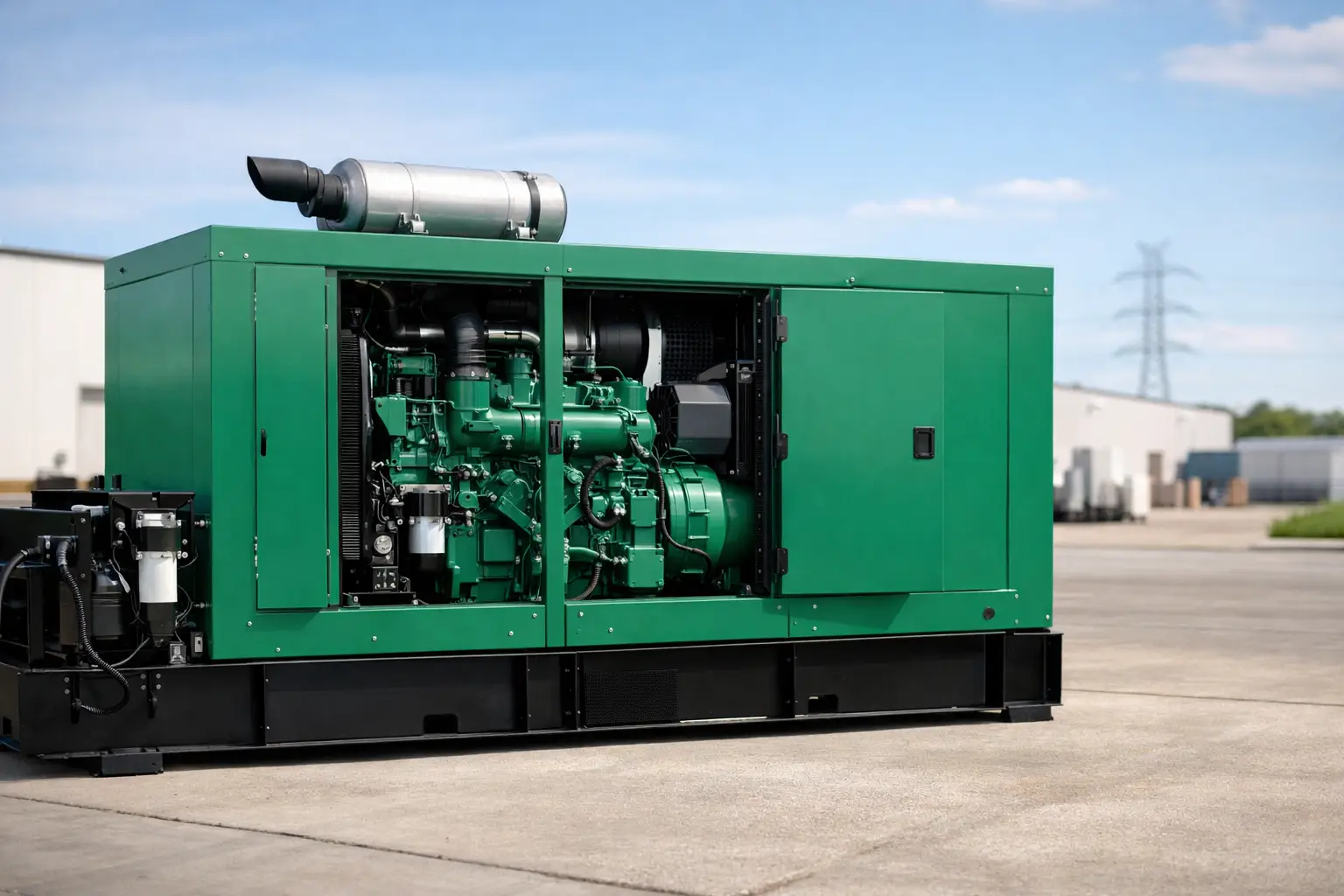
When a site cannot afford a failed start, the Cummins C330D5eQ diesel generator sits in an important part of the market. It is large enough for serious commercial and industrial duty, yet still practical for a wide range of standby and prime power applications where buyers need known engine pedigree, clear ratings and dependable support.
For procurement teams and engineers, this is not a generator you buy on appearance or headline output alone. The real question is whether its rating, alternator package, enclosure format and operating profile match the load, duty cycle and site conditions. That is where purchasing decisions are usually won or lost.
Where the Cummins C330D5eQ diesel generator fits
The Cummins C330D5eQ diesel generator is typically considered by buyers who need a mid-range industrial set with enough capacity for critical building services, plant equipment, site cabins, process loads or mixed commercial demand. In practical terms, this places it in a useful bracket for hospitals, data-adjacent facilities, logistics sites, manufacturing operations, utilities, telecom infrastructure and larger construction projects.
Its appeal comes from balance. Smaller sets may cover only life safety circuits or limited essential loads. Larger units can introduce unnecessary capital cost, fuel burn and installation complexity if the site load profile does not justify them. A model in the C330D5eQ class often suits operations that need substantial backup power without moving immediately into much larger synchronised plant strategies.
That said, suitability always depends on the application. If the site has high motor starting currents, large HVAC plant, frequent load steps or future expansion plans, the headline rating alone will not tell the full story. Load assessment remains essential.
What serious buyers look for first
Most experienced buyers start with the ratings. Standby and prime power are not interchangeable, and confusion here can lead to under-specification or an avoidable cost premium. Standby duty is usually the correct basis where the generator serves as emergency backup during utility failure. Prime power is relevant where the set operates as the main source over longer periods, often with variable load.
On a generator such as the Cummins C330D5eQ, the engine brand matters because service familiarity, parts support and operating history reduce procurement risk. Cummins remains widely specified in mission-critical environments because buyers know what they are getting - established performance, recognised global support and proven use across industrial sectors.
Alternator quality is equally important. Voltage stability, transient response and compatibility with the connected load can be more important than headline engine output when dealing with sensitive systems, pumps, compressors or electronic controls. If the load includes UPS systems, VSD-driven plant or non-linear equipment, harmonics and step-load behaviour should be reviewed carefully.
Specification matters more than brochure language
At this level, buyers are usually not shopping for a generic diesel generator. They are checking whether one set can be integrated into a live operating environment without creating fresh problems. That means looking beyond kVA and asking practical questions.
Is the set supplied in open or acoustic format? An open unit may suit plant room installation where ventilation and access are already engineered. A silent or enclosed configuration is often the better fit for external placement, urban sites or noise-sensitive locations. The right answer depends on where the generator will operate and how much acoustic control is needed at the boundary.
Fuel tank arrangement is another factor that affects real-world performance. Run time expectations vary significantly between sectors. A telecom facility may want long autonomous operation. A commercial building may only need enough tank capacity to cover short interruptions until refuelling support is available. There is no universal best option - only the right match for the resilience plan.
Control systems also deserve attention. Modern buyers generally expect straightforward monitoring, alarm visibility and remote operating capability. For infrastructure and industrial sites, BMS integration, auto start functionality and clear fault diagnostics are often non-negotiable rather than optional extras.
Standby versus prime power on the C330D5eQ
This is where many purchasing conversations become more technical. If the Cummins C330D5eQ diesel generator is intended for standby use, the emphasis is on fast start reliability, load acceptance and confidence under infrequent but high-consequence operation. Maintenance discipline is critical because the machine may sit for long periods before being asked to perform immediately.
For prime power applications, the conversation shifts. Fuel efficiency across the operating band, service intervals, loading discipline and engine life under sustained running become more commercially significant. Running a set designed around standby expectations in a prime duty profile can be an expensive mistake.
There is also an operational middle ground. Some sites use generators for peak support, planned outages, seasonal resilience or temporary power during grid works. In those cases, actual annual hours and load variation should be reviewed in detail before final specification. This is one of the clearest examples of where it depends.
Installation factors that affect performance
A good generator can still disappoint if the installation is poor. The C330D5eQ class needs proper consideration for airflow, exhaust routing, fuel system design, access for servicing and foundation requirements. These are not secondary details. They affect operating stability, maintenance cost and compliance.
Ventilation is particularly important for enclosed spaces. Heat rejection calculations must be right, especially where ambient temperatures rise or plant rooms are constrained. Likewise, exhaust back pressure should be checked against manufacturer limits. If the exhaust design is wrong, performance and engine life can suffer.
On external installations, weather protection, acoustic requirements and security become more prominent. An acoustic canopy may handle much of the environmental exposure, but site layout still matters. Service access should remain straightforward, and refuelling arrangements should not become awkward in an emergency.
Transfer switching also deserves careful coordination. Automatic transfer systems, protection settings and commissioning sequences should be aligned with the building load and operational procedures. A generator is only one part of the standby power chain.
Buying the right configuration
For many buyers, the question is not whether to choose a Cummins-powered set, but which exact configuration to procure. The same generator family can be supplied with different enclosure types, control options, fuel arrangements and distribution accessories.
This is where a specification-led supplier adds value. If the site requires a three phase output, extended base tank, acoustic attenuation, export-ready documentation or fast UK delivery, those details should be addressed before the order is placed, not after the unit arrives. Global Generators works in this enquiry-led way because buyers at this level rarely need a one-size-fits-all package.
Budget remains part of the decision, but lowest purchase price is rarely the right benchmark on critical power equipment. The more useful calculation is total operational value - reliability, serviceability, lead time, compliance and whether the set actually protects the site from outage costs.
Common use cases for this generator size
A generator in this category often makes sense for medium to large commercial buildings, warehousing, production lines, utility support compounds and contractor-led temporary installations. It can also suit healthcare support loads, although exact clinical applications should always be reviewed against the critical systems involved.
The reason this size is often shortlisted is straightforward. It covers a substantial portion of site demand without forcing the buyer into a larger and more expensive plant solution than necessary. For some operations, it is the final answer. For others, it is a strategic step within a broader staged power plan.
The trade-off is that growth can outpace original sizing. If a facility is likely to add major HVAC, process machinery or IT load in the near term, future-proofing should be discussed early. Sometimes the right move is to specify a larger set. In other cases, paralleling strategy is the better route.
What to confirm before placing an order
Before committing to the Cummins C330D5eQ diesel generator, buyers should confirm the true site load, starting characteristics, duty classification, installation format and delivery constraints. They should also review noise limits, tank autonomy, control requirements and any project-specific compliance needs.
Factory specification is only part of the procurement picture. The best results come when the generator, transfer equipment and installation scope are considered together. That reduces the risk of mismatch between the generator set and the real demands of the application.
For operations where downtime carries genuine cost or safety implications, the buying decision should be driven by fit rather than assumption. The right generator is the one that starts when required, carries the intended load without drama and can be supported properly throughout its working life.
If you are assessing this model, the useful next step is not a generic comparison chart. It is a site-specific review of load, duty and configuration so the equipment you order is the equipment your operation can rely on when mains power fails.