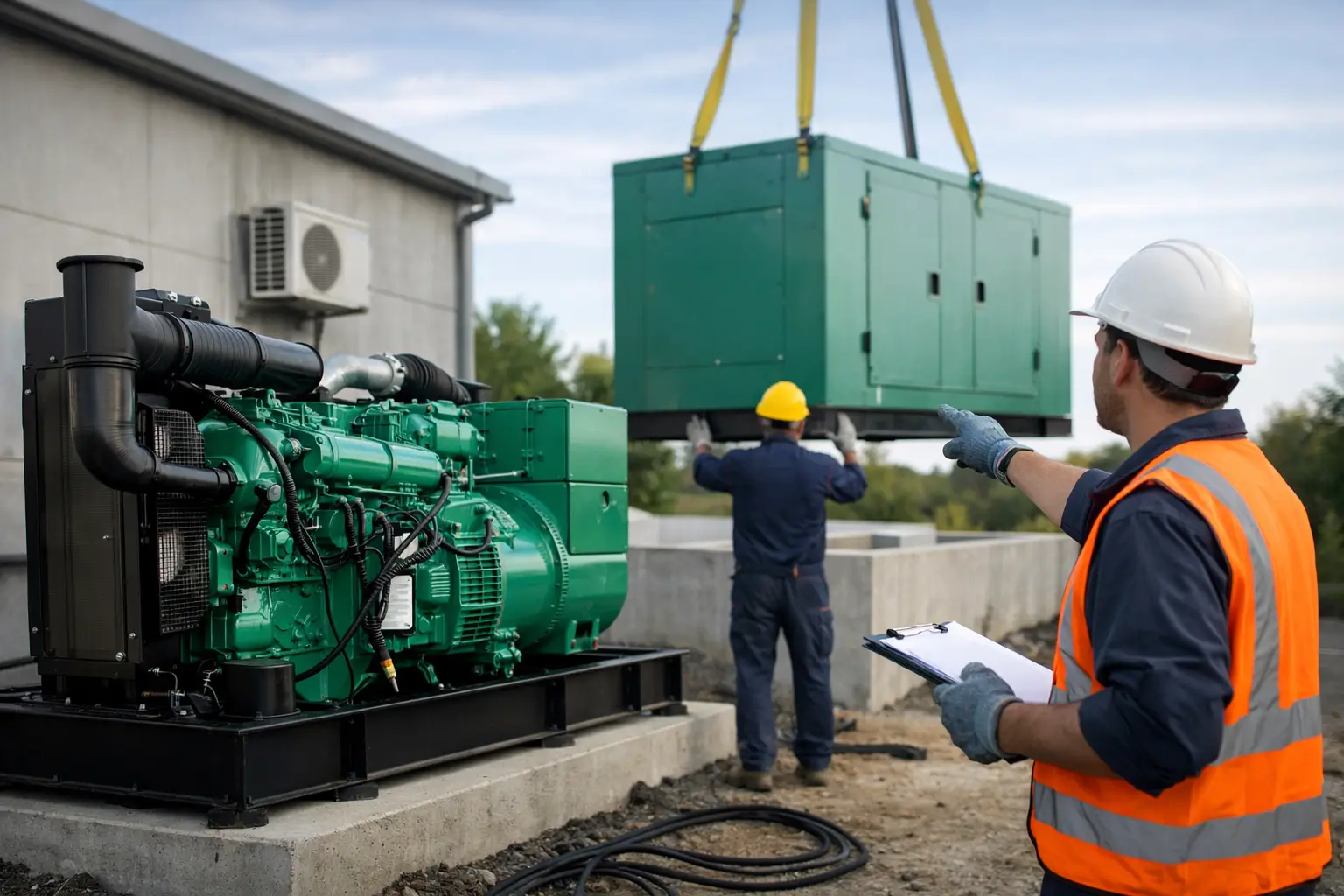
A generator that is correctly specified but poorly installed will still fail when the mains go down. This diesel generator installation guide is written for buyers and project teams who need dependable standby or prime power, and who understand that installation decisions affect uptime, maintenance access, noise control and long-term operating cost.
For most commercial and industrial sites, installation is not a single task. It is a chain of engineering decisions covering generator sizing, enclosure format, base design, fuel storage, cable routing, ventilation, exhaust discharge, controls integration and final commissioning. Get those decisions right early and the set will be easier to maintain, safer to operate and far more likely to perform under load when it matters.
What a diesel generator installation guide should cover first
The starting point is not the concrete pad. It is the duty of the machine. A standby set supporting a healthcare facility, telecoms site or logistics operation will be installed differently from a prime power unit serving continuous site demand. Runtime expectations, load profile, redundancy requirements and refuelling arrangements all change the installation brief.
Sizing must be based on actual electrical demand, not rough assumptions. That means identifying starting currents, non-linear loads, motor loads, future expansion and whether the site requires single-phase or three-phase output. Undersizing creates nuisance trips and poor motor starting. Oversizing can lead to wet stacking, inefficient loading and unnecessary capital cost. In practice, the best installations start with a proper load assessment and a clear distinction between standby rating and prime rating.
Enclosure choice also affects the installation method. Silent generators are usually preferred where noise control, weather protection and cleaner site integration matter. Open sets may suit plant rooms or dedicated generator compounds where acoustic treatment and environmental protection are handled separately. There is no universal best option - it depends on the site, the available footprint and the operational risk of exposing equipment to harsh conditions.
Site selection and civil preparation
Location has a direct effect on reliability and serviceability. The set needs safe access for delivery, lifting, refuelling and maintenance. It also needs clearances around doors, radiators, control panels and fuel connections. A generator squeezed into an awkward corner may fit on paper but become expensive to service for the next ten years.
The base must support the operating weight of the generator, not just the dry weight shown on a datasheet. Fuel, coolant and accessories add mass, and vibration behaviour changes once the set is running under load. A level reinforced concrete plinth is standard for outdoor installations, with allowance for anti-vibration mounting where specified. Drainage matters as much as strength. Standing water around the base, cable entries or fuel lines will shorten component life and complicate maintenance.
If the installation includes a bunded fuel tank, external day tank or separate control kiosk, the civil layout should consider future access rather than minimum spacing. Service engineers need room to work safely. So do operators, especially during poor weather or emergency callouts at night.
Indoor versus outdoor installation
Indoor plant room installations can offer security and weather protection, but ventilation and exhaust management become more demanding. You must allow for combustion air, radiator discharge air, ambient temperature control and safe extraction of exhaust gases. Poor airflow is one of the most common causes of overheating after installation.
Outdoor installations are often simpler from a ventilation perspective, particularly with canopy sets, but they still need weather-resistant cable routing, secure fencing where required, and attention to noise breakout toward neighbouring properties or occupied parts of the site.
Ventilation, exhaust and noise control in a diesel generator installation guide
Airflow should be engineered, not assumed. A diesel generator rejects a large amount of heat, and the radiator cooling path must not be obstructed by walls, louvres, screens or poorly designed ductwork. If a plant room relies on inlet and discharge attenuators, their free area and pressure drop need to match the set's cooling requirements.
Exhaust routing should be as short and direct as practical, while maintaining safe discharge away from personnel areas, air intakes and openings into buildings. Excessive back pressure reduces performance and may affect engine life. Flexible sections, suitable supports and thermal insulation are typically required, particularly for indoor installations. At the design stage, it is also worth considering how rain ingress and condensate will be managed.
Noise control depends on site sensitivity. A silent generator may be sufficient for many commercial applications, but not always for hospitals, residential-adjacent developments or urban infrastructure sites with strict planning conditions. Additional attenuation can help, but it adds footprint, cost and airflow resistance. That trade-off needs to be assessed early, not after complaints arrive.
Fuel system design and compliance
Fuel storage is often treated as a secondary issue until runtime expectations expose a gap. If the set must support extended outages, the installation needs enough usable fuel capacity and a practical refuelling method. For some sites, an integrated base tank is sufficient. For others, external bulk storage, transfer pumps and fuel polishing arrangements are justified.
The design must also address containment, fire precautions and local environmental requirements. Bunding, overfill protection, isolation valves and leak detection are common considerations. Fuel quality is another operational issue. Long-term stored diesel can degrade, and contaminated fuel is a frequent cause of generator starting and running faults. The right installation is not only about capacity. It is about preserving fuel integrity over time.
Cable sizing between tanks, pumps and control systems should be coordinated with the mechanical installation rather than added later. The same applies to return lines, vents and access for inspection. A tidy fuel system is easier to maintain and easier to diagnose when faults occur.
Electrical integration and controls
Electrical installation should be built around the site's operating logic. A basic standby arrangement may require only the generator, an automatic transfer switch and essential load segregation. More complex installations may involve synchronisation, load shedding, remote monitoring, mains parallel operation or integration with building management systems.
Cable routes should minimise voltage drop, avoid heat sources and provide physical protection. Earthing arrangements must be designed to suit the distribution system, fault protection strategy and local regulations. This is not an area for assumptions. Incorrect earthing can create safety issues and lead to unstable operation during fault conditions.
Control panel location matters as well. Operators need clear access to alarms, emergency stop functions and manual controls. If the set is part of a critical infrastructure application, remote alarm outputs and telemetry are usually worth including from day one. Retrofitting them later is possible, but rarely efficient.
Changeover and load testing
The changeover arrangement deserves close attention because it defines what happens at the point of mains failure. Transfer timing, prioritised loads, generator warm-up and retransfer logic all affect real-world performance. Some sites can tolerate a short interruption. Others cannot, which may push the design toward more advanced switchgear and system architecture.
Load bank testing may also be appropriate, particularly where the connected building load is too low or too variable to prove the set properly during commissioning. This is especially relevant for higher-capacity units and mission-critical standby systems.
Commissioning is where installation quality shows
A proper diesel generator installation guide does not stop at mechanical and electrical completion. Commissioning proves whether the design, installation and control strategy work together. That includes pre-start checks, insulation testing, fluid verification, battery checks, alarm validation, ATS operation, load acceptance and runtime observation under representative conditions.
This stage should also confirm that maintenance access is realistic, documentation is complete and operators understand normal and emergency procedures. If a generator can only be serviced by removing ductwork, isolating half the site or waiting for specialist lifting equipment, the installation has not been thought through well enough.
For buyers specifying new equipment, it pays to work with a supplier that understands the difference between supplying a generator and supporting a complete power solution. Global Generators typically sees the strongest outcomes where sizing, format selection and installation planning are aligned from the enquiry stage rather than corrected after delivery.
Common installation errors to avoid
Most failures linked to installation are predictable. The usual problems are inadequate airflow, restricted maintenance access, poor exhaust routing, insufficient fuel storage, incorrect cable sizing and weak coordination between civils, mechanical and electrical contractors. Another frequent issue is specifying a generator by headline kVA alone without considering starting loads, site altitude, ambient temperature or expansion plans.
There is also a commercial mistake that appears in competitive tenders - buying a lower-cost set without allowing for the full installation environment. A cheaper generator can become the expensive option if the canopy is wrong for the site, the tank capacity is too small or the controls cannot support the required changeover arrangement.
A diesel generator installation should be treated as an engineered asset, not a boxed product placed on a slab. When the specification, installation and commissioning are handled with that mindset, the result is simpler: reliable power when the site needs it most.