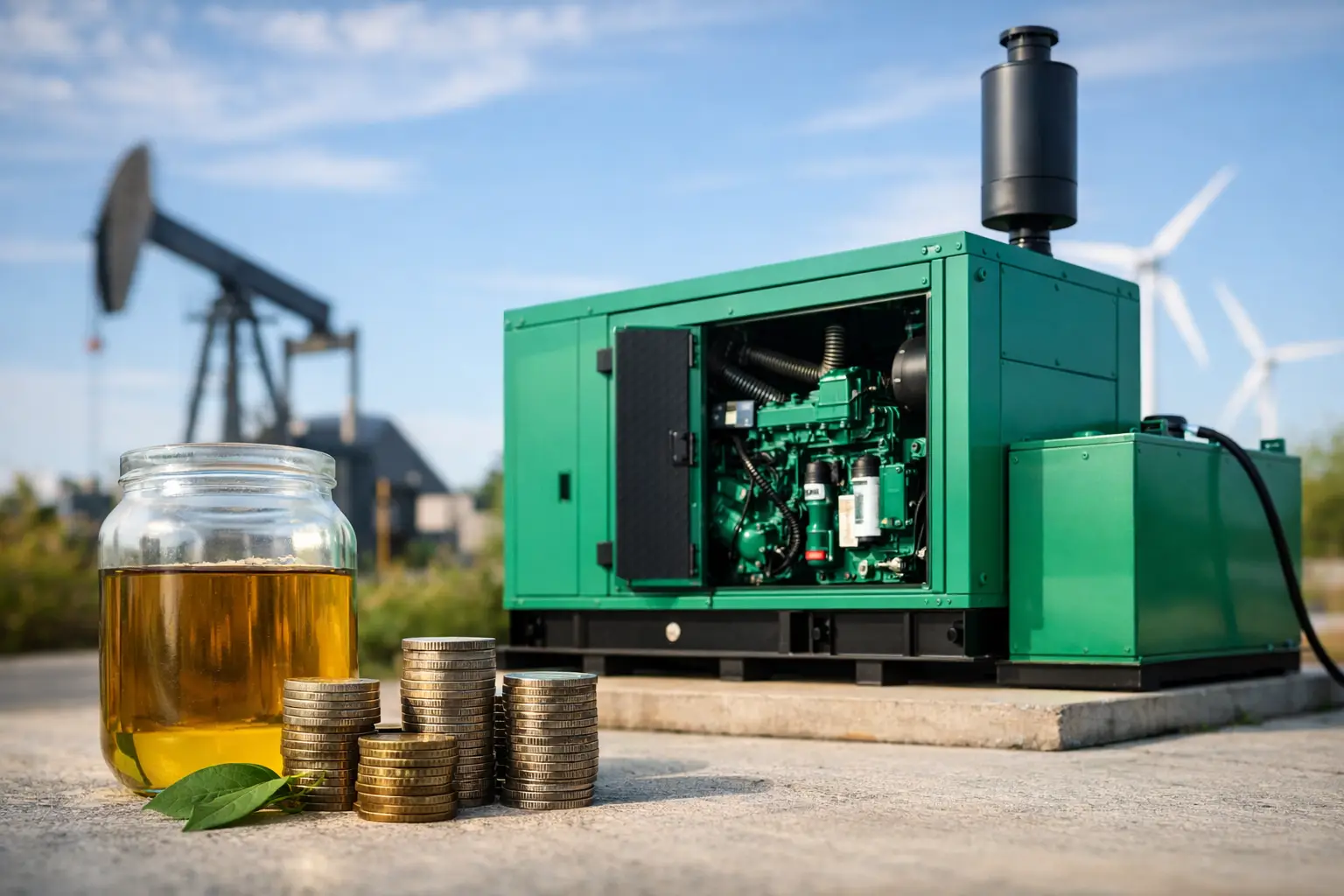
Fuel use is usually where generator cost becomes real. The capital purchase matters, but once a set is running for standby testing, peak shaving or prime power, diesel generator fuel efficiency starts to shape operating cost, refuelling frequency and site resilience.
For buyers responsible for uptime, this is not a minor specification. A generator that burns more fuel than expected can shorten runtime, increase logistics pressure and raise the cost per kilowatt delivered. The right approach is not to chase a headline figure in isolation, but to understand what affects fuel consumption in actual operating conditions.
What diesel generator fuel efficiency really means
In practical terms, diesel generator fuel efficiency is the relationship between fuel consumed and electrical output produced. It is often considered as litres per hour at a given load, or more accurately, litres per kilowatt-hour generated. Both matter, but they answer slightly different questions.
Litres per hour helps with tank sizing, delivery planning and estimating how long a set will run before refuelling. Litres per kilowatt-hour is the better measure when comparing overall efficiency between machines, because it shows how effectively the generator converts fuel into usable power.
This is where some buying decisions go wrong. A larger generator may consume more litres per hour overall, yet still operate efficiently if it is correctly matched to the load. Equally, a smaller set that appears economical on paper can become expensive if it is pushed too hard or spends long periods outside its ideal operating range.
Load factor has the biggest impact
Most diesel generators achieve their best fuel performance within a mid-load band rather than at very low load or absolute maximum load. For many industrial sets, the most efficient operating window sits around 60 to 80 per cent of rated load, although exact performance depends on the engine, alternator, control system and site conditions.
At low load, the engine still has fixed losses. Cooling systems, friction, pumps and other parasitic demands continue regardless of how much useful power is being produced. That means the fuel burned per unit of electricity generated tends to rise when the set is underloaded.
At very high load, fuel use increases sharply and the margin for transient events becomes tighter. There is also more thermal stress on the engine. Running close to maximum output may be acceptable in some duty profiles, but it is rarely the most efficient or operationally comfortable position for long periods.
This is why accurate sizing matters. Oversizing a generator for standby confidence can look sensible at procurement stage, but if the load profile is modest for most of its life, efficiency suffers. Undersizing creates a different problem by forcing the set to work too hard, which can increase fuel burn, maintenance pressure and risk during peak demand.
Standby and prime duty change the equation
A standby generator and a prime power generator are not selected in the same way, and fuel planning should reflect that. Standby sets may spend most of their life idle, then run under emergency conditions where runtime and dependable load acceptance are the priority. In that case, fuel efficiency still matters, but resilience usually matters more.
Prime power applications are different. If a generator is supporting regular operations, remote sites or continuous production demand, fuel consumption becomes a direct commercial issue. A small difference in litres per hour can turn into a significant annual cost over long running hours.
That is why serious buyers look beyond the purchase price. The lower-cost set is not always the lower-cost asset over the full operating cycle. Engine quality, control logic, maintenance intervals and load matching can all influence whole-life cost.
Why engine quality and configuration matter
Not all diesel engines deliver the same efficiency curve. Engine design, fuel injection strategy, turbocharging, governing and emissions calibration all affect how a generator performs across changing loads. Proven industrial engine platforms tend to offer more predictable consumption data and better behaviour under transient conditions.
The enclosure type does not usually transform fuel economy on its own, but generator configuration still matters. Silent generators may be essential for urban, healthcare or commercial environments where noise control is non-negotiable. Open sets may suit plant rooms or controlled industrial sites. The decision should be based on application requirements first, then reviewed against service access, cooling airflow and installation layout.
Three-phase and single-phase output also need to align with the actual electrical demand. A mismatch here can create imbalance, poor utilisation and unnecessary inefficiency. For larger commercial and industrial loads, proper phase distribution is a routine but critical part of getting the best from the set.
Operating conditions affect real-world fuel consumption
Published fuel data is useful, but site conditions often shift actual performance. Ambient temperature, altitude, humidity and fuel quality all have an effect. Hot environments can reduce air density and influence cooling performance. High altitude sites may see derating, which changes both output and consumption characteristics.
The load profile itself matters just as much. A generator feeding a stable base load behaves differently from one serving a site with frequent motor starts, sudden load swings or poor power factor. Transient-heavy applications can increase fuel use because the engine is constantly responding to demand changes rather than operating steadily.
Maintenance standards also show up in the fuel bill. Restricted air filters, injector issues, worn components or poor-quality servicing can all reduce combustion efficiency. A generator that is technically available but not operating cleanly is rarely economical.
How to assess diesel generator fuel efficiency before you buy
Start with the actual load, not the assumed worst case. Many sites estimate demand generously, then carry that figure into procurement without checking real usage. A proper review of starting loads, continuous loads and future expansion gives a better basis for selecting kVA.
Next, ask for fuel consumption figures at multiple load points rather than a single headline number. Data at 25, 50, 75 and 100 per cent load gives a clearer view of how the machine will behave in service. That matters far more than a best-case claim taken from one operating point.
It also helps to model runtime against on-site fuel storage. For critical sites, autonomy is not just about tank volume. It is about how long the generator can support the required load before refuelling becomes necessary, and how practical refuelling will be during disruption.
Buyers should also review whether one larger set or multiple smaller sets would be more efficient. There is no universal answer. A single machine keeps the installation simpler, but parallel sets can improve efficiency if the load varies widely and only part of the installed capacity is needed at certain times.
Ways to improve fuel efficiency on site
The first gain usually comes from better load matching. If the generator is routinely underloaded, the answer may be a smaller set, a staged system, or a revised operating strategy. If it is consistently near its limit, there may be a case for a larger rating or load redistribution.
Routine maintenance is the second area. Clean filters, healthy injectors, correct oil grade and proper cooling system performance all contribute to efficient combustion and stable output. These are standard service items, but they have direct commercial value when running hours are high.
Control strategy can also help. Modern controllers make it easier to monitor trends, avoid unnecessary running and manage sets more intelligently in multi-generator installations. Where loads fluctuate, that visibility can reduce waste.
Then there is the question of duty cycle. A standby set that is used as an informal daily power source without being specified for that role will rarely deliver the best fuel outcome or service life. Equipment should match the operational pattern, not just the emergency scenario.
Efficiency is only one part of the decision
Fuel efficiency deserves attention, but not at the expense of reliability. In critical power applications, the cheapest litre-per-hour figure is not the only measure that matters. Load acceptance, engine durability, parts support, availability and correct specification often carry more weight, particularly where power failure has immediate operational consequences.
That said, there is no reason to treat efficiency and reliability as competing priorities. With the right sizing, a proven engine platform and clear duty definition, both can sit together. This is where a specification-led supplier adds value, especially when buyers need fast availability without compromising the technical fit.
For organisations balancing running cost against resilience, the useful question is not simply which generator uses the least fuel. It is which generator delivers the required power, for the required duration, at the lowest realistic operating cost for that site. That is usually a more disciplined way to buy, and a better way to protect uptime when the mains supply does not hold.