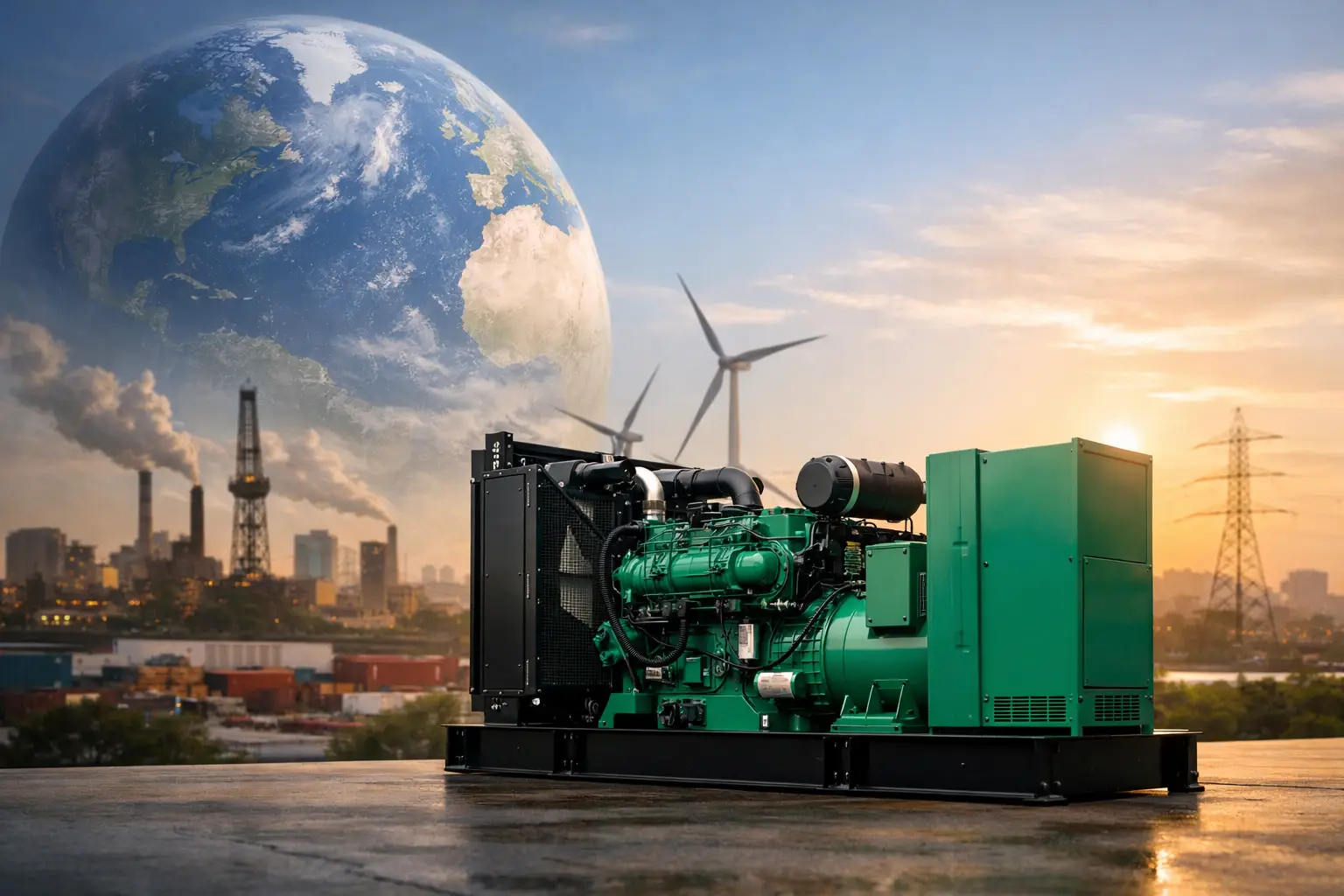
Power resilience has moved from a contingency item to an operational requirement. The increasing global demand for diesel generators is not being driven by one market alone, but by a wider shift in how businesses, infrastructure operators and public institutions assess risk, uptime and energy security. For buyers responsible for continuous operations, the question is no longer whether backup or prime power is necessary. It is how quickly the right set can be specified, procured and deployed.
Diesel generator demand is rising because it answers a hard commercial problem. When the grid fails, fluctuates or cannot reach a site at all, operations still need to continue. That applies to a manufacturing plant running around the clock, a telecoms site in a remote location, a hospital protecting life-critical systems, or a contractor energising a temporary project. In each case, the cost of interruption is greater than the cost of preparedness.
Why increasing global demand for diesel generators continues
The market is expanding for practical reasons rather than temporary sentiment. Grid instability remains a major factor in both mature and developing economies. In some regions, ageing utility infrastructure is struggling with peak load, weather disruption and underinvestment. In others, rapid industrialisation and urban growth are outpacing grid expansion. Diesel generation fills that gap because it is proven, dispatchable and available at scale.
At the same time, more sectors are operating with lower tolerance for downtime. Warehousing, data handling, cold storage, healthcare, water treatment and logistics all depend on consistent power quality. Even short outages can create spoiled stock, process losses, safety incidents or service disruption. That changes the buying decision from cost-only to risk-adjusted value.
There is also a straightforward delivery advantage. Diesel generator sets are a mature technology with established engine platforms, broad service familiarity and a wide power range. Buyers can source compact sets for smaller facilities or high-capacity units for industrial loads without waiting for unproven solutions to mature. When a project has a fixed mobilisation date, that matters.
The sectors driving diesel generator growth
Construction remains one of the clearest demand drivers. Many sites require temporary prime power before grid connection is available, and some operate in locations where grid access is not commercially viable. Contractors typically need equipment that can be moved quickly, loaded reliably and matched to varying site demands. Silent generators are often preferred where planning conditions, urban work or public proximity make noise control a practical issue.
Manufacturing and processing facilities are also adding standby resilience. These buyers are not just looking at full-facility backup. They are increasingly segmenting critical loads such as control systems, chilled processes, pumps, compressed air and safety infrastructure. That often leads to a more specification-led procurement process, with close attention to standby rating, fuel autonomy, phase requirement and transfer arrangements.
Telecoms, utilities and remote infrastructure continue to support long-term diesel generator demand because they operate across dispersed estates where reliability takes priority over aesthetics. In these environments, access conditions, maintenance intervals and proven engine support can be more important than headline purchase price.
Healthcare and large commercial buildings are another major part of the market. Hospitals, care settings, laboratories, hotels and distribution centres all need dependable emergency power. The decision-making process is usually shaped by compliance requirements, business continuity planning and the financial impact of service interruption.
Standby and prime power are shaping different buying patterns
One reason the market is broadening is that standby and prime power needs are increasing at the same time. These are related, but they are not interchangeable.
Standby applications are designed to protect operations during utility outages. In these cases, start reliability, transfer performance and response time are central. The generator may run infrequently, but when it is needed, failure is not acceptable. Buyers in this category usually prioritise tested components, known engine brands and configuration clarity.
Prime power applications involve sustained operation, often in off-grid or weak-grid environments. Here the buying criteria shift. Fuel efficiency, service access, load profile suitability and long-run durability take on greater importance. The wrong specification in a prime power role can lead to unnecessary operating cost, accelerated wear and performance issues under variable site demand.
The increasing global demand for diesel generators is partly a result of this dual-use expansion. More organisations need standby resilience, while more projects and locations require dependable prime power where the grid cannot do the job.
Why diesel remains the preferred choice in critical applications
Alternative technologies are part of the wider energy conversation, but diesel continues to hold a strong position in mission-critical power for clear technical reasons. It provides high energy density, established fuel logistics and strong performance under heavy load. It is also widely supported by service engineers, parts networks and familiar control systems.
For serious buyers, this is not an abstract debate. If a site needs dependable output across unpredictable conditions, diesel is still one of the most practical options available. That is especially true where runtime matters, load steps are significant, or ambient conditions and duty cycles are demanding.
There are trade-offs. Fuel management, emissions compliance and maintenance planning all require proper consideration. Noise attenuation may also be essential depending on the site. But these are manageable engineering and procurement questions, not barriers to deployment. In many cases, diesel remains the least risky solution when measured against uptime requirements.
Specification is becoming more important than broad market trends
Rising demand does not mean buyers can afford vague procurement. If anything, a growing market makes specification discipline more important. Generator selection should start with the load profile, not the catalogue.
Power requirement is the first filter, but not the only one. Buyers also need to confirm whether the application is standby or prime, whether single phase or 3 phase output is required, what voltage configuration is needed, and whether an open or silent set is appropriate for the operating environment. Space constraints, transport access, fuel storage and acoustic limitations can all affect the final decision.
This is where experienced supply matters. Stock availability is valuable, but only if the supplied unit is correctly matched to the site. Oversizing can create inefficiency and wet stacking risk in lightly loaded operation. Undersizing is worse, leading to instability, nuisance trips and reduced service life. The commercial cost of either mistake usually exceeds any apparent saving at purchase.
What buyers are prioritising in a tighter power environment
Procurement teams are becoming more focused on availability, engine pedigree and lifecycle confidence. In practical terms, that means recognised engine brands, transparent ratings and a supplier that can clearly define what is in stock and what lead time applies.
Cummins-powered units remain a strong choice in many industrial applications because buyers know what they are getting - established performance, broad service familiarity and dependable output across multiple ratings. For critical installations, that level of familiarity reduces uncertainty during both commissioning and long-term operation.
Fast availability is another growing factor. Demand surges often expose a weak supply chain, especially when buyers delay procurement until a project reaches the final stage. A supplier with stock across key kVA classes such as Global Generators Ltd https://global-generators.com is in a stronger position to support urgent requirements, whether the need is a compact standby set for a commercial property or a high-capacity package for industrial prime power.
Regional growth is different, but the driver is the same
The global picture is not uniform. In developing markets, generator demand is often linked to inadequate grid coverage, industrial expansion and infrastructure rollout. In established markets, the driver is more likely to be resilience against outage risk, rising continuity requirements and ageing utility assets.
Even so, the common thread is operational exposure. Organisations are making the same calculation in different ways. If power loss threatens revenue, compliance, safety or delivery performance, onsite generation becomes a strategic asset rather than a reactive purchase.
That shift explains why demand is increasing across such a wide spread of applications. It is not simply about electricity supply. It is about control over operating risk.
What this means for generator procurement now
Buyers entering the market should expect stronger emphasis on lead times, technical due diligence and application matching. The right procurement approach starts early, before installation deadlines tighten and before stock pressure narrows the available options.
For businesses securing standby or prime power, the practical route is clear. Define the duty, confirm the load, choose the correct enclosure and phase configuration, and work with a supplier that understands the consequence of getting it wrong. Global Generators operates in that part of the market - specification-led, uptime-focused and built around dependable industrial sets with fast UK delivery and export capability.
The demand trend is unlikely to soften while grid uncertainty, industrial expansion and continuity risk continue to shape capital decisions. For operations that cannot tolerate interruption, diesel generation remains less a discretionary purchase and more a straightforward piece of infrastructure.