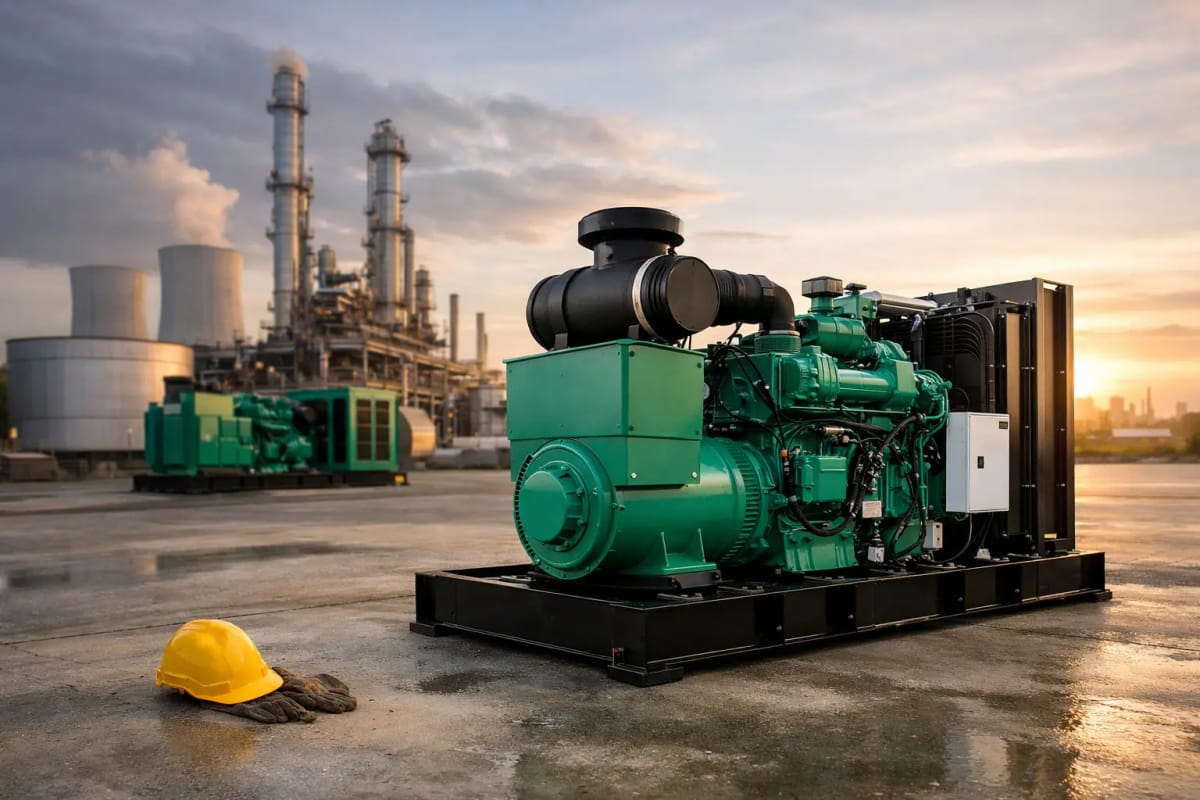
When mains power drops on a live site, the problem is rarely limited to lost electricity. Production stops, temperature control can fail, security systems fall back to reserves, and contractual penalties start to build. That is why industrial generators are not a generic purchase. They are a specification-led decision tied directly to uptime, site risk and operating profile.
For buyers responsible for continuity, the key question is not simply how much power a generator can produce. It is whether the set is correctly matched to the application, load characteristics, installation environment and duty cycle. A unit that looks adequate on paper can still become the wrong choice if the standby rating is misunderstood, the enclosure is unsuitable, or the site really requires 3 phase distribution rather than single phase output.
What industrial generators are designed to do
Industrial generators provide either backup power during a mains failure or continuous power where utility supply is unavailable or unreliable. In practice, that covers a wide range of operating conditions. A hospital plant room, a telecoms site, a manufacturing line and a construction compound may all need generator support, but the duty profile and tolerance for interruption are very different.
For some sites, the set exists primarily as insurance. It may run only during power cuts and routine testing, but when it starts, it has to carry the required load immediately and without hesitation. For other operations, the generator is part of the daily power strategy, supplying prime power over sustained periods. That distinction matters because it affects rating selection, fuel planning, maintenance intervals and total cost over the life of the equipment.
Standby and prime power in industrial generators
One of the most common specification issues is confusion between standby and prime ratings. They are not interchangeable.
A standby-rated generator is intended to operate during utility failure. It is suited to applications where the mains remains the normal power source and the generator runs only when needed, usually for limited annual hours. This is often the correct choice for commercial buildings, healthcare facilities, warehousing and other sites where power continuity is essential but the generator is not expected to be the primary supply.
A prime-rated generator is designed for regular or continuous use where utility power is absent or inconsistent. This is more common on remote projects, temporary works, off-grid locations and certain infrastructure applications. Prime power operation places different demands on the engine and alternator, so selecting a standby unit for a prime application can create reliability issues, shorten service life and raise operating costs.
The practical point is simple. Buyers should define the duty before they compare kVA. If the duty profile is wrong, the rest of the specification can still fail.
Choosing the right power output
Power sizing is where operational risk and procurement discipline meet. Too small, and the set may struggle with starting loads, voltage stability or future expansion. Too large, and the project carries unnecessary capital cost, increased fuel consumption under light load, and in some cases less efficient performance.
Most industrial generators are specified by kVA, with ranges covering smaller commercial loads through to large industrial and infrastructure demand. The right output depends on more than the total connected load. It also depends on the type of load. Motor starting currents, non-linear loads, step loading, HVAC plant, pumps, compressors and data equipment all influence how the generator will perform under real conditions.
This is why site load assessment matters. A straightforward building services load may be sized with relative certainty. A mixed industrial process with intermittent large motor starts needs more careful analysis. Future expansion should also be considered at the outset. A set that only just covers present demand can become a constraint as operations grow.
Silent or open set
Enclosure format is another decision that should be made around the site rather than around catalogue preference. Silent generators are enclosed to reduce noise and provide a degree of weather protection, making them well suited to urban sites, commercial premises, public-facing environments and locations with planning or acoustic restrictions.
Open generators are typically selected for plant rooms, containerised installations or projects where the unit will be housed in a dedicated acoustic enclosure as part of the wider installation. They can be practical in controlled environments and may suit buyers who need flexibility in how the equipment is integrated into a larger power system.
Neither format is universally better. It depends on access, ventilation, ambient conditions, sound limits and how the generator will be installed. A silent set can simplify deployment on many sites, while an open set may make sense where the installation design already addresses housing and attenuation.
3 phase or single phase
For industrial applications, 3 phase generators are usually the correct choice. Most heavy-duty plant, larger HVAC systems, manufacturing equipment and site distribution arrangements depend on 3 phase supply for stable operation and efficient power delivery.
Single phase generators still have a place, particularly in smaller commercial or residential settings, but they are less common in genuinely industrial duty. Choosing between them should be based on the actual site load and distribution architecture, not on short-term convenience. Installing the wrong phase configuration can create compatibility problems and additional cost later.
For buyers managing mixed loads, phase balancing also deserves attention. A poorly balanced load across a 3 phase generator can affect performance and equipment life. This is another area where technical review at enquiry stage avoids preventable problems after delivery.
Engine quality and long-term reliability
In mission-critical power, engine quality is not a secondary detail. Proven engine platforms are central to dependable starts, load acceptance, serviceability and parts support. Recognised engine brands are often preferred for exactly this reason. Buyers are not just purchasing a generator set. They are purchasing confidence in performance under pressure and access to a support ecosystem over time.
Cummins-powered industrial generators are widely specified because they offer a strong combination of reliability, established engineering and broad application suitability across standby and prime power duties. For procurement teams and engineers, that translates into lower perceived risk, clearer technical benchmarks and confidence in a known platform.
It is also worth looking beyond headline engine brand alone. Alternator quality, control system capability, fuel tank sizing, switchgear compatibility and protection features all contribute to how well the set performs in service.
Availability matters as much as specification
A technically suitable generator that cannot be supplied when the project needs it is still the wrong commercial outcome. On urgent projects, lead time becomes part of the specification. Planned maintenance outages, new site energisation dates, temporary power requirements and resilience upgrades often run to fixed schedules, and delays can affect multiple contractors or operational teams.
That is why stockholding matters. Buyers often benefit from working with a supplier that holds key industrial generators in common ratings and configurations, rather than relying entirely on factory lead times. Fast UK delivery can be decisive for domestic projects, while global export capability matters for international contractors and operators managing multi-site programmes.
Global Generators is positioned around this requirement, with stock-led availability across key power bands and enquiry-based support to match the right set to the duty.
What buyers should confirm before making an enquiry
A productive generator enquiry is built on operating facts, not broad estimates. Before approaching suppliers, it helps to confirm the intended application, required kVA, standby or prime duty, preferred engine brand, phase requirement, and whether a silent or open set is needed. Installation conditions should also be clear, including ambient temperature, altitude, access restrictions and any acoustic limitations.
If the generator will integrate with an existing electrical system, transfer arrangements and synchronisation requirements may need to be discussed early. Fuel autonomy is another practical point. A site with limited refuelling access may need longer run times from the base tank or external fuel arrangements.
The better the information at the start, the faster the procurement process moves and the lower the risk of mismatch.
Industrial generators as a risk decision
The most effective generator purchases are not driven only by price. They are driven by consequence. A site that can tolerate interruption has one set of buying priorities. A site where lost power stops production, compromises safety or breaches service obligations has another.
That is why industrial generators should be assessed as part of operational risk management. Specification, availability, engine platform, enclosure type and rating all feed into the same commercial question: will this unit protect the site when the power supply fails, or when the mains is not there to begin with?
For serious buyers, that is the standard worth holding. The right generator should fit the load, the environment and the duty from day one, and continue doing so when the site needs it most.