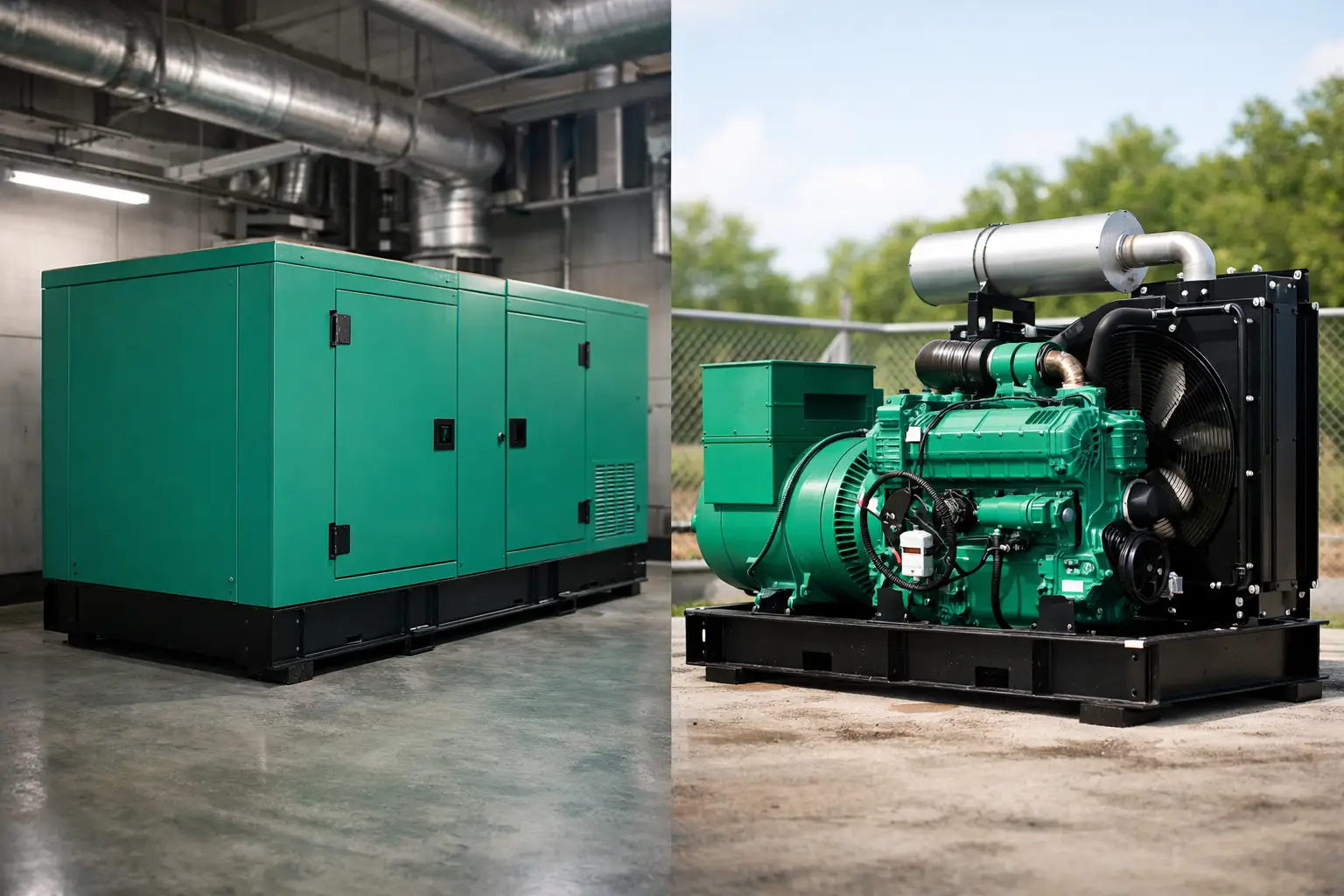
If a generator is going anywhere near staff, neighbours, tenants or the public, the silent generator vs open generator decision stops being a box-ticking exercise very quickly. Enclosure type affects noise output, installation planning, maintenance access, transport, cost and, in some cases, whether the set is practical for the site at all. For buyers responsible for uptime, the right choice depends less on preference and more on operating conditions.
Silent generator vs open generator: what changes in practice?
At engine and alternator level, a silent generator and an open generator can be built around the same core powertrain. The difference is the format. A silent generator is supplied within an acoustic canopy designed to reduce sound levels and provide weather protection. An open generator is supplied without that enclosure, leaving the main components accessible and visible, usually for installation inside a plant room or containerised system.
That sounds straightforward, but the commercial effect is wider than noise alone. The enclosure changes dimensions, weight, service access, airflow management and how quickly the unit can be deployed on site. It also affects compliance with site restrictions and how much additional infrastructure is needed around the generator.
For many buyers, the first question is whether the set will operate indoors or outdoors. If the generator is for an internal plant room with suitable ventilation, exhaust routing and acoustic treatment already built into the project, an open set may be the logical choice. If it is going outside in a yard, on a construction project, beside a commercial building or anywhere exposed to weather and nearby occupants, a silent set is often the more practical route.
Noise is usually the deciding factor
A silent generator is designed to attenuate engine and fan noise through insulated canopy panels, residential or industrial silencers, and an enclosure layout that controls sound escape. In real purchasing terms, that matters where planning conditions, neighbour sensitivity, shift work or operator welfare are part of the brief.
An open generator does not provide that built-in acoustic control. It will typically produce a significantly higher sound level unless it is installed within an acoustically treated room or external housing. On isolated industrial sites, quarries, remote pumping stations or dedicated plant spaces, that may be acceptable. On hospitals, schools, mixed-use developments, depots and occupied commercial premises, it often is not.
Noise should not be assessed in general terms. A buyer should look at the actual dB(A) rating at a stated distance, the expected operating load, the duty profile and the site boundary conditions. A generator that is acceptable during daytime testing may still be unsuitable for overnight operation or regular demand periods. In standby applications, occasional use can sometimes make an open set viable indoors. In prime power duty, where the unit runs for long periods, acoustic control becomes more significant.
Cost matters, but so does what the price includes
Open generators are usually lower in purchase cost than equivalent silent generators. There is less fabricated steelwork, less acoustic insulation and a simpler overall package. For buyers comparing line items only, that can make the open set look like the obvious value option.
The issue is that the generator cost is only one part of the installed cost. If an open set needs a dedicated weatherproof plant room, acoustic treatment, louvres, attenuation, additional security or a bespoke housing arrangement, the initial saving can narrow quickly. A silent set often reduces those secondary requirements because the enclosure already performs several of those functions.
This is where project context matters. For a contractor placing temporary power outside, a silent set may be the most efficient and cost-effective solution because it arrives as a ready-to-position package. For a factory with an existing generator room and engineered ventilation, an open set can remain the more economical specification.
Buyers should also consider programme risk. A lower-cost open set may carry a higher installation burden. If lead times on civils, acoustic works or room modifications delay commissioning, the true commercial cost shifts.
Installation environment changes the right answer
Where silent generators fit best
Silent generators are generally better suited to outdoor installation, especially where speed of deployment and self-contained protection are priorities. The canopy provides shielding against rain and environmental exposure, while also keeping the set more secure and visually contained.
This format is common across construction, telecoms, commercial property, healthcare backup, public-facing sites and temporary infrastructure. It is also useful where the exact final layout is still evolving, because the generator can often be positioned with less supporting building work than an open set.
That does not mean a silent generator can simply be dropped anywhere. Clearances for airflow, exhaust discharge, fuelling access and service access still matter. Acoustic enclosures reduce noise, but they do not remove heat. Poor placement can compromise cooling performance or make routine maintenance difficult.
Where open generators make sense
Open generators are typically the right fit for indoor plant rooms, container builds, OEM integration and large industrial installations where enclosure design is handled at system level. They offer direct access to components, which can be useful for maintenance teams and specialist installations.
At higher power outputs, especially on engineered projects, an open set can be advantageous because the surrounding environment is designed specifically for the generator. Ventilation paths, attenuation, fuel systems and switchgear layouts are planned together rather than added around a packaged canopy set.
Open units can also be preferable where lifting height, access routes or final assembly constraints make a factory-fitted canopy less practical. Again, that is a project-specific judgement rather than a universal rule.
Maintenance access and serviceability
One common assumption is that silent generators are harder to maintain. That is only partly true. A well-designed acoustic canopy includes large lockable doors and access panels for routine service points. Day-to-day checks, fluid changes and scheduled maintenance are generally straightforward.
Open generators do provide more immediate visibility and unrestricted access around the engine and alternator. For service teams working in a controlled plant room, that convenience can reduce maintenance time. It also helps during diagnostics, upgrades and component replacement.
The trade-off is exposure. Without an enclosure, an open set depends on the installation environment for protection. Dust, moisture, temperature swings and accidental interference are all more site-dependent. On harsh or poorly controlled sites, the apparent service advantage of an open machine can be offset by the environment it is working in.
For buyers concerned with uptime, the better question is not simply which format is easier to access. It is which format will remain maintainable, protected and operational in the actual conditions of the site.
Silent generator vs open generator for standby and prime power
Duty type changes the decision. In standby applications, the generator may run only during outages and scheduled tests. That can make indoor open sets entirely suitable, particularly in fixed facilities with established mechanical and electrical infrastructure.
In prime power applications, where the generator supports ongoing operational load for extended periods, enclosure choice has broader implications. Noise fatigue, environmental exposure, operator interaction and fuel logistics become more important when the machine is running regularly. Silent sets often offer stronger all-round practicality for outdoor prime use, while open sets remain effective in purpose-built industrial environments.
Load profile matters too. Higher, steadier loads demand careful attention to cooling and ventilation whatever the enclosure type. A silent canopy that is underspecified for airflow will create problems just as quickly as an open set placed in a poorly ventilated room.
The purchasing decision should start with the site, not the brochure
The fastest way to make the wrong choice is to select enclosure type before confirming where and how the generator will operate. Buyers should define the installation location, duty, load demand, ambient conditions, acoustic limits, service access and delivery constraints before comparing formats.
For some sites, the answer is immediate. If the generator will be outdoors beside occupied buildings, a silent unit is usually the sensible baseline. If it will sit in a properly designed generator room within an industrial facility, an open set may be the cleaner specification. Many projects are less clear-cut, particularly where budgets are tight, planning conditions are uncertain or the application may change over time.
That is why a specification-led approach matters. Power rating, standby or prime classification, engine platform, alternator quality, voltage and control system still come first. Once those are right, the silent versus open decision should be made on operating reality rather than assumption.
Global Generators supplies both configurations across a wide kVA range, which reflects the fact that neither format is universally better. The right generator is the one that supports uptime on the site you actually have, with the noise profile, access conditions and installation method your operation requires.
If there is a useful rule to keep in mind, it is this: buy the format that reduces site compromise. A generator should fit the environment as well as the load. That is what keeps procurement decisions practical once the power fails.