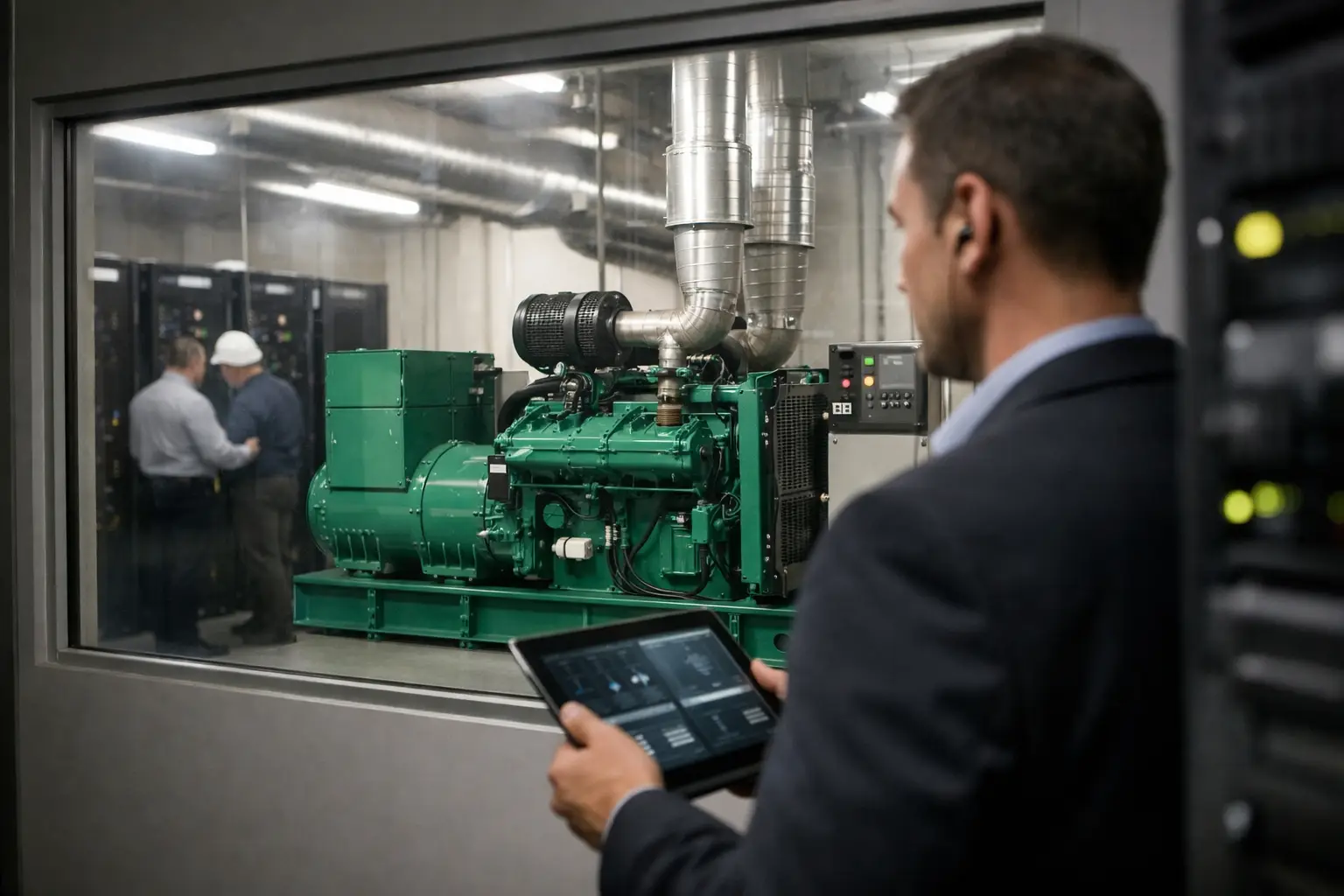
A generator that starts is not the same as a generator you can trust when a site is under pressure. Mission critical reliability is measured at the point of failure - when mains power drops, loads transfer, temperatures rise, and there is no room for delay, instability or operator guesswork.
For buyers responsible for hospitals, telecoms infrastructure, logistics hubs, manufacturing plants or major commercial buildings, the term gets used too loosely. Reliability in a mission-critical setting is not a marketing claim. It is the result of correct sizing, proven engine performance, proper alternator matching, suitable enclosure design, fuel resilience, controls integration and a supplier that understands the operational consequences of downtime.
Mission critical reliability is a system decision
The first mistake many teams make is treating the generator as a standalone product decision. In practice, generator performance sits inside a wider power continuity system that includes transfer switching, distribution, ventilation, fuel storage, maintenance access and the actual behaviour of the connected load.
That matters because even a high-quality set can underperform if the application has been poorly assessed. A generator selected only on headline kVA without reviewing starting currents, load step requirements or site conditions may look acceptable on paper and still fail in service. Mission critical reliability depends on how the complete installation behaves under stress, not simply on the nameplate rating.
This is why specification-led procurement is essential. Buyers need to know whether the duty is standby or prime power, whether the site requires single phase or 3 phase output, whether acoustic limits demand a silent generator, and whether access, ambient temperature or export conditions affect enclosure and cooling design.
What buyers should test when reliability matters most
In critical applications, the question is not whether a generator can run. The real question is whether it can carry the right load, in the right sequence, for the right duration, without introducing new operational risk.
Engine quality sits at the centre of that decision. Proven engine platforms matter because support, parts availability and known performance characteristics reduce uncertainty over the asset life. That is one reason many professional buyers favour recognised engine brands with an established service footprint.
Alternator performance matters just as much. Voltage stability, frequency control and transient response all affect how well a set handles real operating conditions. Sensitive equipment, motor starting and variable site loads can expose weak matching between engine and alternator very quickly.
Controls are another common weak point. A modern controller should provide clear operating data, alarm visibility, protection logic and practical integration with site systems. If operators cannot quickly identify faults, test status or fuel-related issues, a manageable event can become an outage.
There is also the question of enclosure format. Open generators may suit plant environments where access and ventilation are straightforward. Silent generators are often the better option where noise control, weather protection and external siting are part of the requirement. Reliability is not improved by choosing the wrong format for the site just because the base machine is sound.
Standby and prime power are not interchangeable
One of the clearest indicators of procurement risk is confusion between standby and prime ratings. This is not a minor technical distinction. It directly affects equipment life, available output and operating expectations.
A standby-rated generator is intended to supply emergency power during utility failure. A prime-rated generator is designed for longer-running use where utility supply is unavailable or unreliable. Using a standby set as though it were a prime power asset can shorten service life, increase maintenance pressure and create performance issues under sustained demand.
For mission critical reliability, duty classification must be settled early. Construction sites, remote facilities and temporary infrastructure often need prime-rated capability. Hospitals, data-linked telecoms facilities and commercial buildings with stable utility supply may need standby power with fast response and high confidence. The wrong decision at this stage can affect every later specification choice.
Sizing is where reliability is won or lost
Undersizing is the obvious problem, but oversizing should not be ignored either. A set that is too small may struggle with motor starts, load acceptance or peak demand. A set that is too large may run inefficiently at low load, creating avoidable operating issues over time.
Critical load analysis should look beyond total connected load. Starting currents, harmonic content, future expansion and staged transfer all need consideration. Some sites need a generator that can accept a large block load immediately. Others benefit from load sequencing that reduces the initial impact during transfer.
There is also the question of redundancy. In some applications, one correctly sized generator is enough. In others, parallel sets or additional contingency are justified because the cost of a single point of failure is too high. It depends on the site risk profile, maintenance philosophy and tolerance for outage.
This is where practical supplier input adds value. A serious supplier should ask how the load behaves, not just what headline capacity you think you need.
Reliability depends on speed of availability as well as build quality
For many projects, the ideal technical solution is not the only concern. Lead time matters. If a replacement set is needed quickly, or a project programme cannot tolerate extended factory wait times, stock availability becomes part of the reliability equation.
That may sound commercial rather than technical, but it is operationally important. A well-specified generator that arrives too late does not protect uptime. Buyers working to shutdown windows, construction deadlines or emergency replacement scenarios need suppliers who hold stock at relevant power bands and can respond quickly.
This is particularly important across common industrial requirements, from smaller commercial standby sets through to large 3 phase generators for heavy-duty applications. Range breadth allows specification to stay close to operational need rather than forcing compromises based on what happens to be available.
Maintenance and support are part of mission critical reliability
A reliable generator on day one is only part of the picture. The more serious question is whether it will remain dependable after repeated testing cycles, environmental exposure and real operating events.
Maintenance access, service intervals, consumables, parts availability and fault diagnostics all shape long-term performance. A site team that can inspect, test and service the equipment properly is far less likely to face avoidable failures. Equally, if support is slow or documentation is unclear, relatively minor issues can create major downtime risk.
Regular testing matters, but test regimes should reflect actual duty. A no-load exercise tells you less than many operators assume. Where practical, load testing gives a better indication of real response and system behaviour. Fuel condition, battery health and cooling performance should be monitored with the same seriousness as engine hours.
Mission critical reliability is sustained by discipline. It is not purchased once and forgotten.
How to assess mission critical reliability before you buy
The most dependable purchasing processes are usually the least dramatic. They begin with a clear load profile, duty classification and site constraint review. From there, buyers can assess the right kVA range, configuration and engine platform without relying on guesswork.
Ask direct questions. Is the rating standby or prime? Is the set suitable for the site environment? What enclosure options are available? How quickly can the unit be delivered? What support exists for commissioning, parts and ongoing service? If the application is critical, ask how the equipment performs under step load and what protection logic is built into the controls.
It is also sensible to look at commercial clarity. Reliable procurement requires transparent specification, pricing and availability. Vague answers usually lead to avoidable problems later.
For buyers who need a direct, specification-led route to backup or prime power, suppliers such as Global Generators are strongest when they combine recognised engine options, broad stock coverage and fast response to technical enquiries. In this market, confidence comes from detail.
The practical test is simple. If utility power failed tonight, would you trust the installed generator package to carry the site without hesitation - and could you explain exactly why? If the answer is uncertain, the specification needs more work before the risk becomes real.