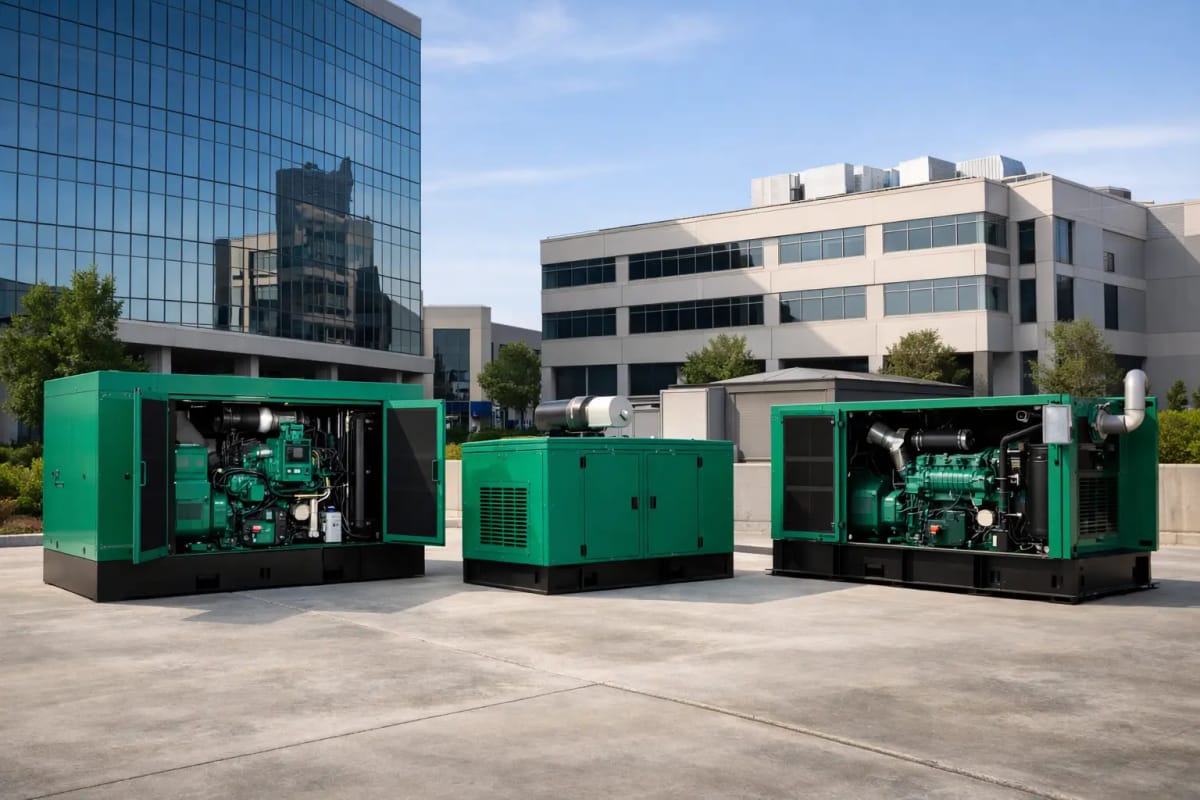
A power failure at a commercial site is rarely limited to lights going out. It can stop production lines, disable building-management systems, interrupt cold storage, halt loading bays and leave tenants without essential services. The best generators for commercial buildings are therefore not simply the largest available sets. They are correctly sized, correctly rated and configured around the loads that must remain operational.
For facilities managers, project engineers and procurement teams, the decision starts with the consequence of downtime. A small office with essential IT and emergency lighting has a different requirement from a logistics hub, private hospital, manufacturing plant or multi-tenant commercial development. The generator must support the required load, start reliably during a mains failure and operate for the duty cycle the site demands.
What makes the best generators for commercial buildings?
The strongest commercial generator specification balances capacity, engine quality, operating duty, noise control and maintainability. A proven diesel generator remains the standard choice for many commercial and industrial applications because it delivers high torque, practical fuel autonomy and dependable performance under sudden load changes.
For sites where failure is unacceptable, engine and alternator pedigree matter. Cummins-powered generator sets are widely specified for critical installations because they are built for demanding duty, supported by established parts networks and available across substantial power ranges. However, a recognised engine brand does not remove the need for correct system design. Poor load assessment, inadequate fuel storage or an unsuitable transfer arrangement can undermine an otherwise capable set.
The right machine also depends on whether the generator is required for standby or prime power. Standby-rated generators are designed to support a site during utility failure. Prime-rated units are intended for variable, extended running where mains power is unavailable or unreliable, such as construction compounds, remote facilities and temporary commercial operations. Selecting standby power for a regular prime-power application can shorten service intervals and create avoidable operational risk.
Start with the load, not the generator size
Generator capacity is commonly stated in kVA, but building demand is often recorded in kW. The relationship between the two is affected by power factor. As a simple indication, a generator rated at 500 kVA may provide around 400 kW at a 0.8 power factor, but the actual specification must account for the site’s electrical characteristics.
A proper assessment should establish the maximum essential load, the expected load profile and the largest motors or plant that will start while the generator is running. Lifts, pumps, compressors, refrigeration systems and air-handling equipment can draw a substantial starting current. If several loads start together, the voltage dip can affect controls, IT equipment and other sensitive circuits.
Do not size a set solely from the building’s incoming supply. The incoming connection may be designed for future expansion or include non-essential loads that do not need generator support. Equally, avoiding all headroom to reduce capital cost is a false economy. Commercial sites change. A modest allowance for future load, alongside clear load-shedding priorities, is usually more valuable than installing a set that is already operating at its limit.
Essential-load and whole-building strategies
Many commercial buildings do not need whole-site backup. A selective arrangement can supply fire and life-safety systems, emergency lighting, security, servers, critical process equipment and selected tenant services. This reduces generator size, fuel consumption and installation cost.
Whole-building backup can be appropriate where every interruption causes material loss, such as data-intensive operations, high-value storage, continuous manufacturing or large distribution sites. It requires a more detailed design, particularly where the building contains high inrush loads, multiple distribution boards or equipment with electronic speed drives.
Choosing the right generator configuration
Commercial buyers should compare generator sets by application, not just output. The following configurations each have a clear place in a commercial power strategy:
- Silent generators are supplied in acoustic enclosures and are generally preferred for offices, retail parks, healthcare settings, urban logistics sites and locations close to neighbours. The enclosure also provides weather protection, although access for servicing and airflow must be considered.
- Open generators are suited to plant rooms, purpose-built generator enclosures and protected industrial locations. They can be cost-effective where acoustic control is provided by the building or installation design.
- Three-phase generators are the normal choice for larger commercial buildings because they support three-phase distribution, motors and commercial plant. Voltage and frequency must match the site supply and connected equipment.
- Single-phase generators are generally reserved for smaller premises or specific single-phase loads. They are rarely the correct solution for a substantial commercial facility with three-phase plant.
An enclosed set is not automatically the quietest option in every installation. Exhaust discharge, radiator airflow and structure-borne vibration all influence the final noise level at the site boundary. Where planning conditions or neighbour sensitivity apply, assess the complete installation rather than relying on an enclosure’s quoted sound figure alone.
The equipment around the generator matters
A generator set is only one part of the standby power system. The automatic transfer switch, or ATS, detects utility failure and transfers the designated load to the generator once voltage and frequency are stable. The transfer arrangement must be sized for the electrical system and designed to avoid unsuitable switching sequences.
Fuel storage deserves the same attention as kVA rating. Runtime depends on generator load, tank capacity and fuel consumption, not a single headline figure. A hospital, logistics operation or remote commercial site may require extended autonomy, while an office site with dependable grid restoration may need less. Fuel quality, water contamination prevention and scheduled tank management are central to reliable starting, particularly where sets operate infrequently.
Battery chargers, jacket-water heaters and regular exercise arrangements help ensure a standby set is ready when required. For critical sites, remote monitoring provides early visibility of alarms, battery condition, fuel level and running status. It does not replace maintenance, but it gives operations teams time to act before a minor issue becomes a failure during an outage.
Commercial generator sizing by application
There is no universal kVA band for a commercial building, yet broad application patterns can guide an early enquiry. Smaller commercial premises may require sets from approximately 13 kVA upwards for essential lighting, security and limited IT loads. Larger offices, retail sites and workshops often need substantially more capacity, depending on HVAC, lifts and tenant demand.
Warehouses, manufacturing facilities, distribution centres and major mixed-use developments may require hundreds of kVA or multiple generators operating in parallel. Paralleling can provide capacity growth and resilience, but it introduces additional controls, switchgear and commissioning requirements. It is most valuable where one large set would create an unacceptable single point of failure or where load demand varies significantly.
For high-load applications, assess non-linear loads such as UPS systems, variable speed drives and modern IT equipment. These may introduce harmonics and affect alternator sizing. A specialist supplier should review the load schedule rather than assuming a standard generator-to-load ratio will be sufficient.
Questions to settle before buying
A productive commercial generator enquiry should include the required standby or prime rating, site voltage, phase requirement, expected runtime and installation location. It should also identify the largest starting loads, whether an ATS is required, acoustic constraints, fuel-tank requirements and any space or access limitations.
Ask how the set will be delivered, positioned, commissioned and serviced. A generator that fits electrically but cannot be safely craned into a basement plant room or maintained once installed is not a complete solution. For UK projects with tight programmes, stock availability and delivery speed can be as important as the final specification.
Global Generators supplies diesel generator sets from 13 to 3000 kVA, including silent, open, single-phase and three-phase options for standby and prime-power applications. For a commercial purchase, the practical route is to match the site load and duty requirement to an available set, then confirm the control, fuel and installation scope before placing an order.
The best result is a generator that is quiet enough for its location, large enough for the real starting and running load, and maintained well enough to start without hesitation when the grid does not.