A generator that starts on command is only part of the picture. If it cannot carry its rated load for the required duration, it is not protecting the site when mains power fails. That is why generator load bank testing matters for hospitals, data environments, manufacturing plants, logistics facilities and any operation where downtime has a direct operational cost.
For buyers and operators of standby power equipment, load bank testing is not a box-ticking exercise. It is a controlled way to prove that a generator set, its alternator, engine, cooling system and controls can perform under genuine demand. It also exposes problems that often stay hidden during no-load or light-load running.
What generator load bank testing actually does
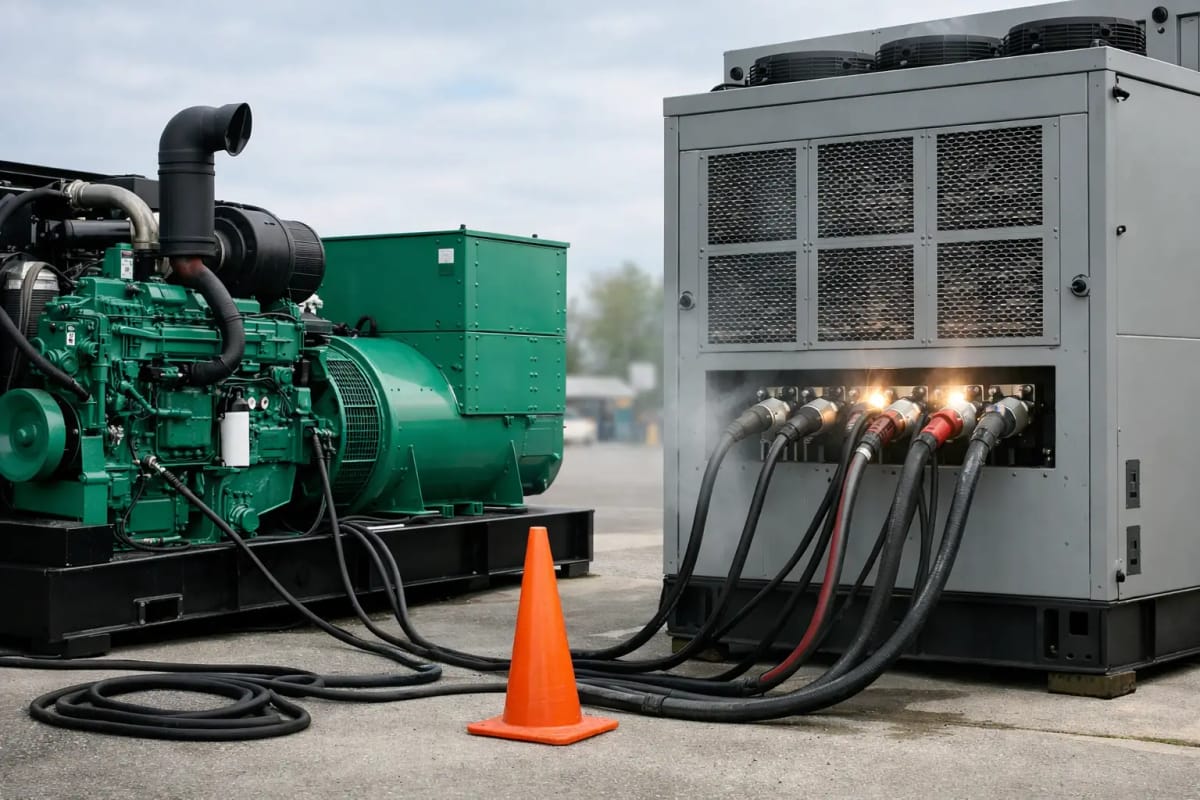
Generator load bank testing applies an artificial electrical load to a generator so the set can be assessed under measurable conditions without relying on the building's own connected equipment. Instead of waiting for a real outage to discover whether the machine performs correctly, the test creates that demand in a planned environment.
In practical terms, a load bank allows engineers to step the generator through defined percentages of its rated capacity, often 25, 50, 75 and 100 per cent, while monitoring voltage, frequency, temperature, oil pressure and overall stability. On larger or more critical installations, testing may include extended run periods, transient response checks and system-level verification with switchgear and automatic transfer arrangements.
This matters because a diesel generator can appear healthy during short unloaded starts but still struggle when asked to support a full building load. Fuel delivery issues, governor faults, cooling deficiencies, alternator weaknesses and control problems often only show themselves once the set is working properly.
Why load bank testing matters on standby diesel generators
Standby generators spend most of their life waiting. That idle profile creates its own risk. When engines run lightly loaded for repeated test cycles, combustion temperatures stay lower than intended. Over time, this can contribute to wet stacking, carbon build-up and reduced engine efficiency.
Generator load bank testing helps counter that by bringing the engine up to a meaningful operating level. It proves the machine can maintain output and also helps clean out deposits associated with prolonged light-load operation. For mission-critical assets, that is not a minor maintenance benefit. It is part of keeping the set ready for a genuine outage.
There is also a commercial point here. Facilities teams and procurement managers are often judged on resilience, not just purchase price. A generator with an attractive specification on paper still needs validation in service conditions. A proper test provides evidence that the installed asset matches the expected standby duty.
Generator load bank testing during commissioning
The most valuable time to test is often before the generator is fully relied upon. During commissioning, load bank testing confirms that installation quality matches equipment specification. Cable terminations, exhaust routing, ventilation, fuel supply, control integration and breaker operation can all affect performance.
For a newly installed set, the test answers straightforward but important questions. Can it achieve stable rated voltage and frequency? Does it carry step loads without unacceptable dip? Does coolant temperature remain controlled over time? Do alarms, shutdowns and instrumentation operate correctly?
On larger projects, especially where multiple generators operate in parallel, commissioning tests are even more important. Synchronisation, load sharing and control logic need to be proven under managed conditions. Sites with life safety obligations or process-critical operations should not leave that to assumption.
When periodic testing is the right choice
One successful commissioning test does not remove the need for future verification. Periodic load bank testing is often appropriate where generators see little real demand, where site load has changed, or where compliance and resilience standards require regular proof of performance.
The interval depends on the application. A hospital, telecoms site or data-led operation may need more rigorous testing than a small commercial building with lower outage impact. Runtime history matters as well. If a generator regularly supports substantial building load during utility failures, separate load bank sessions may be less frequent than on a unit that only ever runs for short weekly exercises.
It also depends on the set itself. Older generators, machines with incomplete service records, or units exposed to harsh site conditions can benefit from closer monitoring. The aim is not to test for the sake of testing. It is to reduce uncertainty around equipment that protects critical operations.
What a proper test should assess
A credible test is more than connecting a resistive bank and watching the set run. It should record how the generator behaves across the load profile and whether the complete system remains within acceptable limits.
Engine performance is central. The set should accelerate cleanly, hold frequency, maintain oil pressure and operate within temperature limits. The alternator must sustain voltage and current output without instability. Controls should report accurately, and protective functions should trigger correctly when simulated faults or threshold conditions are introduced.
Just as important is duration. A generator that carries full load for a few minutes may still reveal cooling or fuel system weaknesses over a longer period. The right test length depends on rating, duty, ambient conditions and site criticality. There is no single universal script.
For some sites, reactive load capability may also matter, particularly where the connected electrical profile is not purely resistive. That is one reason testing should reflect the actual application rather than follow a generic checklist.
Common faults revealed by load bank testing
One reason this testing remains valuable is that it exposes issues that routine visual inspection may not. A set can look well maintained and still have performance limitations.
Typical faults include overheating under sustained load, unstable voltage regulation, poor frequency control, fuel starvation, turbocharger inefficiency, blocked filters, weak batteries, cooling airflow problems and incomplete combustion linked to long periods of light running. On control systems, alarm set-points, sensors and shutdown logic can also prove inaccurate once the machine is under pressure.
These problems vary in seriousness. Some are straightforward service items. Others indicate that the generator has been undersized, poorly installed or operated outside the intended duty profile. Either way, finding them during a planned test is far preferable to finding them in the middle of a power failure.
Load bank testing and generator sizing
Load bank results can also inform future procurement. If a site repeatedly operates a large standby generator at very low demand, that may point to oversizing. Oversized diesel sets are common where expansion plans never materialised or where buyers selected capacity with too much margin.
The trade-off is clear. Too small, and the generator may not support starting currents or peak load. Too large, and the set can spend years running inefficiently at light load, increasing the risk of wet stacking and avoidable maintenance issues. Testing helps clarify where the operating point really sits.
For buyers reviewing replacement strategy, this is useful evidence. It supports better decisions on kVA rating, enclosure type, duty classification and whether a single larger unit or multiple smaller sets would suit the site more effectively.
Choosing the right approach for critical sites
Not every generator installation needs the same testing regime. A temporary construction application has different priorities from a healthcare facility or a manufacturing process line with high restart costs. The right approach depends on operational risk, maintenance history, actual site load and the role of the generator within the wider power system.
For some operators, a periodic resistive test is enough to confirm basic engine health. For others, especially where UPS systems, transfer panels and parallel generator controls are involved, a broader integrated test is the better option. What matters is that the test reflects the real consequence of failure.
That is where technical support from a specification-led supplier can make a difference. A business such as Global Generators works with buyers who need dependable standby and prime power equipment matched to site demand, not generic assumptions. Load testing is part of that broader reliability picture.
The commercial value of proving performance
There is a tendency to see testing only as a maintenance cost. For serious operators, it is better understood as risk control. A failed generator event can stop production, interrupt patient services, compromise refrigerated stock, bring telecoms assets offline or force an evacuation of critical areas. Against those outcomes, proving generator performance is a practical operational measure.
It also supports internal reporting. Facilities managers and engineers are often required to show that backup systems are fit for purpose. Test records provide evidence for audits, insurance discussions, compliance reviews and capital planning.
A standby generator is purchased for the moment normal power disappears. If that asset has not been properly proven under load, the site is relying on assumption rather than engineering evidence. The sensible position is simple: test the set as it will be expected to perform, then make decisions with the data in hand.