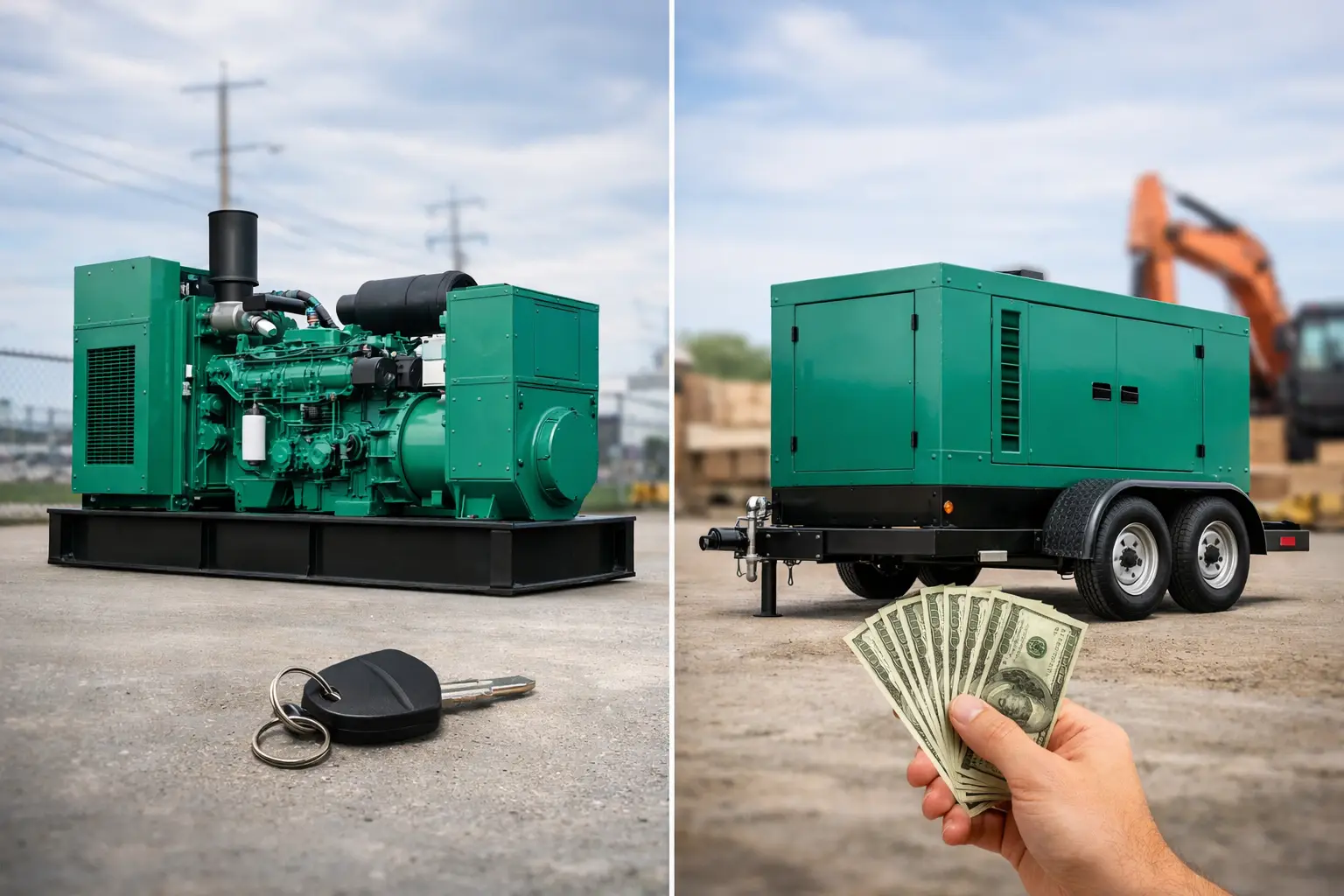
A generator decision usually gets urgent when the risk of outage becomes real - a new site is opening, grid reliability is deteriorating, a contract has been won, or resilience standards have tightened. At that point, generator rental vs purchase is not a theoretical procurement exercise. It is a practical decision about uptime, cash flow, deployment speed and operational control.
For some buyers, rental is the right commercial answer. For others, buying is the only sensible route because the unit will become a long-term asset supporting a fixed load profile. The correct choice depends less on headline price and more on how the generator will be used, how critical the load is, and how much certainty exists around duration, site conditions and future demand.
Generator rental vs purchase for critical power
If the requirement is short-term, uncertain or tied to a temporary site, rental often makes sense. Construction projects, planned shutdowns, seasonal peaks, emergency response and bridging power during utility upgrades are common examples. In these cases, speed and flexibility usually matter more than ownership.
If the requirement is permanent or near-permanent, purchase tends to offer better long-term value. That is particularly true where a facility has a defined standby need, a stable load profile, and a clear requirement for a specific configuration such as a silent generator, open set, single phase unit or 3 phase generator. Ownership gives the operator direct control over specification, maintenance planning and lifecycle cost.
The mistake is to frame the decision as rental being cheaper or purchase being cheaper in absolute terms. Either option can be more expensive if it is used in the wrong scenario.
When rental is the better option
Rental is strongest where time, flexibility and temporary demand are the main drivers. If a site needs power next week, not next quarter, a ready-to-deploy hire unit can reduce programme risk. That matters on construction projects, temporary compounds, events infrastructure, utility works and emergency replacement situations.
It also suits projects where the load is still changing. Early-stage developments often do not yet have a settled power profile. A contractor may start with welfare units and small tools, then move to tower cranes, batching equipment or temporary cabins. In that situation, committing capital too early to a fixed asset can be inefficient.
Rental can also simplify commercial risk. Instead of tying up budget in a generator that may only be needed for six months, the business pays for the period of use. That can be easier for short contracts or one-off jobs where equipment ownership offers little residual value.
There is another practical point. Temporary power packages often involve more than the generator itself. Distribution boards, cabling, synchronisation, fuel management and service response may all need to be arranged. For many buyers, especially under deadline pressure, a rental route can reduce the coordination burden.
The trade-off is that rental costs accumulate. A weekly or monthly rate may look manageable at first, but over an extended period it can exceed the cost of ownership by a wide margin. Rental also leaves less control over exact unit selection if availability is tight.
When purchase is the better option
Purchase becomes more attractive when the generator will support an ongoing operational need. A manufacturing plant with standby requirements, a logistics facility protecting cold storage, a healthcare setting safeguarding continuity, or a telecoms site relying on prime or backup power all have one thing in common: power resilience is not temporary.
In these environments, buying allows the equipment to be specified around the application rather than adapted from what is available in a hire fleet. That matters because generator performance is application-specific. Starting currents, motor loads, harmonics, ambient conditions, duty cycle, acoustic requirements and site footprint all affect correct sizing and configuration.
Ownership also improves lifecycle visibility. The buyer knows the engine platform, alternator, enclosure type, control system and rating from day one. Maintenance can be aligned with site schedules. Fuel storage and changeover arrangements can be engineered properly. If the set is mission-critical, service strategy can be built around the actual installation rather than a temporary workaround.
For long-duration use, the financial case for purchase is often straightforward. Once the utilisation period extends beyond a certain threshold, rental stops being a flexible solution and starts becoming an expensive one. Capital expenditure may be higher at the outset, but the asset then continues to deliver value over years rather than months.
Cost is more than hire rate versus purchase price
Procurement teams often begin with the obvious comparison: rental charges versus the purchase price of a new set. That is necessary, but it is not enough.
A proper assessment should include transport, installation, fuel consumption, servicing, compliance requirements, load bank testing where relevant, switchgear integration, operator access, acoustic treatment and expected utilisation. For a purchased generator, depreciation, maintenance contracts, parts support and residual value should also be considered. For a rental generator, contract extensions, call-out terms, fuel logistics and availability during peak demand periods can materially affect the final cost.
Downtime risk must sit in the calculation as well. If a site loses production, refrigeration, communications or life-safety support during a power issue, the cost of being under-prepared can exceed the equipment cost itself. That is why the cheapest option on paper is often not the most economical one in service.
Usage pattern should drive the decision
The simplest question is this: how often will the generator run, and for how long?
If the set is for occasional standby use with regular testing at a fixed site, purchase is usually logical. The generator becomes part of the facility infrastructure. It can be sized accurately, installed correctly and maintained for dependable readiness.
If the set will move from project to project, or if the need may disappear when a contract ends, rental may be more appropriate. Mobility changes the economics. So does uncertainty.
Prime power applications need especially careful thinking. If the generator is expected to run as the main power source for extended periods, the specification must match that duty. A standby-rated set chosen on price alone can become a costly mistake if the application requires continuous or prime operation. This is where a specification-led supplier approach matters more than a generic equipment comparison.
Lead times, availability and deployment pressure
There are situations where the purchase-versus-rental question is answered by timing rather than preference. If a unit is needed immediately, rental may be the only practical way to maintain operations while a permanent generator is sourced and installed.
Equally, if a supplier holds stock in the right kVA range and configuration, purchase can be far quicker than many buyers assume. Fast availability changes the equation, especially for buyers who need dependable standby power without accepting long project delays.
This is why lead time should be assessed early. A technically correct buying decision can still fail if the delivery schedule does not match the risk window.
Specification matters more than ownership model
Whether renting or buying, the wrong generator is still the wrong generator. Capacity must be matched to actual site demand, including starting loads and future headroom. Voltage, phase, enclosure type, sound attenuation, fuel autonomy and operating environment all need to be accounted for.
A hospital, data room, quarry, warehouse and construction compound may all ask for a diesel generator, but the operating demands are not the same. One site may prioritise low noise, another weather resistance, another synchronisation capability, and another fuel efficiency under variable load. The ownership model does not remove the need for correct engineering.
Buyers should also think beyond the set itself. Changeover equipment, installation layout, exhaust routing, maintenance access and compliance obligations can all influence whether rental or purchase is more practical.
A straightforward way to decide
If the requirement is temporary, mobile, urgent or uncertain, rental is often the safer commercial choice. If the requirement is fixed, long-term, mission-critical or specification-sensitive, purchase usually provides better control and stronger value over time.
There is a middle ground as well. Some organisations rent first to cover immediate risk, then purchase a permanent unit once the load profile and site design are confirmed. That approach can be sensible where programme deadlines are tight but long-term resilience is non-negotiable.
For serious power users, the decision should not be driven by a generic rule. It should be based on duty, duration, load, risk and deployment speed. When those factors are clear, generator rental versus purchase becomes much easier to assess - and much less likely to create problems later.
If the cost of downtime is high, treat the generator as an operational decision first and a buying decision second.