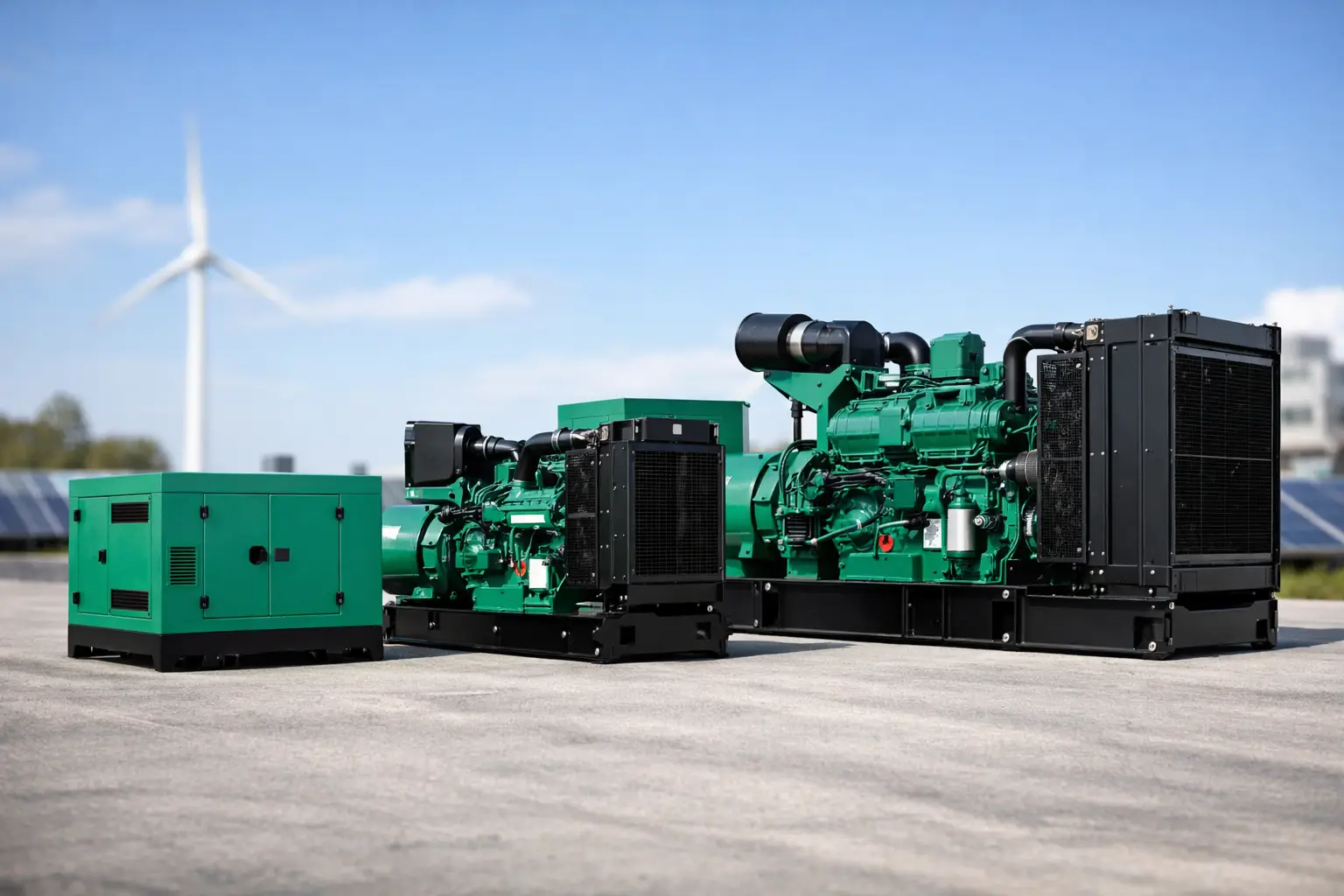
When a site loses power, the question is rarely whether a generator is needed. The real issue is capacity. The most popular diesel generator sizes tend to cluster around common building loads, standard plant requirements, and practical transport limits, which is why certain kVA bands appear again and again across construction, healthcare, logistics, telecoms, manufacturing, and commercial facilities.
For buyers comparing options, popularity matters because it usually reflects proven demand, faster availability, and simpler specification. It does not automatically mean a given size is right for your application. A warehouse with modest lighting and door systems has very different load behaviour from a factory with motors, compressors, and fluctuating process demand. The right generator size sits at the point where reliability, starting performance, fuel efficiency, and capital cost remain in balance.
Why the most popular diesel generator sizes cluster around key kVA bands
In the UK market, generator demand is rarely spread evenly across every possible output. Instead, it tends to concentrate around practical ranges such as 20-30 kVA, 40-60 kVA, 80-100 kVA, 150-200 kVA, 250-500 kVA, and larger containerised sets beyond that. These are the sizes that repeatedly suit common applications without forcing buyers into unnecessary overspend.
There are several reasons for this. First, many sites have load profiles that naturally fall into these brackets. Second, standard alternator and engine pairings are often optimised around these outputs, making them easier to source and support. Third, transport, acoustic enclosure design, and on-site installation become more predictable at established size points.
For procurement teams, common sizes also tend to mean better stock coverage and shorter lead times. A specialist supplier holding popular kVA ratings can usually respond faster than one sourcing an unusual specification from scratch.
Small diesel generator sizes - 13 to 30 kVA
At the lower end of the range, 13-30 kVA sets are commonly used for smaller commercial premises, residential backup, telecoms infrastructure, farms, workshops, and light site power. These units are popular because they cover essential circuits without taking up excessive space or budget.
In practice, this size range suits loads such as lighting, alarms, access systems, small pumps, refrigeration, office equipment, and limited HVAC support. They are also a practical option where single phase or smaller three phase requirements need dependable standby protection.
The trade-off is headroom. A 20 kVA set may keep critical services live, but it will not tolerate much scope creep if more circuits are added later. Buyers often underestimate motor starting demand in this range, especially with pumps and compressors. On paper the running load may look acceptable, but the starting current can push the set beyond comfortable operating margins.
Mid-range popular sizes - 40 to 100 kVA
This is one of the busiest parts of the market. Generators from 40-100 kVA are widely specified for offices, retail units, schools, clinics, smaller industrial buildings, mobile welfare facilities, and construction compounds. They offer enough capacity to support broader building services while remaining manageable in footprint and installation terms.
A 40-60 kVA generator is often selected where the priority is to keep key systems operational rather than carry the full building load. A 60-80 kVA unit is a common choice for mixed loads with moderate motor demand. Around 100 kVA, buyers gain more flexibility for larger HVAC components, heavier three phase demand, and future resilience.
This range is popular because it bridges the gap between light commercial backup and more serious operational continuity. It is also where enclosure choice becomes particularly important. For urban or occupied sites, silent generators are often preferred to control noise. For plant areas or temporary installations where acoustic performance is less critical, open sets may be considered if the installation environment supports them.
The most popular diesel generator sizes for industrial and larger commercial use - 125 to 250 kVA
Once demand moves into larger buildings and industrial processes, 125-250 kVA becomes a very common buying band. These sets are regularly used for manufacturing units, larger care environments, data-heavy facilities, logistics operations, hotels, major office blocks, and utility support applications.
A 150 kVA or 200 kVA generator often sits in the sweet spot for sites that need a serious standby capability without stepping into the complexity and cost of very large multi-set systems. These ratings can support substantial building services, distribution boards, mechanical systems, and selected process loads. They are also common where buyers want a margin above current demand to reduce strain and allow for controlled growth.
However, bigger is not always better. Oversizing a diesel generator can lead to inefficient running and underloaded operation, particularly where the set spends long periods at very low demand. That affects fuel use and, over time, can create maintenance concerns. The best specification is not the largest unit you can afford. It is the unit that matches actual operating conditions, starting characteristics, and duty profile.
Large generator sizes - 300 kVA and above
From 300 kVA upward, applications become more infrastructure-led. These generators are widely used in hospitals, large manufacturing plants, utilities, major commercial estates, data environments, water treatment operations, and high-demand construction projects. As outputs rise through 500 kVA, 1000 kVA, and into multi-megawatt territory, buyers are usually planning around critical uptime, phased load management, and engineered resilience rather than basic backup.
At this level, the most popular sizes often align with standard industrial power blocks. A 400 kVA or 500 kVA set is frequently used as a single substantial standby unit. Larger sites may install multiple generators in parallel instead of relying on one very large machine. That approach can improve redundancy, maintenance flexibility, and staged loading.
Prime power and standby power also need to be treated carefully here. A standby-rated set designed for emergency use is not the same as a prime-rated unit expected to carry regular or continuous operational demand. Buyers who blur that distinction can end up with the wrong machine for the duty.
What actually determines the right size
The popularity of a generator size should only be a starting point. Final selection depends on your load list, starting sequence, duty type, site conditions, and configuration requirements.
The first consideration is whether the generator is supporting the whole site or only essential loads. Many facilities do not need to back up every circuit. By separating critical and non-critical demand, buyers can often specify a more efficient and commercially sensible set.
The second is load behaviour. Resistive loads such as lighting are relatively straightforward. Motor loads are not. Pumps, fans, compressors, and refrigeration plant may need significantly more power at start-up than during normal operation. If several items start together, the generator has to absorb that transient demand without unacceptable voltage or frequency dip.
The third is phase and voltage. Single phase generators may suit smaller properties and specific equipment, but most commercial and industrial applications require three phase output. Selecting the wrong format creates unnecessary installation and operational problems.
The fourth is duty. A standby generator for infrequent outages can be sized and specified differently from a prime power unit expected to support regular operation in remote or unstable grid conditions.
A practical way to assess diesel generator sizes
A sound sizing exercise starts with a proper schedule of connected loads and their running and starting characteristics. From there, you establish what must run immediately, what can be delayed, and what can remain off during an outage. That staged approach often changes the required kVA more than buyers expect.
You then check power factor, site altitude, ambient temperature, and any non-linear loads that may affect alternator performance. If the generator is feeding sensitive electronics or variable speed equipment, the quality of the specification matters as much as the headline output.
Finally, you decide on enclosure type, fuel tank capacity, changeover arrangement, and whether the project requires a single set or a parallel solution. This is where stock availability and technical support become commercially valuable. Global Generators, for example, focuses on key industrial sizes because buyers in this market typically need dependable availability as much as they need the right rating.
Popular does not mean interchangeable
Two 100 kVA generators can look similar on paper and behave very differently in service depending on engine quality, alternator design, control system, acoustic package, and standby or prime rating. This matters most where the consequences of failure are expensive or unsafe.
That is why specification-led buying usually produces better results than chasing a headline price. The most popular diesel generator sizes are popular for good reason, but the correct purchase still depends on how your site loads, starts, switches, and operates under real conditions.
If you are narrowing down options, treat the common kVA bands as a useful reference point rather than a shortcut. The best generator is the one that carries the load properly on the day the mains fails, not the one that merely looked about right on a spreadsheet.