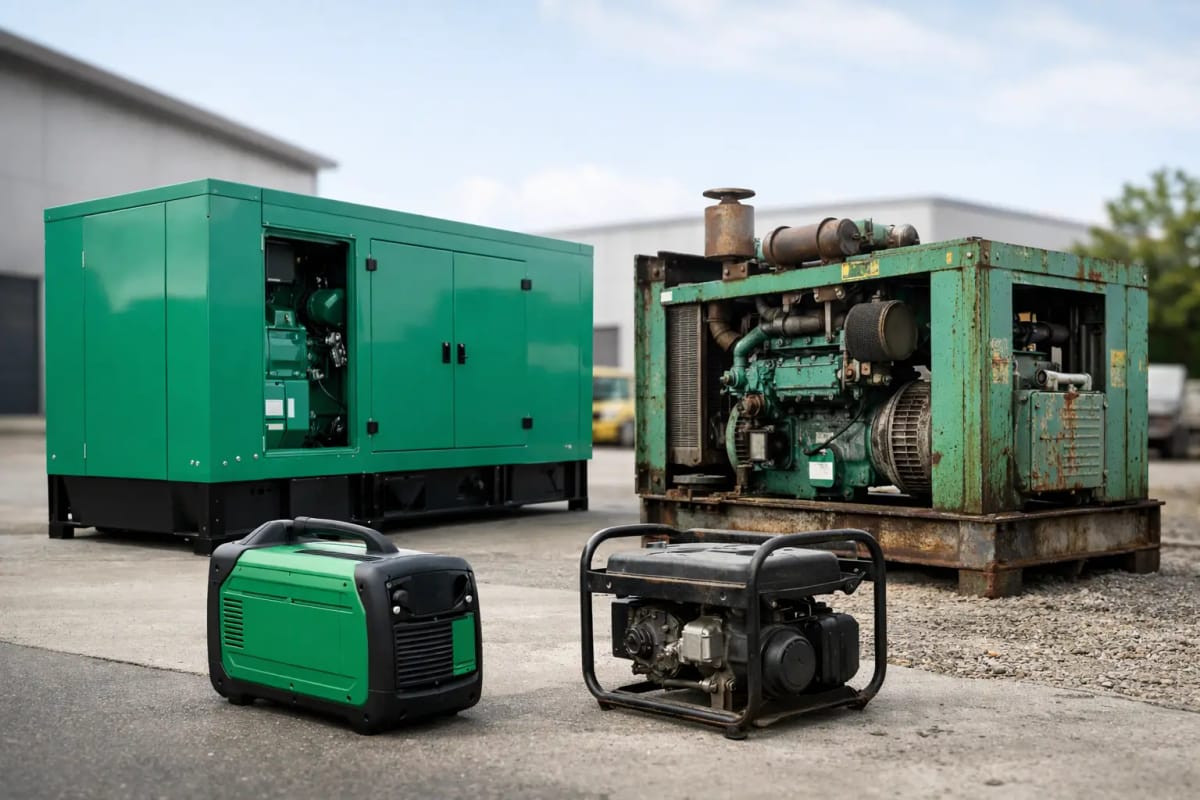
A generator purchase usually looks straightforward until the real question lands on the table: do you protect budget now, or do you protect risk over the next five to ten years? For buyers weighing new vs used generators, that decision affects far more than capital cost. It affects uptime, service planning, compliance, lead time and how much operational exposure your site can realistically accept.
For a residential backup unit, a used set may be a workable compromise. For a hospital plant room, a data-led logistics site, a live construction project or a manufacturing facility with tight production windows, the answer is often less flexible. The right choice depends on duty, criticality and the quality of information available about the machine itself.
New vs used generators: the real decision
The market often frames this as a simple price comparison. It is not. A generator is a power asset with a defined operating history, maintenance burden and remaining service life. Two units with the same kVA rating can represent very different levels of risk depending on engine hours, load profile, alternator condition, control system age and whether the package was built for standby or prime operation.
A new generator gives you a known starting point. You know the specification, the engine platform, the emissions standard where relevant, the enclosure type, fuel consumption data and the warranty position. That matters when the application is sensitive and downtime carries financial or safety consequences.
A used generator can reduce initial spend, and in some cases significantly. That has obvious appeal for temporary works, secondary backup or projects with a constrained capital budget. But the lower purchase price only makes sense if the unit is properly assessed and the remaining life is sufficient for the intended duty.
When a new generator is the stronger commercial choice
New equipment is usually the safer decision for mission-critical standby and continuous-use environments. The reason is not simply that it is unused. It is that the full asset life is ahead of you, and the specification can be matched precisely to site requirements from the start.
If you are buying for a healthcare site, telecoms installation, utilities application or industrial facility where failure is expensive, new equipment gives stronger control over reliability. You can select the correct standby or prime rating, choose silent or open configuration, specify single phase or 3 phase output, and align the set with the expected load characteristics rather than adapting your site around what is available in the second-hand market.
There is also a practical procurement advantage. A new set from a specialist supplier should come with documented technical data, clear rating information and a traceable build standard. For procurement teams and engineers, that makes approval easier. For operations teams, it simplifies maintenance planning because service intervals, parts support and expected wear are predictable.
Warranty is another factor. A new generator typically includes manufacturer or supplier-backed warranty cover, and that has value beyond the paperwork. It reduces exposure in the early operating period, when any installation, commissioning or component issue is most likely to surface.
Where used generators can make sense
Used generators are not automatically a poor option. In the right application, they can be commercially sensible and technically adequate.
A used set can work well where the duty is occasional, the site can tolerate a higher maintenance burden, or the machine is being purchased for short to medium-term deployment. Contractors, temporary facilities, seasonal operations and some lower-risk commercial sites may find used equipment gives acceptable performance at a lower upfront cost.
The key point is that a used machine should be bought on evidence, not assumption. A low-hours unit with a strong service record, a recognised engine platform and a documented test history may represent better value than a cheaper but poorly documented alternative. In this market, provenance matters.
If you are buying used because availability is more important than factory-new lead times, that can also be justified. A stocked, inspected used generator can help bridge an urgent requirement, particularly where site energisation or contingency planning cannot wait.
Cost is not the same as value
The headline price gap between new and used equipment can be substantial, but procurement decisions should be based on total cost over the life of the asset.
A new generator generally costs more upfront and less in uncertainty. A used generator generally costs less upfront and more in inspection, maintenance and contingency planning. The difference sits in the unplanned events. If a used set requires injector work, control panel replacement, alternator repair or cooling system attention within the first year, the original saving can narrow quickly.
Fuel efficiency also deserves attention. Older units may not deliver the same operating efficiency or control sophistication as current models, especially under variable loading. On a lightly used standby set that may be marginal. On a prime power application, fuel consumption differences become commercially significant over time.
Then there is residual value. A well-specified new generator from a recognised engine platform typically holds value better and is easier to support over its service life. That matters if the asset may later be redeployed, sold or incorporated into a broader fleet strategy.
What to check before buying a used generator
If a used unit is under consideration, due diligence should be uncompromising. Engine hours are important, but they are not enough on their own. A low-hours machine that has been poorly stored or irregularly exercised can still present risk.
Start with service history. You want records that show routine maintenance, any major component replacements and evidence of load testing. Ask how the set was used. Standby operation with periodic testing is very different from sustained prime duty on a demanding site.
Inspect the package as a complete system, not just the engine. The alternator, controller, fuel system, cooling pack, breakers, acoustic enclosure and baseframe all affect reliability. Signs of corrosion, fluid leaks, wiring modifications or poor repair work should be taken seriously.
It is also worth checking parts support and control system age. An older generator may still run well, but obsolete controllers or limited parts availability can make future maintenance slower and more expensive. Buyers focused on uptime should pay close attention here.
Load bank test evidence is especially useful. A proper test helps verify voltage stability, frequency control and operational behaviour under demand. Without that, you are relying too heavily on appearance and seller assurance.
Specification fit matters more than the age label
One of the most common buying mistakes is choosing a generator based on whether it is new or used before confirming whether it is actually correct for the load.
An undersized new unit is still the wrong asset. An oversized used unit may introduce poor load performance, higher running costs and inefficient operation. The starting point should always be site demand, load type, starting currents, redundancy expectations, environmental conditions and whether the duty is standby or prime.
Configuration matters as well. Some buyers need a silent generator because the installation is near occupied buildings or subject to local noise limits. Others require an open set for plant room integration. Some applications need 3 phase distribution with specific voltage requirements. These are specification decisions first and purchase-path decisions second.
This is where supplier knowledge becomes critical. A dependable supplier should help narrow the choice based on duty profile and operational risk rather than simply offering the lowest-cost unit available.
Lead time, availability and project pressure
In live projects, timing can force the decision. If a site must be energised quickly, the best technical answer is only useful if it can be delivered in time.
New equipment can involve production lead times, especially for larger kVA ranges or bespoke configurations. Used equipment or in-stock new units may therefore become more attractive when programme pressure is high. For contractors and facilities teams dealing with failure recovery or temporary resilience planning, immediate availability can outweigh the preference for a factory-new machine.
That said, urgency should not remove technical discipline. A fast purchase that creates months of reliability issues is not a saving. It is just deferred cost.
Which option is right for your site?
If the site is business-critical, if the generator will support life safety, core operations or continuous production, new equipment is usually the stronger long-term decision. It gives clearer warranty support, known specification, better lifecycle planning and lower uncertainty.
If the duty is less critical, the budget is constrained, or the asset is needed for a shorter period, a used generator may be entirely appropriate - provided it has been properly assessed and comes from a credible source.
For many buyers, the answer is not ideological. It is operational. The right purchase is the one that matches risk tolerance, runtime profile, budget and availability. Global Generators supports that decision with stocked generator options across key power sizes, helping buyers move quickly without losing sight of technical fit.
The most reliable buying position is simple: treat the generator as a long-term power asset, not a box with an engine. When you do that, the better option usually becomes clear.