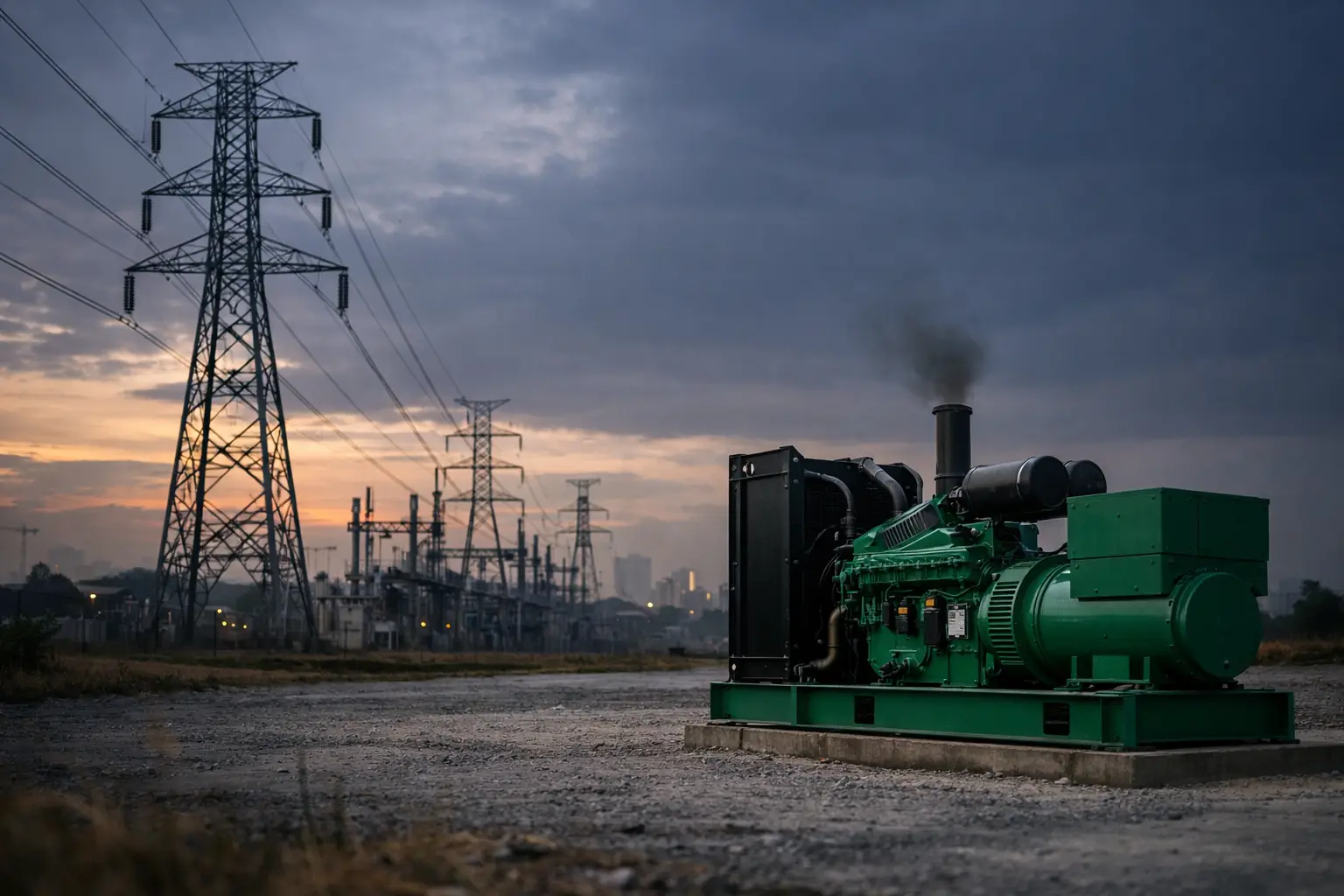
A grid reading of zero is not a routine supply interruption. When Nigeria's grid has fallen to zero, it indicates that generation available to the national transmission system has collapsed or been disconnected to the point that the grid cannot supply customers. For hospitals, telecoms networks, factories, logistics operators and water infrastructure, the immediate issue is not the headline. It is whether onsite power starts, accepts the load and continues to run for as long as restoration takes.
A national grid collapse exposes the gap between having a generator on site and having a dependable power continuity system. The difference is determined by capacity, starting performance, fuel security, switching equipment and maintenance discipline. Those factors need to be specified before the next outage, not assessed during it.
When Nigeria's grid has fallen to zero, what happens?
Electricity grids must maintain a close balance between generation and demand. If large generating stations trip, transmission faults spread, or the system becomes unstable, frequency can fall outside safe operating limits. Protective systems then disconnect equipment to prevent damage. What begins as a regional fault can become a full or near-full system collapse within minutes.
A zero-generation or zero-grid reading does not mean every generator in the country has stopped. It means central grid supply is unavailable. Sites with capable standby or prime-power systems may continue operating independently, while unprepared facilities move immediately to darkness, process shutdown or manual contingency procedures.
Restoration is rarely instant. Grid operators must bring generation back in stages, energise transmission routes, stabilise frequency and reconnect load carefully. This process can take hours and, depending on the fault, the available generation and transmission constraints, may be uneven across regions. A site designed only for a short utility interruption can therefore face a much longer operating period on generator power.
The operational cost is wider than lost lighting
For a production plant, an unplanned power loss may stop conveyors, pumps, compressors, furnaces and control systems in the wrong sequence. Restarting safely can take longer than the outage itself. Material may be wasted, equipment may require inspection, and production schedules can be missed.
Healthcare facilities have a different exposure. Life-safety systems, theatres, diagnostic equipment, cold storage and critical IT require an orderly transfer to emergency power. The generator set must start promptly, but it must also sustain the actual load without unacceptable voltage or frequency variation.
Telecoms sites, data rooms and security infrastructure rely on continuity at a much smaller timescale. Battery-backed UPS systems cover the seconds before a generator assumes the load. If the generator, automatic transfer switch or fuel system fails, communications and monitoring can disappear when they are needed most.
For warehouses, ports and commercial facilities, the commercial effect can be equally serious. Dock equipment, refrigeration, access control, billing platforms and fire systems may all depend on reliable electrical supply. The appropriate response is not necessarily to buy the largest available generator. It is to identify the loads that must remain live, their starting characteristics and the required runtime.
Standby power versus prime power
The first specification decision is the intended duty. A standby-rated generator is designed for emergency use during utility failure, normally with limited annual operating hours and variable load. It is suitable where the mains supply is generally dependable and the generator exists to protect against exceptional events.
Where grid interruptions are frequent or prolonged, a prime-power rating may be more appropriate. Prime-rated sets are built for variable load over extended periods, subject to the manufacturer’s operating limits and maintenance schedule. They are the better fit for facilities that expect the generator to carry the site repeatedly, or for projects without a stable utility connection.
This distinction has a direct cost and lifecycle implication. A standby set may have a lower initial specification, but operating it as a de facto prime-power asset can accelerate wear, increase service requirements and reduce reliability. Procurement teams should assess actual outage duration and frequency rather than select a rating based on purchase price alone.
Correct sizing starts with the load, not the kVA label
Generator capacity is commonly expressed in kVA, while many site loads are measured in kW. The relationship depends on power factor. At a power factor of 0.8, a 500 kVA generator provides 400 kW of active power. That simple calculation is useful, but it is not a complete sizing exercise.
Motor-driven loads can require high starting current. Pumps, chillers, compressors, cranes and large fans may impose a substantial transient demand as they start. If the generator is too small, voltage can dip, frequency can fall and control systems may trip. If it is significantly oversized and operated at very low load for long periods, diesel engines can suffer from poor combustion and wet stacking.
A proper load assessment considers running load, motor starting method, harmonic loads, load sequence, future expansion and required load acceptance. Variable-speed drives, UPS systems and non-linear electronic loads also need attention because they can affect alternator performance and voltage waveform quality.
For larger sites, multiple generators operating in parallel can provide a more controlled solution than one oversized machine. Paralleling allows staged capacity, maintenance without total loss of protection and improved fuel efficiency at lower demand. It adds controls and commissioning complexity, so the operational benefit must justify the additional investment.
Transfer systems matter as much as the generator
A generator set cannot protect a facility if power transfer is manual, poorly rated or incorrectly configured. An automatic transfer switch detects utility failure, sends a start signal, transfers the designated load once generator supply is stable, and returns the load when the mains is restored. Its settings should reflect the needs of the site, particularly where short voltage dips must not trigger unnecessary generator starts.
Critical installations may require closed-transition transfer, synchronisation controls or a UPS to bridge the start interval. The correct arrangement depends on the process. A basic warehouse office and a hospital operating theatre do not have the same transfer requirements.
Distribution design is equally important. Essential and non-essential circuits should be separated so the generator serves priority loads first. During an extended outage, staged load shedding can preserve fuel and prevent overload. This is often more valuable than simply adding capacity.
Fuel autonomy is part of the power specification
A generator with an undersized day tank is only a short-duration solution. Facilities should calculate fuel consumption at expected operating loads, then determine the runtime required for their risk profile. Consumption rises with load, so estimates based solely on a low-load figure can create a false sense of security.
The fuel system needs as much scrutiny as the engine. Storage capacity, transfer pumps, filtration, water contamination, tank bunding, fuel quality and refuelling access all affect whether the set can run when required. A generator may be technically sound yet fail operationally because fuel is unavailable, contaminated or cannot be transferred during an emergency.
Longer runtime is not always the right answer. In dense urban areas, fuel storage constraints, noise limits and emissions requirements may favour a combination of onsite storage, contracted refuelling and carefully managed load shedding. The right arrangement depends on the site location, operating duty and regulatory obligations.
Testing should prove the system under meaningful load
No-load starts are useful checks, but they do not prove that a generator can support the site. Regular testing should include the automatic start sequence, transfer equipment, priority circuits, alarms, battery charging and fuel transfer arrangements. Periodic load-bank testing is particularly valuable where the site cannot safely impose sufficient load during a routine test.
Maintenance must follow engine-hour and calendar-based intervals. Oil, filters, coolant, belts, starting batteries and control panels all require planned attention. Operators should also record test results, runtime, fuel levels and defects. A clear log gives facilities teams evidence of readiness and identifies recurring faults before an outage does.
Building a power continuity plan after a grid collapse
The practical next step is a site-specific review: define the critical load, establish the required runtime, classify the duty as standby or prime power, and assess the starting and transfer sequence. Then match the generator set, enclosure, voltage, control system and fuel arrangement to that requirement.
Silent generator enclosures can be appropriate where noise control and weather protection are priorities. Open generator sets may suit plant rooms or protected industrial compounds. Three-phase systems are normally required for larger commercial and industrial loads, while single-phase units can support smaller applications. Cummins-powered generator sets are widely specified where proven engine support and dependable performance are central to the procurement decision.
Global Generators can assist buyers requiring a defined kVA range, standby or prime-power duty, and the right open or silent configuration for the application. The most useful enquiry includes the load schedule, voltage, runtime target, installation environment and any requirement for automatic transfer or synchronised operation.
The next grid event will not allow time for a capacity study or fuel strategy. Treat the loss of grid supply as a design condition, test the full system against it, and ensure the power plan can carry the operation for as long as the grid takes to return.