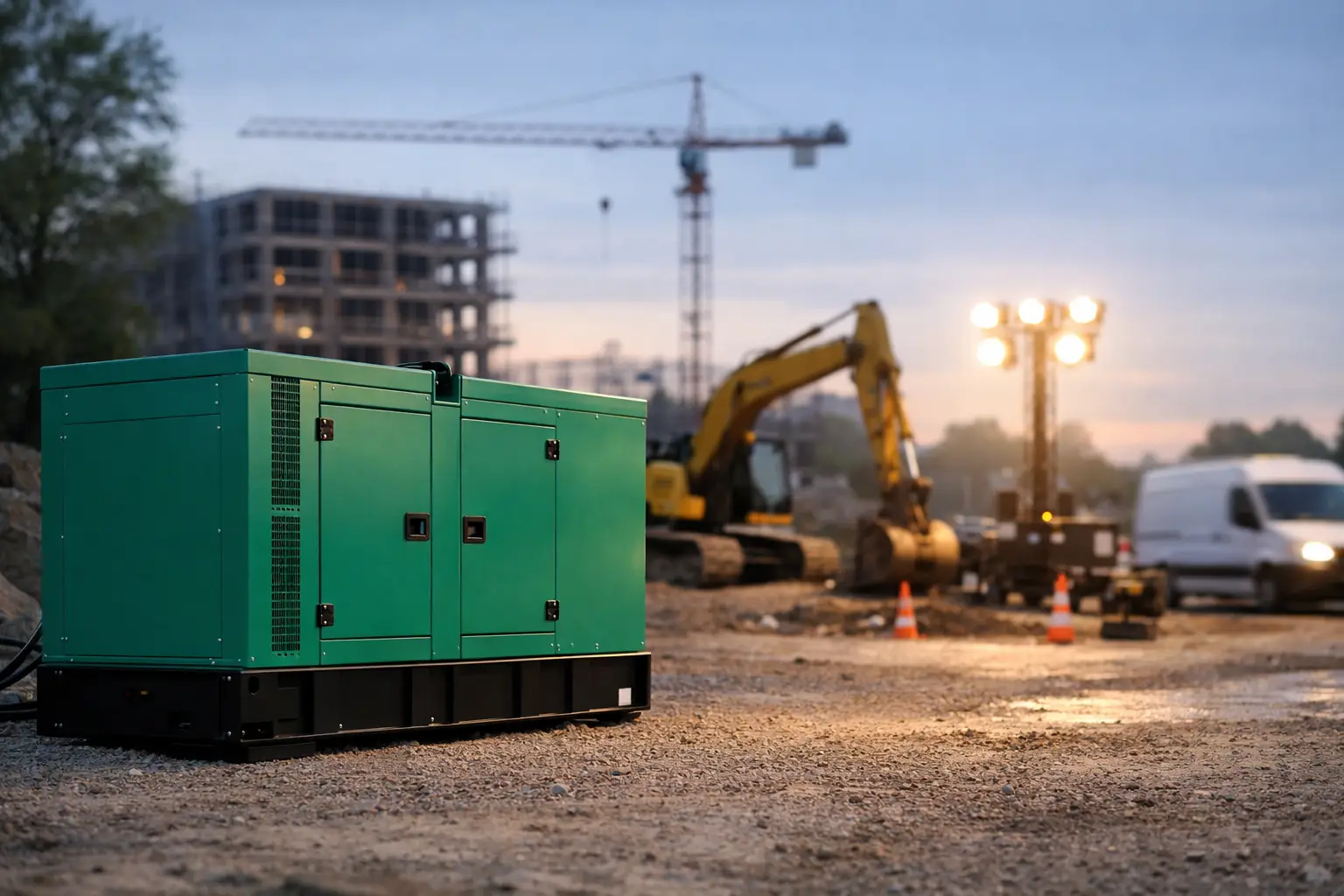
When a generator is going to sit next to an occupied building, a live construction project or a noise-sensitive boundary, output is only part of the buying decision. Silent generators are often the right format because they combine dependable power with controlled sound levels, which matters just as much as kVA on many commercial and industrial sites.
Why silent generators matter on working sites
A silent generator is not literally silent. In practice, the term refers to a generator set housed within an acoustic enclosure designed to reduce operating noise to a level that is far more manageable than an open set. That distinction matters. Buyers comparing options need realistic expectations about what acoustic treatment achieves and where its limits sit.
For facilities teams, contractors and procurement managers, noise control is usually tied to a practical constraint. It may be planning conditions, staff welfare, neighbouring properties, public-facing operations or site rules on overnight running. In these cases, specifying an enclosed set is not a cosmetic preference. It is part of keeping the site operational without creating a second problem while solving the first.
This is why silent generators are widely used for standby and prime power across healthcare, telecoms, logistics, commercial property, utilities and construction. They give buyers a way to secure dependable power where an open machine would expose the site to unnecessary acoustic impact.
What makes a generator a silent generator
The core difference is the canopy. A silent generator uses an acoustic enclosure engineered to contain and reduce sound through insulated panels, controlled airflow, attenuation around intake and exhaust paths, and a structural design that limits vibration transfer. The generator inside may use the same engine and alternator platform as an equivalent open set, but the enclosure changes how the machine behaves in the field.
Good enclosure design has to balance three things at once: noise reduction, cooling performance and service access. If the canopy restricts airflow too heavily, operating temperatures rise and performance suffers. If service doors, fuel fill points and control panels are poorly arranged, maintenance becomes slower and more expensive. That is why enclosure quality should be assessed as an engineering feature rather than an add-on.
For serious buyers, the published sound level should always be read alongside the test distance and load conditions. A figure in dBA at 7 metres is useful, but only when it is compared on the same basis across machines. Without that, one quoted noise level can look better than another while describing a different test standard.
Silent generators versus open sets
The choice between silent and open is rarely about which format is universally better. It is about site conditions, operating profile and installation method.
An open generator can make sense inside a properly designed plant room where acoustic treatment is handled by the building itself. It may also suit buyers prioritising lower upfront cost in controlled environments. Open sets can offer easier full-frame access for servicing, but they place more responsibility on the installation to manage sound, ventilation and protection from weather.
Silent generators are usually the stronger option for outdoor deployment, temporary works, mixed-use environments and locations where rapid installation is required. The enclosure provides weather protection, acoustic control and a more self-contained package. That can reduce the amount of additional site engineering needed to get the unit into service.
The trade-off is straightforward. Silent sets are heavier, bulkier and typically cost more than open equivalents. In return, they simplify deployment and reduce acoustic exposure. For many projects, especially where complaints, restrictions or public interface are possible, that is a commercially sound trade.
How to specify silent generators properly
The first step is still the same as with any generator procurement: establish the load accurately. Under-sizing creates start-up problems and instability. Over-sizing can lead to inefficient running, poor load factor and unnecessary capital spend. Standby and prime duty also need to be distinguished clearly, because a set selected for emergency backup is not necessarily the right machine for sustained daily operation.
Once load has been defined, the acoustic requirement should be treated as a measured specification rather than a general preference. If the generator is serving a hospital extension, a data facility, a retail development or a night-shift construction programme, the acceptable noise limit should be understood early. It is far better to match the enclosure level from the outset than to rely on remedial attenuation later.
Fuel autonomy, access for refuelling, site footprint and maintenance clearance also need to be reviewed at specification stage. Silent generators often help with compact external placement, but the canopy still requires adequate door swing, exhaust routing consideration and safe service access. On constrained sites, these physical details can decide whether a model is viable.
Engine platform matters as well. Buyers responsible for mission-critical uptime generally prefer recognised engine brands because parts support, service familiarity and long-term reliability are easier to manage across the asset life. The enclosure reduces noise, but the underlying quality of the generating set remains the primary determinant of dependable performance.
Standby or prime power?
This is where many buying decisions become blurred. A standby-rated silent generator is designed to support the site during mains failure. A prime-rated unit is intended for regular or continuous duty within defined operating parameters. If a site expects prolonged outages, scheduled off-grid operation or rental-style utilisation, the duty rating needs to reflect that reality.
Specifying a standby machine for a prime-style application may look cost-effective on paper, but it usually creates risk in service life and operational resilience. Matching the rating to the actual duty cycle is a basic procurement discipline.
Single phase or 3 phase?
Voltage configuration should follow the load profile, not convenience. Many commercial and industrial users will require 3 phase output to support mixed plant, motors and distribution systems. Smaller residential or light commercial applications may suit single phase. Where future expansion is likely, it is worth considering whether the current load tells the full story.
Where silent generators deliver the most value
Silent generators are especially effective where people, process and proximity all matter. On construction sites near occupied buildings, they allow work to continue with less disruption. At healthcare and care settings, they support backup power without adding unnecessary noise stress around sensitive environments. In logistics, retail and commercial estates, they are often the practical answer for external standby installation where operations continue close to the generator location.
They also suit infrastructure and utilities projects where temporary power must be deployed quickly and safely in the field. The acoustic enclosure helps with weather exposure and general site protection while keeping the package easier to position than a separate open set plus acoustic housing arrangement.
That said, buyers should avoid treating every application as identical. If a remote industrial site has no nearby receptors and a dedicated plant area, an open set may still be the more efficient specification. The right answer depends on the operational environment, not the label alone.
Buying for uptime, not just for noise reduction
Acoustic performance should never distract from the core purpose of the equipment. A silent generator is still a critical power asset, and its value depends on start reliability, load acceptance, fuel efficiency, control system integrity and maintainability.
This is where stock availability and clear specification support become commercially important. Buyers under deadline do not just need a generator that looks right on paper. They need confidence around rating, enclosure type, engine brand, delivery times and whether the machine genuinely suits the application. Global Generators focuses on this practical side of procurement by offering clearly segmented diesel generator stock, including silent generators, across a broad kVA range for both standby and prime power requirements.
For most serious applications, the buying process should involve more than comparing headline price. Consider the operating duty, noise target, site layout, servicing plan and the consequences of failure. A cheaper set that is awkward to maintain, wrong for the duty cycle or too noisy for the location can become an expensive mistake quickly.
There is also value in thinking beyond first installation. If the generator will support an expanding facility, temporary modular build programme or changing site demand, flexibility matters. A machine that fits the current requirement but leaves no margin for growth can shorten the replacement cycle unnecessarily.
Silent generators as a practical risk-control measure
In many sectors, silent generators are best understood as a risk-control decision. They reduce the risk of noise complaints, planning friction, site restrictions and operational disruption while still delivering the power continuity the site depends on. That is why they continue to be specified across critical environments where downtime is unacceptable but so is avoidable acoustic impact.
For buyers who need dependable backup or prime power, the right silent generator is the one that meets the electrical demand, suits the duty profile, aligns with the site layout and keeps noise within acceptable limits without compromising serviceability. If those factors are handled properly at the enquiry stage, the result is not just quieter operation. It is a more workable power solution from day one.
The strongest procurement decisions usually come from asking one direct question early: what must this generator do, every time, on this site? Once that is clear, the right enclosure, rating and configuration tend to follow.