Quick answer
On 1 September 2026, a severe heatwave pushed PJM Interconnection — America's largest electric grid, serving 67 million people across 13 states and Washington D.C. — to the brink of rotating blackouts. The US Department of Energy issued an emergency order authorising PJM to call on backup generation as a last resort before declaring its most serious energy emergency alert level. This wasn't a one-off: it's the latest in a string of federal emergency orders issued to PJM throughout 2026, driven by a structural mismatch between rising demand and retiring generation capacity. The Department of Energy itself noted that more than 35GW of unused backup generation capacity exists nationwide — a striking acknowledgement, at federal policy level, of how central on-site backup power has become to grid reliability.
What Happened on 1 September
A severe heatwave pushed temperatures above 90°F (32°C) across Chicago, St Louis, and Washington D.C. during peak electricity demand, straining PJM Interconnection — the grid operator responsible for supplying power to roughly 67 million people from the Mid-Atlantic through to the Midwest.
Late that evening, US Secretary of Energy Chris Wright signed an emergency order under Section 202(c) of the Federal Power Act, authorising PJM to direct backup generation resources into service as a last resort — one step before declaring an Energy Emergency Alert Level 3, the stage that typically precedes rotating blackouts. PJM's own "maximum generation emergency" alert was already active, directing power stations on planned maintenance outages to report how quickly they could return to service.
The strain wasn't confined to PJM. The Midcontinent Independent System Operator (MISO), which serves 15 US states across the Midwest and South, forecast peak demand approaching 121 gigawatts that same day — closing in on its all-time record of 127.1GW — and widened its reserve margins as a precaution against further outages or transmission congestion.
Understanding the Alert Levels
For readers unfamiliar with US grid terminology, PJM's Energy Emergency Alerts (EEAs) escalate in stages as conditions worsen. A Maximum Generation Emergency — the alert active on 1 September — asks all available generation to be ready and directs plants on planned outages to report how quickly they could return to service. An EEA Level 1 signals early concern about maintaining adequate reserves. EEA Level 2 indicates PJM anticipates using emergency procedures. EEA Level 3, the level the September order was explicitly designed to help avoid, is the stage at which PJM may need to call on voltage reductions or, ultimately, controlled rotating outages to protect the wider system from an uncontrolled failure. The September order sat deliberately one step below that threshold — a measure of how close conditions were running to the edge, even if the public rarely sees these distinctions reported in day-to-day news coverage.
This Wasn't a One-Off — It's a Pattern
What makes the September event genuinely significant isn't that it happened once. It's that federal emergency intervention in PJM has become almost routine throughout 2026. The Department of Energy's own record shows repeated 202(c) emergency orders issued to PJM across the year — in January, May, June, July, and August — each responding to a different squeeze on the grid's capacity.
The most striking prior example came at the end of June, when the Department of Energy issued two further emergency orders ahead of forecast demand that threatened to break PJM's all-time peak record of 165,563 megawatts — a record that had stood since 2006. That same order authorised PJM to curtail large data centres and other big energy users, requiring them to switch onto their own backup generation rather than draw from the strained public grid — a direct, real-world example of exactly the kind of contingency planning discussed later in this piece.
Separately, earlier in the year, the Department also extended the operating life of specific power stations — including units at Pennsylvania's Eddystone and Wagner generating stations — well past their originally scheduled retirement dates, specifically to preserve capacity margin through the summer.
Seen individually, each order looks like a response to a specific heatwave. Seen together, they describe a grid operating with progressively less spare margin, needing federal intervention more frequently just to get through ordinary summer conditions.
Why PJM Keeps Needing Rescuing
The underlying cause isn't a mystery, and PJM has said as much itself: a growing mismatch between rising electricity demand and the retirement of dispatchable generation capacity. Data centre growth, broader electrification, and hotter, more frequent heatwaves are pushing demand upward, while ageing power plants continue to retire on schedule — a dynamic that echoes the global pattern we explored in Is Your Country Next? The Growing Global Problem of Grid Instability, just playing out inside the world's most mature electricity market rather than an emerging one.
It's a useful companion case to the Indiana derecho blackout from earlier this year, too. That event was about physical storm damage to infrastructure; the PJM emergencies are almost the opposite problem — the wires and substations are largely fine, but the underlying balance between supply and demand has become genuinely fragile during periods of extreme heat.
The Number That Should Get a Business Owner's Attention: 35GW
Buried in the Department of Energy's own announcement is a genuinely striking figure: an estimated 35 gigawatts of unused backup generation capacity exists nationwide — power that businesses and facilities already own, sitting idle, that could in principle be called upon during exactly these kinds of emergencies.
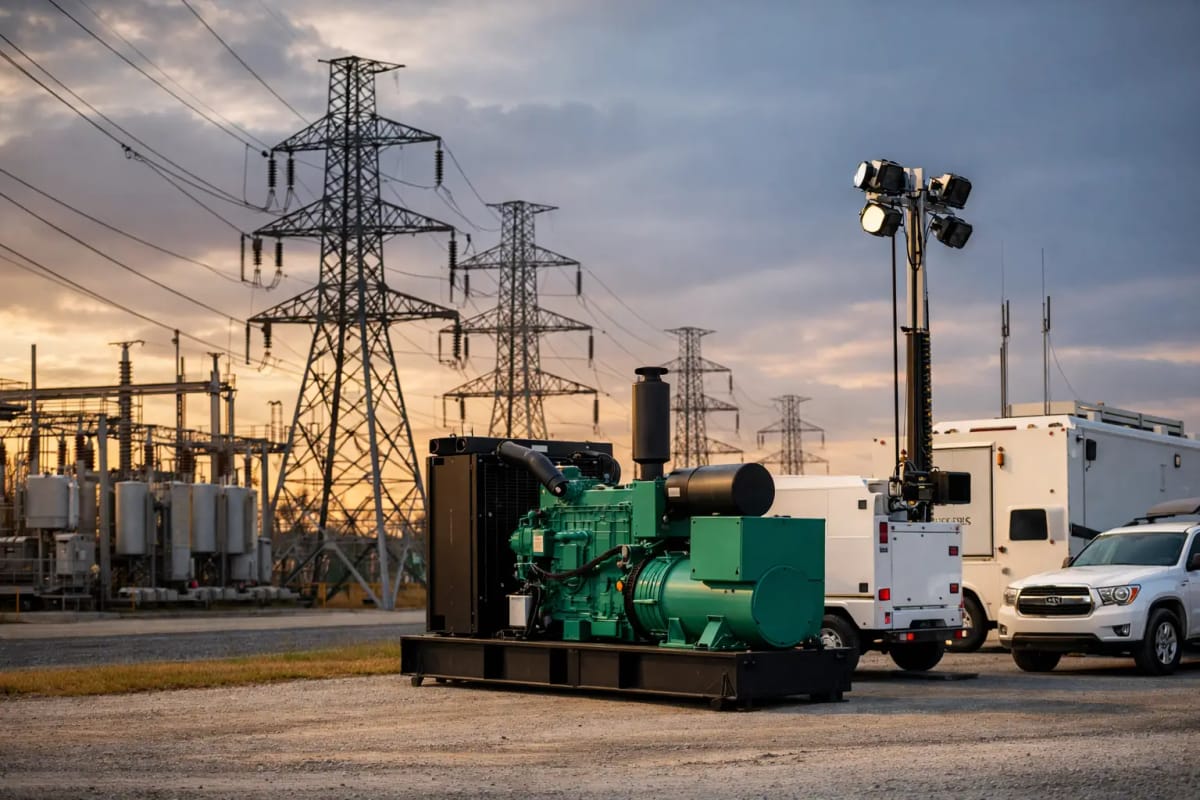
That's a remarkable acknowledgement from federal energy policy itself: on-site backup generation isn't a fringe contingency anymore. It's being explicitly counted, at a national level, as part of the toolkit for keeping America's largest grid stable. For any business currently treating its backup generator purely as an insurance policy against downtime, this is a useful reframe — it's increasingly viewed by grid operators and regulators as genuine, usable capacity, not just a private safety net.
What This Means If You Operate in PJM or MISO Territory
Grid alerts are becoming a seasonal expectation, not an anomaly. Businesses operating in the Mid-Atlantic, Midwest, or broader PJM/MISO footprint should treat summer emergency alerts as a near-certainty each year going forward, not a rare event worth reacting to only when it happens.
Backup power planning should assume the grid is running with thinner margins than it used to. A generator specified years ago, before this pattern of repeated 2026 emergency orders, may no longer reflect how often the surrounding grid is genuinely under strain.
Correct sizing and automatic switching matter more as grid events become more frequent. A properly sized standby generator with automatic transfer switching means a business's continuity no longer depends on whether PJM's emergency measures work as intended on any given afternoon.
Facilities with flexible, well-maintained backup capacity are arguably better positioned than ever. With federal policy now explicitly counting distributed backup generation as part of the national reliability picture, businesses that invest in properly specified, well-maintained systems are aligning with where grid policy is heading, not working against it.
The Bottom Line
America's largest grid didn't fail on 1 September 2026 — federal intervention and existing backup capacity helped ensure it didn't. But the fact that this was the latest in a long string of 202(c) emergency orders through the year says more than any single event could: PJM is running closer to its limits, more often, than it used to. For businesses in its territory, and in comparable grids elsewhere, that's less a reason for alarm than a reason to make sure backup power planning reflects the grid conditions of 2026 — not the more comfortable margins of a decade ago.