Quick answer
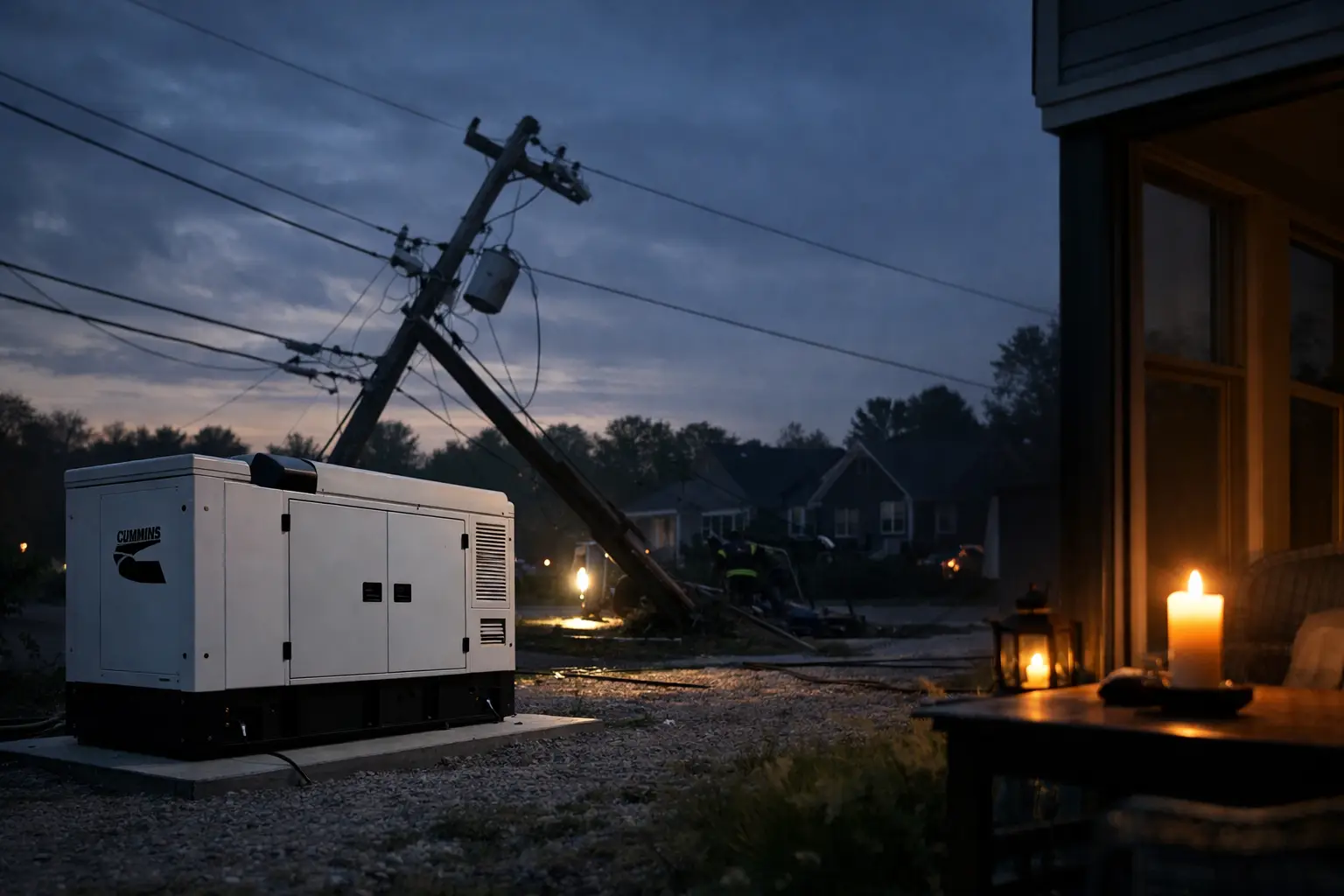
On 11 August 2026, a derecho with wind gusts approaching 100mph tore across northern Illinois and Indiana, cutting power to roughly 313,000 NIPSCO customers — the largest outage event in the utility's history. Full restoration took nearly 14 days, with tens of thousands still without power more than a week later. Unlike grid instability driven by demand outpacing supply (as in the UK, Nigeria, or Pakistan), this was a physical damage event — downed lines, poles, and substations — in a mature, well-resourced US utility territory. It's a reminder that grid resilience risk comes in more than one form, and that even developed grids can leave communities without power for far longer than most backup power plans are built to cover.
What Happened on August 11
A powerful line of thunderstorms — a derecho — swept across the Midwest on 11 August, producing widespread damaging winds from Illinois into Indiana and Ohio. In Gary, Indiana, the National Weather Service recorded a gust approaching 100mph, comparable to a Category 2 hurricane.
Northern Indiana Public Service Company (NIPSCO) reported that roughly 313,000 customers — about 60% of its entire electric customer base — lost power during the storm, describing it as the largest and most widespread outage event in the company's history. The damage wasn't confined to a single afternoon: recovery efforts were complicated the very next day when a second round of severe thunderstorms swept through the same area, producing additional outages and torrential rainfall, with flash flooding making roads impassable and hampering crews trying to reach damaged equipment.
Why Restoration Took So Long
This is where the Indiana event differs meaningfully from a typical storm outage. NIPSCO initially estimated 90% restoration by 18 August and full restoration by 21 August. In practice, the utility didn't reach 99% restoration until 25 August — a full two weeks after the storm first hit, and several days beyond its own original estimate.
The delay came down to the sheer physical scope of the damage. More than 1,200 contractor crews were brought in from out of state to supplement NIPSCO's own workforce, repairing damaged substations, poles, power lines, and other infrastructure across nearly the utility's entire service territory. Unlike a supply shortfall, which can sometimes be resolved by importing power or bringing an additional plant online, physically destroyed transmission and distribution infrastructure has to be rebuilt piece by piece before power can flow again — a process that scales with the geographic size of the damage, not just the number of customers affected.
For real-time detail on how NIPSCO managed the restoration, the utility's own storm update page tracked customer counts and community-level restoration estimates throughout the event, and remains a useful reference for how a major US utility communicates during an extended outage.
The Part That Doesn't Make the Headlines: Essential Services
One of the more striking details to emerge from the recovery wasn't about homes — it was about the infrastructure that depends on continuous power to protect everyone else. Local officials in some of the hardest-hit towns reported that police departments, fire stations, and wastewater treatment facilities had been running on backup generators for several days straight while grid power remained out.
That's a genuinely important data point. It means the towns' own emergency and public health infrastructure was, in effect, stress-testing its own backup power capacity in real time during an event lasting well beyond a typical short outage. Residents needing help with utility bills, disconnections, or disaster-related support during events like this can also turn to Indiana's Office of Utility Consumer Counselor, the state agency that represents residential utility customers' interests during exactly this kind of prolonged disruption.
What Is a Derecho, and Why Does It Cause This Kind of Damage?
For readers outside the US Midwest, "derecho" is a term worth understanding on its own, since it explains why this event caused such widespread structural damage rather than a localised outage. A derecho is a long-lived, fast-moving band of severe thunderstorms that produces widespread, straight-line wind damage over a large area — often hundreds of miles — rather than the more concentrated, spinning damage of a tornado.
That distinction matters for grid infrastructure specifically. A tornado can devastate a narrow path with extreme intensity, but a derecho spreads damaging, near-hurricane-force winds across an entire region simultaneously — which is exactly why NIPSCO's damage wasn't confined to one substation or a handful of neighbourhoods, but stretched across nearly its entire service territory at once. That geographic breadth is the core reason restoration took weeks rather than days: repair crews couldn't concentrate on one damaged area and move outward, because the damage was already everywhere.
Why This Matters Beyond Indiana
It would be easy to file this away as a regional storm story. But taken alongside the other grid instability events of 2026 — the UK's near-miss blackout during a June heatwave, Nigeria's repeated national grid collapses, South Africa's tens of thousands of unplanned outages, and Pakistan's chronic shortfall — Indiana adds an important, distinct category to the picture. We explored the demand-and-investment side of this global pattern in The Growing Global Problem of Grid Instability, but Indiana is a different mechanism entirely: not too little generation capacity, but physical vulnerability to extreme weather, even in a mature, well-invested utility territory serving roughly half a million customers.
That distinction matters for planning purposes. A business or public facility that has assessed its exposure to demand-driven outages (rolling blackouts, load shedding, capacity shortfalls) hasn't necessarily assessed its exposure to a physical-damage event that can take two weeks to repair, regardless of how strong the underlying grid's generation capacity is. Both categories of risk are real, and increasingly, both are showing up in the same calendar year across different parts of the world.
What This Means for Backup Power Planning
Most standby power plans are built around a 24–72 hour outage. That assumption has been reasonable for the vast majority of storm-related outages historically. Indiana's event — a genuine two-week restoration window, roughly 336 hours, in a well-resourced Midwestern utility territory — shows that assumption can fail in exactly the kind of location most planners would have considered low-risk.
Fuel logistics matter as much as generator capacity for extended events. A generator sized correctly for a 72-hour outage can still fail an organisation if fuel resupply hasn't been planned for a much longer event. Businesses and public facilities in storm-prone regions should have a genuine refuelling plan — a contracted supplier and confirmed access routes — not just an on-site tank sized for a short outage.
Duty rating matters for multi-day continuous operation. A generator that's rated and maintained for occasional standby use is a different proposition from one expected to run continuously for a week or more. Facilities in regions exposed to major storm events should confirm their backup generator's duty classification actually matches the realistic worst-case runtime, not just the manufacturer's headline rating.
Essential public infrastructure needs the same scrutiny as commercial facilities. If police stations, fire stations, and water treatment plants in affected towns were running on generators for days, it's worth any organisation in a similar risk category — hospitals, care facilities, water utilities, emergency services — auditing whether their own backup provision was ever actually tested against a two-week scenario, or only ever assumed to cover a much shorter one.
Geographic scale of damage, not just customer count, should inform recovery-time assumptions. NIPSCO's own experience shows that when damage is spread across an entire service territory rather than concentrated in one area, restoration time scales with the physical footprint of the damage — a detail worth factoring into any organisation's own outage-duration assumptions, especially in regions prone to wide-area severe weather events.
The Bottom Line
Indiana's derecho wasn't a failure of grid capacity or a supply-demand imbalance — it was a demonstration that physical infrastructure, however well maintained, has real limits against extreme weather, and that restoring it after a wide-area event takes time measured in weeks, not hours. For any organisation whose backup power plan was built around a short outage assumption, this is a useful, concrete data point to revisit that plan against: not "how long could the grid realistically be down," but "how long has it actually been down, recently, somewhere no less prepared than us."