Quick answer
No generator is truly silent, but a well-built silent diesel generator is far quieter than an open set. The four canopied sets we checked, from 10 to 170 kVA, are rated at 65 to 68 dB(A) at 7 metres and 77 to 81 dB(A) at 1 metre. Always compare figures taken at the same distance, because 1 m, 7 m and sound power ratings cannot be compared directly.
This guide uses datasheet figures from silent generators in our own range, explains what the decibel values mean, and sets out the UK rules that matter when a generator is near people or neighbours. If you are choosing a set for a noise-sensitive site, it gives you the questions to ask before you buy.
What does "silent" actually mean on a generator?
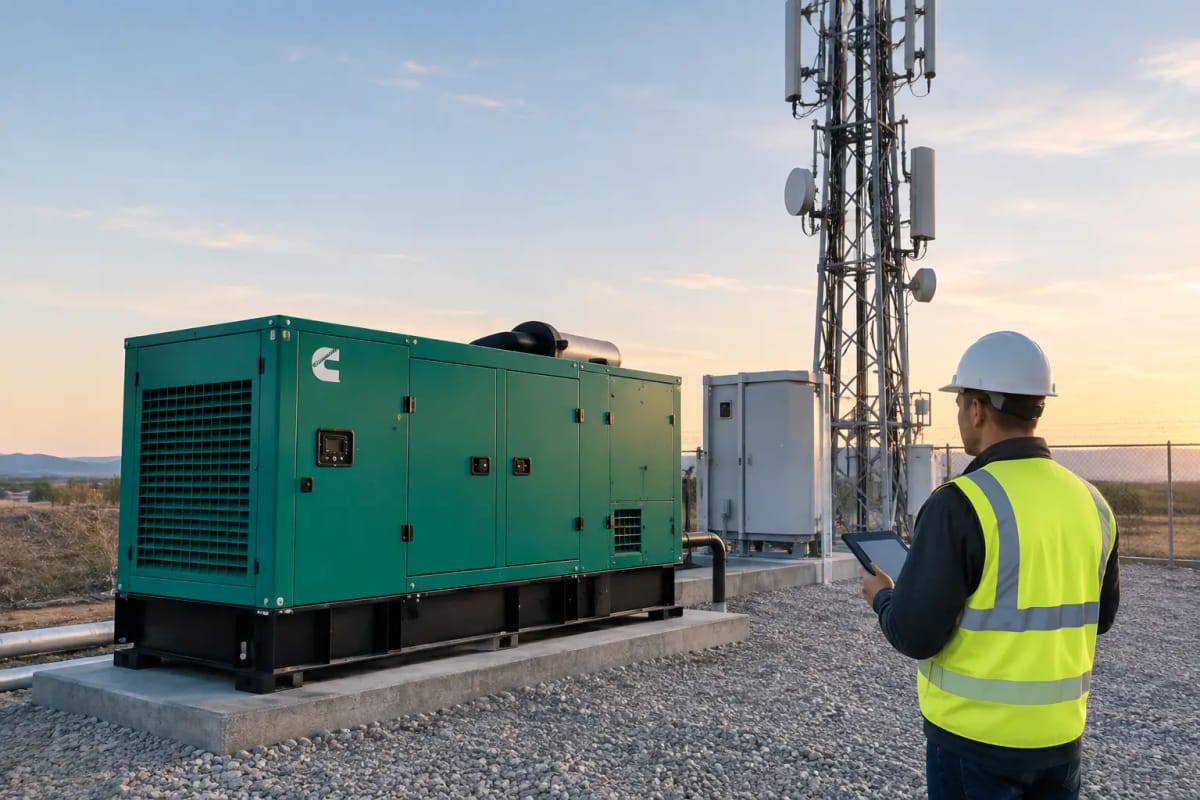
No combustion engine is completely silent. A silent generator is a diesel set fitted inside an acoustic enclosure that reduces the noise from the engine, the cooling fan, the alternator and the exhaust to a controlled level.
There is no single universal standard that defines "silent" or "super silent". That is why a number on a datasheet is more useful than the label. A typical acoustic enclosure uses:
- Sound-absorbing insulation around the engine and alternator
- Attenuated air inlet and outlet paths
- A high-performance exhaust silencer
- Anti-vibration mountings
- Sealed access doors
An acoustically enclosed set is quieter than an open generator, but the enclosure has to leave enough airflow for cooling. Quiet and cool have to be balanced, which is why you should never box a generator in to make it quieter.
Real noise levels from four sets in our range
The table below uses the canopy noise levels published on each product page. All four are canopied sets, and each datasheet gives one figure at 1 metre and another at 7 metres.
| Generator | Rating (standby / prime) | Supply | dB(A) at 1 m | dB(A) at 7 m | |---|---|---|---|---| | Cummins C10D5Q | 10 kVA / 9 kVA | Three phase, 400 V | 77 | 65 | | Pramac P11000-1P | 10.8 kVA / 10 kVA | Single phase, 230 V | 81 | 68 | | Cummins C66D5EQ | 66 kVA / 60 kVA | Three phase, 400 V | 77 | 67 | | Cummins C170D5Q | 170 kVA / 155 kVA | Three phase, 400 V | 79 | 68 |
Three things stand out:
- The 7 m figure barely moves with size. It runs from 65 to 68 dB(A) across sets from 10 to 170 kVA. A bigger generator is not automatically a louder one.
- Two sets of the same size can differ. The two 10 kVA-class sets above are 3 dB apart at 7 m. Design differences, including engine speed and enclosure construction, affect the result. The Pramac runs at 3,000 rpm and the Cummins sets at 1,500 rpm.
- The 1 m figure is much higher. On these four datasheets, the level at 1 m is 10 to 13 dB above the level at 7 m.
These are manufacturer figures for the canopied set. Larger and containerised sets vary, so check the datasheet for the exact model.
How to read a dB(A) figure
What the "A" means
dB(A) is a sound level weighted to match how the human ear responds, which is less sensitive to very low and very high frequencies. It is the standard unit for generator noise.
Distance changes everything
Sound falls with distance. A reading at 1 m describes a generator you are standing next to, while a reading at 7 m describes one across a yard. A figure quoted at 1 m and another quoted at 7 m are therefore not directly comparable, which is the main trap when comparing suppliers.
The decibel scale is logarithmic
A 3 dB difference means double the sound energy but is usually only just noticeable. A 10 dB difference sounds roughly twice as loud, or half as loud, to most people. For context, normal conversation is typically around 60 dB.
Sound pressure versus sound power
A datasheet may also quote a sound power level, which describes the total noise a machine emits, regardless of distance. For example, the Pramac P11000-1P lists a guaranteed sound power level of 96 dB(A) alongside its 68 dB(A) at 7 m. Sound power is useful for acoustic calculations, but it is not a level you would hear at a given spot, so don't compare it to a sound pressure figure.
How noise changes with distance and surroundings
As a rough guide, the sound pressure level from a small source in open air falls by about 6 dB each time the distance doubles. Starting from a set rated at 65 dB(A) at 7 m, the estimate looks like this:
| Distance from generator | Estimated level (open ground, no barriers) | |---|---| | 7 m | 65 dB(A) | | 14 m | About 59 dB(A) | | 28 m | About 53 dB(A) | | 56 m | About 47 dB(A) |
Treat these as rough estimates. Hard walls and paving can reflect sound and make a generator seem louder, while buildings, barriers and soft landscaping change how it travels. A generator that is quiet in an open yard can sound noticeably louder beside reflective walls. For noise-sensitive sites, a site-specific acoustic assessment is the reliable way to know.
UK rules that matter
Noise at work
The Control of Noise at Work Regulations 2005 set a lower exposure action value of 80 dB(A), an upper exposure action value of 85 dB(A) and an exposure limit value of 87 dB(A). These are levels of daily or weekly personal noise exposure, so they depend on how long someone is exposed, not on a single meter reading. The full text is on legislation.gov.uk.
The 1 m figures for the sets above sit at or near the lower action value, so staff who work right next to a generator for long periods should have their exposure assessed.
Noise affecting neighbours
In England, councils must look into complaints about noise that could be a statutory nuisance under the Environmental Protection Act 1990. If one exists, they must serve an abatement notice. Noise only counts if it unreasonably interferes with the use of premises or harms health. The GOV.UK guide to noise nuisances and how councils deal with complaints explains the process. That guidance applies to England, so check the rules that apply in Scotland, Wales and Northern Ireland.
There is no single decibel figure that decides whether a generator is a nuisance. Where a planning condition applies, acoustic consultants often assess commercial and industrial sound against the background level using BS 4142. If your site has a noise condition, ask your planning officer what level is required before choosing a set.
How to choose a quiet generator
- Ask for dB(A) at 7 m and at 1 m, and confirm both come from the same test.
- Check the sound power level if an acoustic consultant needs it.
- Confirm the load and conditions of the measurement, because figures recorded under different conditions cannot be compared.
- Be wary of "super silent" claims. There is no single standard behind the term, so ask for a figure.
- Match the set to the site. Distance to the nearest neighbour, working hours and reflective surfaces matter as much as the rating.
- Plan for airflow and exhaust. The best acoustic package still needs to cool the engine and vent exhaust safely.
> Need a quiet generator for a noise-sensitive site? Send us the nearest boundary distance, the hours it will run and any planning noise condition, and we will suggest sets from stock with the datasheet figures to match. Use the contact page or call +44 1302 700200.
Placing a silent generator to keep noise down
- Increase the distance to occupied buildings and boundaries where you can.
- Avoid hard, reflective surfaces close to the canopy, such as walls on two sides.
- Point air outlets and exhausts away from noise-sensitive neighbours where possible.
- Use a solid, level base and the correct anti-vibration mounts so that vibration is not carried into a structure.
- Never enclose the set in a box or building without proper ventilation. Diesel exhaust contains carbon monoxide, and cooling air must flow freely.
- Test on site with the generator under load before finalising the position.
Where silent generators are used
Noise matters most around homes, offices and public buildings. A single-phase set can provide whole-house backup, as in our case study of a 28 kVA Cummins generator for home backup in Devon. If you are comparing options for a property, see our range of generators for homes.
On the four sets above, size changed the 7 m figure by only 3 dB, so choose by load first. Our guides to what a 15 kVA generator can power and what a 60 kVA generator can run show how to size a set, and you can browse the 10 kVA and 60 kVA ranges for models with the noise data on the product page.
Frequently asked questions
Are silent generators completely silent?
No. No combustion engine is. A silent generator uses an acoustic enclosure to reduce noise to a controlled level, but it is still audible, especially close up.
How many dB is a silent generator?
On the four canopied sets we checked, the figure is 65 to 68 dB(A) at 7 m and 77 to 81 dB(A) at 1 m. There is no universal standard for "silent", so check the datasheet for the exact model.
What does dB(A) at 7 metres mean?
It is the sound level, weighted to match human hearing, measured 7 metres from the generator. A figure at 1 metre or a sound power rating describes something different, so only compare numbers measured the same way.
Is a silent generator quiet enough for residential areas?
It depends on the distance to neighbours, the hours of use and local conditions. In England, councils judge noise complaints against the statutory nuisance test, and there is no single decibel figure that applies to every site. If a planning condition applies, ask what level is required.
Do I need hearing protection near a silent generator?
Not automatically. The noise at work limits are based on personal exposure across a working day, not a single reading. Because the 1 m levels on these datasheets are 77 to 81 dB(A), anyone working beside a generator for long periods should have their exposure assessed.
Can I put a silent generator inside a building to make it quieter?
Not without proper ventilation. A generator needs a free flow of cooling air and a safe route for exhaust, which contains carbon monoxide. Boxing it in can cause overheating and is dangerous. For quieter operation, choose a lower-noise canopy and plan the location instead.
Conclusion
A silent generator is a quieter generator, not a silent one. The figure that matters is the dB(A) at a stated distance. On the sets we checked, that is 65 to 68 dB(A) at 7 m and 77 to 81 dB(A) at 1 m. Compare like with like, think about distance and surroundings, and ask for the datasheet before you buy.
> Talk to a real person: Global Generators is an authorised Cummins reseller and an authorised Grupel and Pramac dealer, with new diesel generators in stock for UK delivery and export. Browse our silent generators or check the stock list, then contact our team on +44 1302 700200 or at enquiries@global-generators.com and we will help you match a set to your site.