Quick answer
In a solar and battery system, the generator's job is to top up the batteries when the sun is not enough, not to run the whole site. So size it for battery charging plus the loads that run at the same time, not for the site's peak demand. Add the critical loads, the maximum battery charge load and the system losses, then keep the generator running near 75 to 80% of its prime rating while it charges, because very light loads waste fuel and cause wet stacking. The generator also needs a way to start automatically from the inverter, and a set with a manual key-start panel will not do that on its own
This guide explains how a generator fits into a solar and battery system, how to size it, how it starts and stops automatically, and what our three installations show. It is general guidance. The exact settings for your site depend on your inverter, batteries and loads, and your system designer should confirm them.
Why add a generator to solar and batteries?
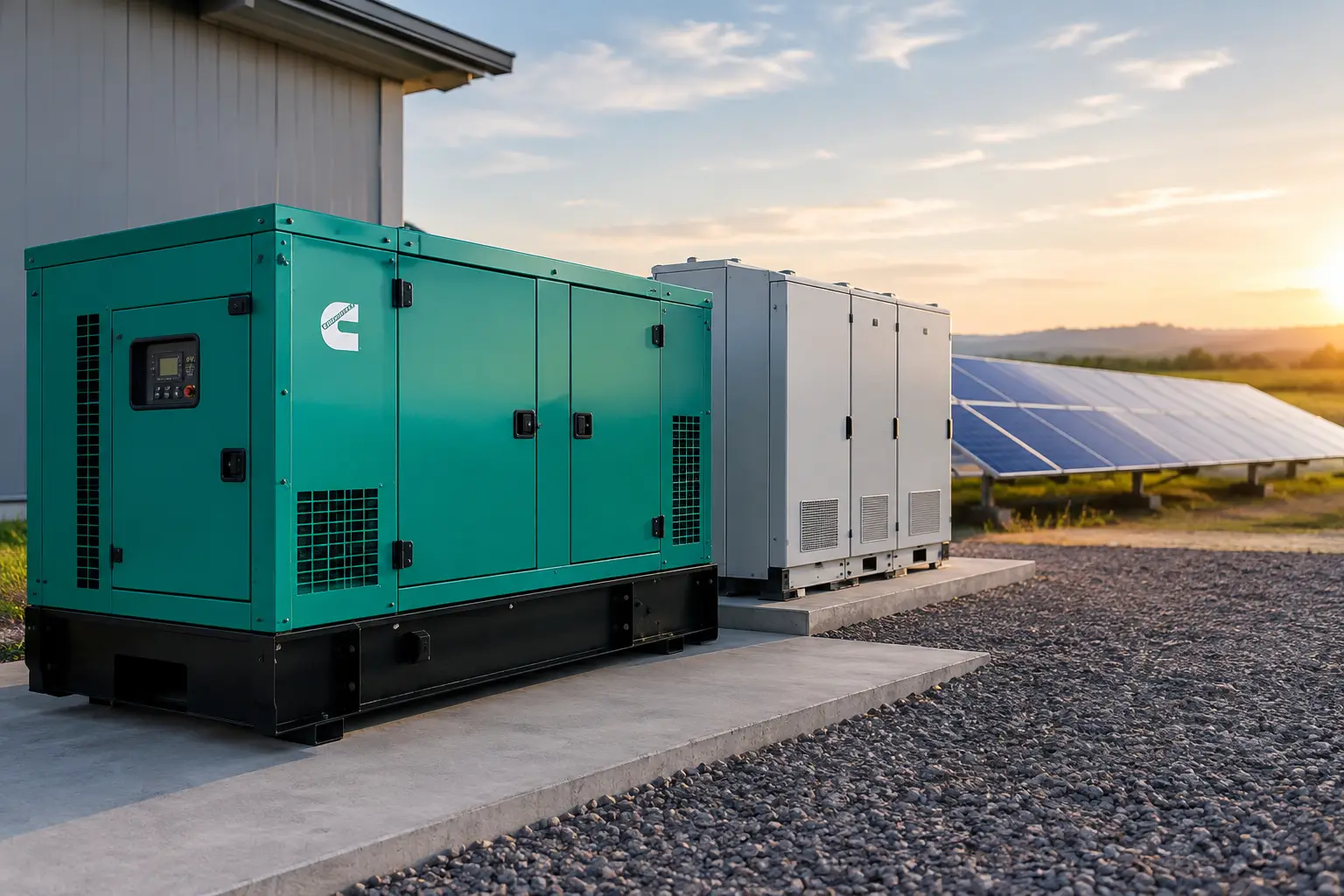
Solar output varies by season and weather, while loads do not. A generator fills the gaps and protects the batteries from deep discharge. We supplied generators to three UK sites that use this arrangement:
- An EV rapid charging hub in Manchester. A padel club needed two 50 kW DC rapid chargers but had no grid supply behind them. The operator built an off-grid system with a 30 kWp solar canopy, around 200 kWh of usable battery storage and a 100 kW inverter, and a Pramac GBW22P generator that charges the battery overnight. It runs roughly 10 hours at about 80% load and produces around 129 kWh. Read the Manchester case study.
- A telecoms site at a solar and battery facility in Hertfordshire. We supplied a Cummins C22D5Q 22 kVA silent generator to a new solar and battery storage site under construction, to power its critical telecoms infrastructure. See the Hertfordshire case study.
- Off-grid log cabins in Stoke-on-Trent. A Cummins C38D5Q 38 kVA silent generator keeps off-grid solar batteries charged for remote cabins. Read the Stoke-on-Trent case study.
If you are weighing a generator against a larger battery alone, our guide to diesel generator vs battery backup for business power compares them.
How a generator fits into the system
The inverter-charger is the controller of an off-grid or hybrid system. It decides when to use solar, when to draw on the batteries and when to ask the generator to run. The sequence looks like this:
- Solar and batteries supply the load while the batteries are above the start threshold.
- The batteries fall to a set level, for example a low state of charge or battery voltage.
- The inverter-charger signals the generator to start.
- The generator takes over and charges the batteries, while also supplying any loads on the system.
- When the batteries reach their target, the inverter stops the generator and solar leads again.
Most inverter-chargers can also start a generator on load, not just battery level. If the loads exceed a set amount for a set time, the generator starts, usually with a delay so a short peak does not trigger it.
Starting the generator automatically
Automatic start usually uses a two-wire start signal from the inverter-charger to the generator controller. Check three things before you buy:
- Does the generator controller accept a remote start signal? The Cummins PowerStart 0600 controller fitted to our trailer-mounted Cummins C22D5Q and C38D5Q sets accepts a remote start signal in auto mode. It can also be set to delay the start after that signal by up to 300 seconds, though the default is zero.
- What happens if a start fails? The same controller supports cycle cranking, configurable from one to seven attempts, and then shows a fail-to-start fault. Your system should alert you if that happens.
- Does the inverter support the signal you need? Confirm the start and stop interface with your inverter supplier, and ask your generator supplier to confirm the connection.
Not every generator suits unattended automatic start. The Pramac GBW22P is a manual key-start set with socket outlets, and the Manchester case study describes it as prime power for an off-grid EV hub, so the way it is started and stopped there depends on how that system was configured. For a new project, specify the start and stop arrangement at the start, and see our guides to generator remote monitoring systems and automatic versus manual transfer switches.
Sizing a generator for solar and batteries
In a hybrid system the generator is sized for charging, not for peak site load. One off-grid solar engineer's sizing guide gives this formula:
Generator capacity = critical loads + maximum battery charge load + system losses
Forgetting the battery charging demand is described as the single most common sizing mistake. A generator that is sized only for the loads can overload as soon as the batteries start charging.
A worked example
These numbers are illustrative. Suppose a site has 5 kW of loads that run while the generator is on, and the inverter-charger can be set to charge the batteries at around 7 kW of AC input. That is 12 kW in total, which is 75% of a 16 kW prime rating, such as the Cummins C22D5Q or Pramac GBW22P. If the charger were left at a higher setting of 12 kW, the total would be 17 kW, beyond the generator's 16 kW prime rating, and it would overload.
The fix is to limit the charger's AC input current and charge rate in the inverter-charger settings, so the generator runs near the target load. Power factor also matters, because a charger's input power factor differs from the generator's rating basis, so ask your inverter supplier for the input current and power factor at the charge rates you plan to use.
Which generator for which charging load?
Keep the total load, loads plus charging, near 75 to 80% of the prime kW rating. These sets from our range give you the targets:
| Model | Prime rating | 80% of prime |
|---|---|---|
| Pramac GBW22P or Cummins C22D5Q | 20 kVA / 16 kW | 12.8 kW |
| Cummins C38D5Q | 35 kVA / 28 kW | 22.4 kW |
| Cummins C55D5EQ | 50 kVA / 40 kW | 32 kW |
| Cummins C66D5EQ | 60 kVA / 48 kW | 38.4 kW |
For what each size can run, see our guides to what a 20 kVA generator can run and what a 50 kVA generator can run, and browse the 30 kVA generators for the size around the C38D5Q.
Run the generator at an efficient load
A generator charging batteries gives a steady, high load, which is what a diesel engine likes. Light loads do the opposite. Running below about 30% load is inefficient and leads to wet stacking, where unburnt fuel builds up in the exhaust. Our guides to what causes generator wet stacking, how to prevent it and optimising generator load profiles explain the problem.
The Cummins C22D5 datasheet shows the effect on fuel use per unit of electricity:
| Load (prime) | Output | Fuel use | Litres per kWh |
|---|---|---|---|
| 25% | 4 kW | 2.5 litres per hour | About 0.63 |
| 50% | 8 kW | 3.2 litres per hour | About 0.40 |
| 75% | 12 kW | 4.1 litres per hour | About 0.34 |
| 100% | 16 kW | 5.2 litres per hour | About 0.33 |
At 25% load the engine burns nearly twice as much fuel per kWh as at 75%. That is why a hybrid system should run the generator in fewer, longer, well-loaded periods rather than many short, light ones.
> Expert tip: Set the charge rate so the generator runs between 75 and 80% of its prime kW rating during charging. That keeps it away from the light-load zone without pushing it into overload.
Prime or standby?
A generator that runs most days is in a prime duty, not a standby one. The standby rating is for emergencies only. The Pramac GBW22P in the Manchester hub is described as prime power, and its prime rating is 20 kVA / 16 kW.
The daily duty cycle also fits the ISO 8528-1 guideline on average load. For prime power, the permissible average output over 24 hours is 70% of the prime rating. A 10-hour run at 80% of a 16 kW set is an average of about 33% over 24 hours, well within that guide. Our guides to prime versus standby power and how to size a generator for critical loads explain how to check it.
Warranty terms reflect the duty. On the Cummins sets, cover is two years or 500 hours for standby and one year with unlimited hours for prime. On the Pramac GBW22P, standby cover is two years or 1,000 hours and prime cover is one year or 3,000 hours, so check the hours against your expected running before you buy.
Fuel, tanks and run time
For a daily charging run, the question is whether one tank covers it. Interpolating between datasheet points, a 16 kW set at about 80% load (12.8 kW) uses roughly 4.3 litres an hour. A 10-hour run needs around 43 litres, which fits within the 55-litre tank on the C22D5Q and the 51-litre tank on the GBW22P, with a limited margin. These are estimates by interpolation, so check your own figures with our guide to how to calculate generator runtime.
If you need longer between refills, we supply separate free-standing fuel tanks from 450 litres upwards, which can extend autonomy for remote sites.
Noise, siting and site rules
Hybrid sites are often near people: a padel club, cabins or a telecoms compound. The Pramac GBW22P is rated at 66 dB(A) at 7 m, and the Cummins C22D5Q at 65 dB(A) at 7 m, according to their product pages. Our guide to how quiet a silent generator really is explains how to read the figures, and you can browse our silent generators for other options.
The GBW22P has a Stage V Perkins engine, which matters on sites with mobile machinery emission requirements. Connection to the inverter and the site electrics should be made by a qualified electrician, and the HSE's electrical safety guidance covers the general principles of working safely with electricity.
Maintenance and monitoring
A hybrid generator may run far more hours than a standby set, so servicing follows running hours, not the calendar. Keep to the manufacturer's schedule, and our backup generator maintenance guide sets out a routine. On unattended sites, remote monitoring that reports failed starts and faults matters even more.
> Planning a generator for a solar and battery site? Tell us your inverter-charger details, your loads and how often you expect the generator to run, and we will help you choose a set and check the start and stop arrangement. Use the contact page or call +44 1302 700200.
Common mistakes
- Sizing the generator for the loads only, and forgetting the battery charge load.
- Leaving the charger at its maximum setting, so the generator overloads.
- Running at a very light load, which wastes fuel and risks wet stacking.
- Choosing a manual-start set for an unattended site without a way to start it automatically.
- Using the standby rating for a daily duty.
- Not planning for failed starts, with no alert.
- Ignoring tank size relative to the length of each charging run.
Frequently asked questions
What size generator do I need for a solar and battery system?
Size it for the loads that run at the same time plus the battery charging load and system losses, not for peak site demand. Then limit the charger so the generator runs at about 75 to 80% of its prime kW rating.
Can a generator charge solar batteries?
Yes. The generator feeds the inverter-charger's AC input, and the inverter-charger charges the batteries and supplies loads. Set the charger's input current and charge rate to match the generator.
How does the generator start automatically?
The inverter-charger sends a start signal, typically a two-wire signal triggered by battery voltage or state of charge, or by high load. The generator's controller must accept it. The Cummins PowerStart 0600 does, and the Pramac GBW22P is a manual key-start set.
Why does my generator overload when charging batteries?
The battery charge load adds to the site loads, and if the charger's AC input is set higher than the generator can supply, the generator overloads. Reduce the charger's input current and charge rate, and check the charger's power factor.
Should I use the prime or standby rating?
If the generator runs most days, use the prime rating. The standby rating is for emergencies only, and warranty cover differs between the two.
How many hours a day should the generator run?
It depends on the season, your loads and the battery size. A hybrid system aims for fewer, longer runs at an efficient load, such as the roughly 10-hour overnight run at about 80% load on our Manchester EV hub.
Conclusion
A generator in a solar and battery system is a charging source, so size it for the loads plus the charge load, keep it near 75 to 80% of its prime rating while it runs, and make sure it can start and stop automatically from the inverter. Plan the tank, the duty rating and the monitoring, and have your system designer confirm the settings.
> Talk to a real person: Global Generators is an authorised Cummins reseller and an authorised Grupel and Pramac dealer, with new diesel generators in stock for UK delivery and export. Browse the stock list, then contact our team on +44 1302 700200 or at enquiries@global-generators.com and we will help you choose a set for your site.