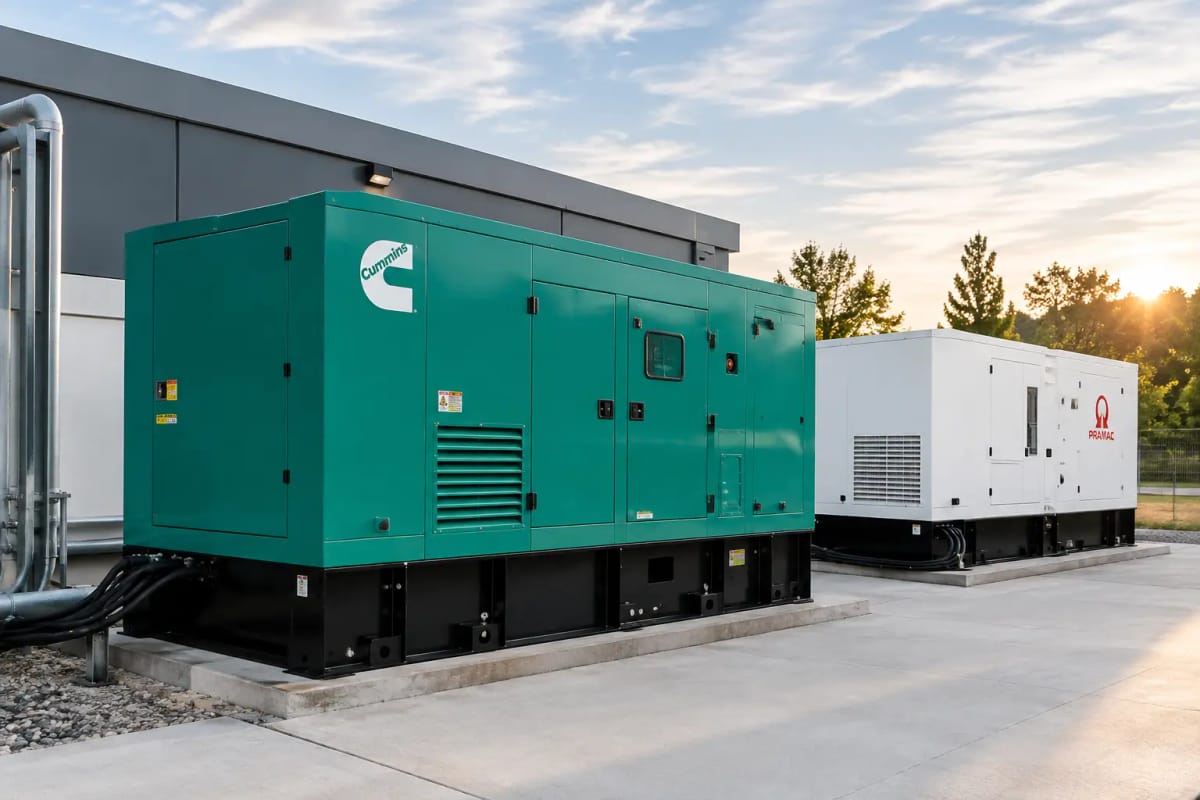
A generator can appear correctly sized on paper and still be the wrong machine for the job. The usual cause is not the kVA figure itself, but the duty rating behind it. Prime versus standby power determines how long a generator can run, what load it can support and whether the engine, alternator and cooling system are specified for the site’s real operating pattern.
For a hospital, logistics depot, data facility or manufacturing plant, that distinction has direct operational and commercial consequences. A standby-rated generator may provide more headline kVA than its prime-rated equivalent, yet it is not designed to carry regular production loads. Specifying it for continuous use can shorten service life, invalidate assumptions around maintenance and leave the site exposed when power is needed most.
What is prime power?
Prime power, commonly shown as PRP, is intended for applications where the generator operates as the main source of electricity for variable loads over an unlimited number of annual operating hours. Typical applications include remote construction sites, quarries, temporary utilities, agricultural operations, telecoms infrastructure and facilities in areas with an unreliable mains supply.
A prime-rated set is engineered for sustained operation. Its rated output reflects the capacity it can provide over extended periods, subject to the manufacturer’s operating conditions and maintenance schedule. Load can vary during operation, but the generator should not be treated as a permanently fully loaded machine.
Under ISO 8528 guidance, prime power is generally based on variable load operation, with an average load commonly considered over a 24-hour period. Some manufacturers permit a limited overload allowance under defined conditions, while others do not. The data sheet for the selected generator is the authority here. Do not assume an overload allowance applies simply because a previous set had one.
Prime power is the appropriate starting point when the generator will run daily, for long shifts, or whenever there is no certainty that utility power will be available. It is not just a standby set with a different label. The rating reflects a different duty expectation.
What is standby power?
Standby power is intended for emergency use when the normal utility supply fails. It is often described as emergency standby power, or ESP. The generator remains off or in automatic standby until an outage occurs, then starts through an automatic mains failure arrangement and carries essential or full-site loads for the duration of that event.
Because standby duty is intermittent and limited, the standby kVA rating is often higher than the prime rating for the same generator model. This can make a standby unit look more attractive during an initial comparison. However, that higher figure should not be used to justify routine operation, load banking production equipment or supporting a site through frequent grid failures without reviewing the duty cycle.
ISO 8528 emergency standby power is commonly associated with limited annual running hours, often up to 200 hours, with variable load and no overload capability. Exact limits and permitted loading conditions vary by manufacturer, engine and specification. Where outages are frequent, prolonged or predictable, a prime-rated generator may be the safer commercial choice even if the intended role is nominally backup power.
A standby set is well suited to buildings with a reliable utility connection where interruption is unusual but unacceptable. Examples include offices, healthcare facilities, retail distribution centres, commercial premises and critical building services. The key condition is that the generator is not expected to become a regular source of operational power.
Prime versus standby power: the practical difference
The central question is not, “How much power does the site need?” It is, “How much power does the site need, for how long and how often?” A generator supporting a six-hour outage twice a year has a very different duty from one operating ten hours a day while a utility connection is installed.
A prime-rated generator supports ongoing, variable-load operation. A standby-rated generator supports infrequent emergency events. Both may use the same engine family, alternator manufacturer and enclosure format, but their published ratings are not interchangeable.
This affects procurement in several ways. Selecting on the higher standby figure alone can result in insufficient prime capacity. Conversely, specifying prime power for a low-hour standby application may increase capital cost unnecessarily. The correct selection balances expected runtime, actual load, future load growth, resilience requirements and service access.
It also affects fuel planning. A set running continuously will require a fuel storage strategy, refuelling arrangements and operating procedures that are very different from those needed for occasional backup use. For remote prime-power sites, fuel autonomy and reliable delivery can be as critical as the generator rating.
Size the generator around the real load profile
A generator should be selected against measured or properly calculated load, not an estimate based solely on the site’s incomer size. An incomer may reflect future expansion or maximum theoretical capacity rather than the demand the generator will actually see.
Start by identifying the running load in kW, the required apparent power in kVA and the power factor of the connected equipment. Then assess what happens at start-up. Motors, pumps, compressors, lifts and refrigeration equipment can produce significant inrush current. Variable speed drives, UPS systems, battery chargers and non-linear loads can also affect alternator sizing and voltage performance.
For many sites, staged load acceptance is preferable to starting every circuit at once. A properly configured automatic transfer switch and load-shedding strategy can reduce the generator size required while protecting priority services. Critical loads such as fire systems, life safety equipment, process controls, refrigeration or communications should be identified separately from non-essential demand.
Allow sensible capacity for growth, but avoid excessive oversizing. A diesel generator that spends long periods at very low load can suffer from inefficient operation and poor combustion conditions. The acceptable loading range depends on the engine and operating profile, so this should be reviewed with the generator supplier rather than applied as a fixed rule.
Consider the operating environment, not just the rating
Ambient temperature, altitude, dust, humidity and enclosure design all influence available performance. A generator rated at a standard reference condition may require derating in high temperatures or at elevation. If the set is being installed in a plant room, the ventilation system must remove radiator heat and provide sufficient combustion air without recirculating hot discharge air.
Acoustic requirements matter as well. A silent generator is often essential near occupied buildings, residential boundaries or public-facing sites. An open generator may suit a protected plant room or a containerised installation where acoustic treatment is provided separately. Neither format changes the prime or standby duty rating, but each changes the practical installation scope.
Fuel tank capacity should match the required autonomy. For standby installations, this may be based on a defined emergency duration. For prime-power applications, it should account for normal consumption, safe refuelling intervals, weather disruption and access for a fuel lorry. Secondary containment, fire safety and local planning requirements should be considered from the outset.
When standby duty becomes prime duty
Sites sometimes begin with a standby generator and later experience repeated grid instability, network upgrades or extended utility outages. At that point, the original operating assumption may no longer be valid. Logging generator hours, loading and outage duration provides the evidence needed to reassess the specification.
A standby generator that runs regularly for planned demand management, construction support or production continuity is no longer performing a purely emergency role. Continuing with that arrangement may appear cost-effective in the short term, but it can create avoidable maintenance, warranty and reliability risks.
Where resilience is critical, a better solution may be a prime-rated generator, a larger fuel system, parallel generating sets or a revised load-priority plan. The right route depends on whether the risk is short interruptions, long-duration outages or a permanently weak utility supply.
Specify the rating before comparing prices
A meaningful generator quotation should state the prime and standby kVA ratings, engine and alternator details, voltage and frequency, enclosure type, fuel tank arrangement, control panel and transfer equipment requirements. It should also confirm the intended duty and any site conditions that affect output.
This allows like-for-like comparison. Two generators described as “500 kVA” may have different ratings, different fuel autonomy and very different suitability for the required operation. The lowest purchase price is not a useful benchmark if the set cannot meet the actual duty cycle.
Global Generators supports buyers across standby and prime-power applications, from smaller commercial installations to large industrial projects. Providing the expected runtime, load profile, starting requirements and installation environment at enquiry stage enables the set to be matched to the duty rather than simply selected from a headline kVA figure.
Before committing to a generator, confirm how the site will use it on its most demanding day, not its most optimistic one. That single decision will determine whether standby or prime power is the rating that protects uptime when it matters.