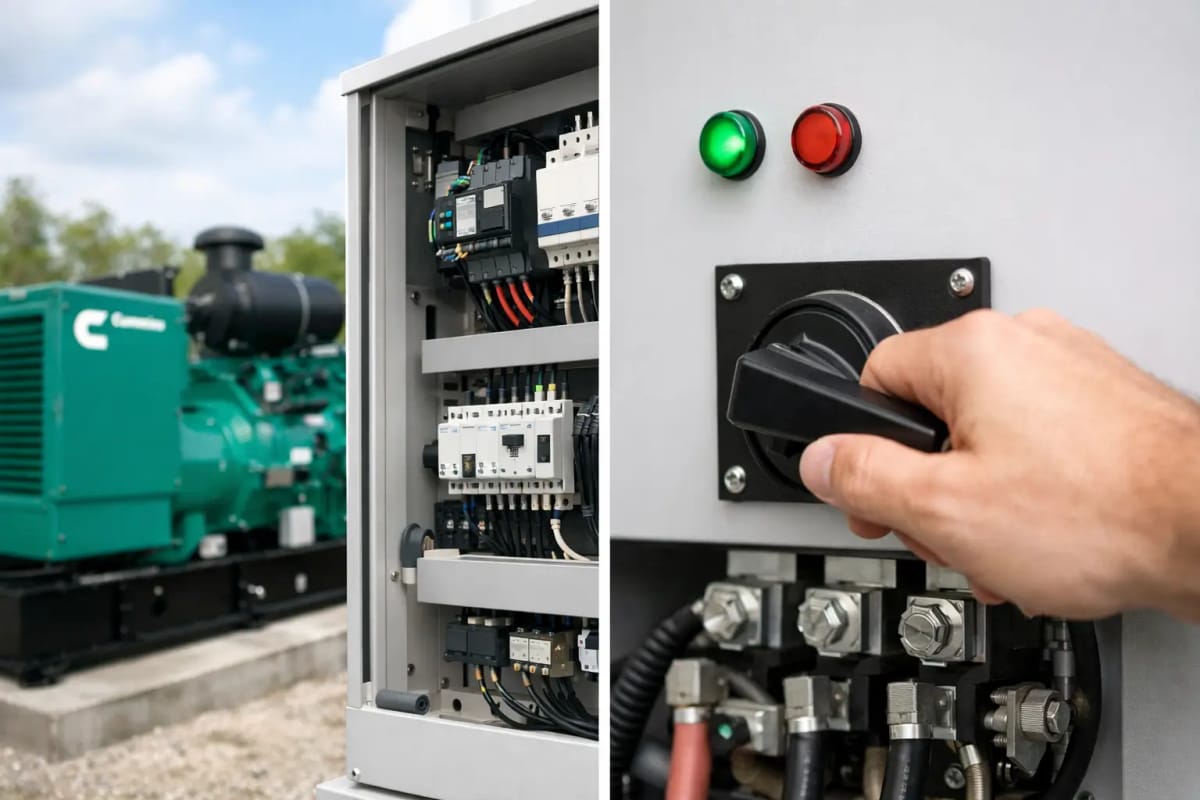
A generator can have the correct kVA rating, proven engine and adequate fuel autonomy, yet still leave a site exposed if changeover is not properly specified. The decision between automatic versus manual transfer switches determines how quickly a standby generator assumes the load, who must be present, and how much risk remains during a mains failure.
For a small site with a trained operator on duty, a manual arrangement may be entirely appropriate. For a data room, care environment, telecoms installation, production line or remotely managed facility, waiting for somebody to operate a switch can be unacceptable. The right choice depends on the consequence of interruption, the generator duty, the electrical installation and the operating procedures around the site.
What a transfer switch does
A transfer switch changes the supply feeding a distribution board or defined essential-load panel. Under normal conditions, that supply is usually the mains. When the mains fails or falls outside agreed voltage and frequency limits, the switch transfers the load to the generator supply. Once utility power is stable again, it returns the load to mains power and allows the generator to complete its cooling run.
The switch must prevent the generator and utility from being connected in parallel unless the installation has been specifically designed and controlled for synchronisation. In a conventional standby system, this break-before-make function protects equipment, personnel and the network connection.
Transfer equipment is not an accessory to be selected after the generator. Its rating, pole configuration, switching duty, fault withstand capability, control logic and physical location all need to align with the generator and the site's electrical design.
Automatic versus manual transfer switches: the operating difference
A manual transfer switch requires an authorised person to identify a supply failure, start the generator if necessary, confirm stable output and move the load from mains to generator. Depending on the equipment, this may be a manual changeover switch or a mechanically interlocked pair of switching devices. The essential point is that human intervention is required.
An automatic transfer switch, commonly called an ATS, monitors the incoming mains supply. When it detects a qualifying failure, it sends a remote start command to the generator. After the generator reaches acceptable voltage and frequency, the ATS transfers the load automatically. It then monitors the returning mains supply, waits for a programmed retransfer delay, returns the load and stops the generator after cooldown.
Neither system provides genuinely uninterrupted power in the way a UPS does. An ATS has a short but real interruption while the generator starts and the switch transfers. Sensitive IT, controls and emergency systems may need UPS support to bridge that interval. The transfer switch and UPS should be engineered as one continuity strategy, not bought as unrelated items.
When a manual transfer switch is the right commercial choice
Manual changeover equipment is often the lower-cost and simpler solution. It can be suitable where a generator is deployed occasionally, a competent operator is reliably available, and a short interruption does not create a safety, compliance or financial event. Construction compounds, agricultural sites, workshops, temporary works and some small commercial premises may fall into this category.
The advantages are clear: lower initial equipment cost, straightforward controls and fewer automated components to commission. Operators also retain direct control over when the generator takes the load, which can be useful where a site wants to assess the cause of a local mains issue before starting its set.
That simplicity does not remove the need for discipline. The operator must know the sequence, understand the load limit, verify generator oil, coolant and fuel status, and avoid attempting a transfer when the generator output is unstable. Written procedures and periodic practical testing are essential. A manual system that depends on one keyholder is not a resilient system.
Manual transfer is a weaker fit where the premises are unmanned overnight, response times are uncertain, or the power loss affects life safety systems, refrigerated stock, security, communications or process equipment. The apparent saving can be minor beside the cost of an avoidable outage.
Where an ATS earns its cost
An ATS is usually specified when restoration speed and independence from personnel are central to the standby-power requirement. It allows the generator to respond even when no operator is on site and provides a repeatable transfer sequence during an event that may occur outside normal working hours.
For mission-critical applications, automatic changeover reduces the operational gap between a utility failure and generator support. This matters in healthcare support areas, logistics operations, large commercial buildings, manufacturing processes, telecoms, utilities and critical infrastructure. It is equally valuable where an outage may not stop operations immediately but would leave a site without heating controls, pumps, access control, fire-system interfaces or monitored security.
An ATS also supports routine testing. With the correct controls and site permissions, generators can be exercised under load at planned intervals, helping expose faults that a no-load start test will not reveal. However, automatic operation does not mean maintenance-free operation. Batteries, chargers, fuel systems, generator controls, sensing circuits and the transfer mechanism all require inspection and test.
The cost of an ATS includes more than the switch itself. Allow for installation, control cabling, commissioning, protection coordination and potentially a suitably rated generator control panel. These costs should be assessed against the site’s realistic downtime exposure, not treated as an optional electrical upgrade.
Specification points that affect performance
A transfer switch must be sized for the intended load and installation conditions, rather than simply matching the generator headline kVA. Continuous current, inrush current, motor starting, power factor, load diversity and future expansion all matter. A site with pumps, lifts, compressors or large fans may create switching and starting conditions that require careful review.
Rated current and fault duty
The equipment must carry the full design current and withstand the prospective short-circuit level at its point of installation. Fault rating is often overlooked when a generator package is selected separately from the building’s main electrical infrastructure. The panel builder or electrical designer should confirm protective-device coordination and conditional short-circuit ratings.
Three-pole or four-pole switching
Whether the neutral is switched is a design decision with practical safety implications. A three-pole switch leaves the neutral connected, while a four-pole switch transfers it. The correct arrangement depends on the earthing system, generator neutral-earth bonding, RCD protection and the wider installation design. This should be confirmed by a competent electrical engineer, not assumed from the generator size.
Open transition, delayed transition and bypass arrangements
Most standby installations use open-transition switching: the mains connection opens before the generator connection closes. Some loads may need a programmed delay between sources to allow residual motor voltage to decay. Higher-resilience sites may require bypass-isolation transfer equipment so the ATS can be maintained without removing the critical supply, subject to the electrical design.
Load prioritisation
A generator does not always need to support the entire building. Splitting essential and non-essential circuits can reduce the required generator rating and improve recovery performance. An ATS can be used with load-shedding controls to bring priority loads on first, then add lower-priority circuits once the generator has stabilised. This is often more commercially sensible than oversizing a set to carry every non-critical load.
Generator controls, fuel and location still determine uptime
Automatic transfer equipment cannot compensate for an incorrectly specified generator. The set must have the appropriate standby or prime power rating, sufficient capacity for starting loads, a dependable starting battery system and fuel provision matched to the required run time. A silent enclosure may be necessary where noise restrictions apply, while an open generator may suit a protected plant room or containerised installation.
The control panel must support automatic remote start and communicate correctly with the ATS. Commissioning should prove the complete sequence: mains failure sensing, generator start, warm-up where programmed, transfer, load acceptance, mains restoration, retransfer and cooldown. Testing only that the engine starts is not proof that the standby system will protect the site.
Location also matters. The ATS should be accessible for inspection without putting operatives at risk, protected from unsuitable environmental conditions, and installed with cable routes that support safe isolation and maintenance. For outdoor generator packages, cable entry, weather protection and emergency access should be established before delivery.
A practical decision for procurement teams
Choose a manual transfer switch when the site can tolerate a controlled delay, trained staff are always available and the operational case for automation is limited. Choose an ATS when downtime exposure is high, response must be consistent, the site may be unmanned, or standby power supports essential systems.
Before requesting quotations, define the required generator rating, voltage, phase, essential-load schedule, maximum acceptable outage time, earthing arrangement, preferred transfer location and any requirement for remote monitoring or bypass isolation. This gives suppliers and electrical contractors the information needed to specify a complete system rather than a generator and switch that only appear compatible on paper.
For critical sites, the most useful question is not whether an automatic switch costs more than a manual one. It is how long the operation can safely wait for a person to arrive, assess the fault and act. That answer should set the transfer strategy from the start.