A mains failure rarely affects every system equally. The first problem is usually not generating electricity, but deciding which loads must remain live, how quickly they must recover, and how long they need to run. This emergency power continuity guide sets out the decisions facilities, operations and project teams need to make before an outage tests the site.
For a warehouse, lost power may stop conveyor systems, security and goods handling. For a healthcare facility, it can affect life-safety systems, clinical equipment and cold storage. On a manufacturing site, an uncontrolled shutdown can damage product, machinery and production schedules. The generator is a critical part of the solution, but only when its rating, controls, fuel arrangement and installation are matched to the actual operational risk.
Start With the Consequences of Failure
A continuity plan should begin with a load and risk assessment, not a generator size. Identify the operational effect of a power interruption at 10 seconds, 10 minutes, 10 hours and several days. This exposes the difference between systems that need immediate support and those that can remain offline until normal supplies return.
Separate loads into clear operating priorities. Life-safety and statutory systems normally take precedence, followed by process controls, communications, security, refrigeration, IT infrastructure and essential production equipment. Some loads can be shed automatically during generator operation, while others may need to restart in a controlled sequence to prevent excessive starting demand.
The critical-load schedule should record the running kW, kVA, power factor, starting method and required recovery time for each item. Include less obvious equipment such as fire pumps, smoke extraction, gate controls, sump pumps, fuel transfer pumps and battery chargers. These items are often overlooked until they are needed.
A site also needs to establish whether its objective is standby protection or prime power operation. Standby generators are designed for use during utility outages, with the appropriate emergency rating and operating limits. Prime-rated sets are intended for variable load operation where the generator may be the principal source of power. Applying a standby rating to an extended off-grid duty can shorten service life and create avoidable reliability risk.
Specify the Generator Around the Real Load
Generator sizing is not simply a matter of adding connected loads and selecting the next available kVA. A set that is too small may suffer voltage and frequency dip when large motors start. A heavily oversized set can run at low load for prolonged periods, increasing the risk of wet stacking, inefficient fuel use and maintenance issues.
The right capacity depends on the maximum expected running load, future allowance, motor starts, non-linear loads and load acceptance requirements. Variable speed drives, UPS systems, welding equipment and some modern power supplies can introduce harmonic distortion or poor power factor. Their effect should be assessed as part of the specification, rather than treated as a standard load.
Motor starting is particularly important. Direct-on-line starting can demand several times the normal running current. Soft starters, star-delta arrangements and variable speed drives reduce the impact, but the generator and alternator must still be checked against the actual starting sequence. Where several motors restart after a mains failure, staged controls can make a smaller and more efficient generator viable.
Voltage and phase must match the site distribution. Most commercial and industrial premises require a 400/230V, 50Hz, three-phase generator, but single-phase loads, specialist voltages and export applications may need alternative configurations. The generator should also be specified with a suitable neutral and earthing arrangement, coordinated with the existing installation and protective devices.
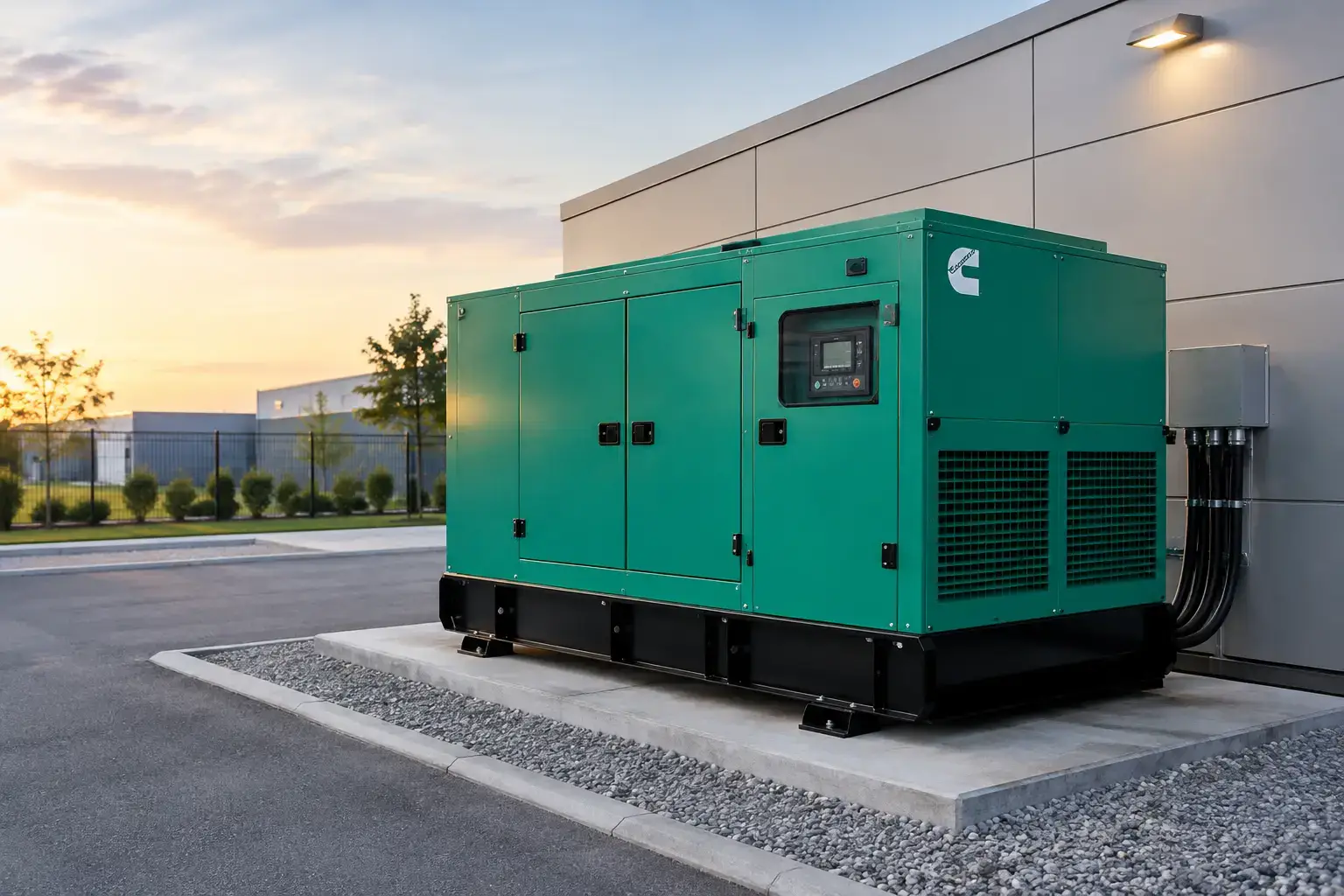
For buyers comparing sets, the core information should be visible from the outset: standby and prime ratings, engine manufacturer, alternator, control panel, enclosure type, fuel tank capacity, voltage, frequency and dimensions. Cummins-powered generator sets are widely specified for demanding applications because parts support, service familiarity and proven industrial performance matter when uptime is the priority.
Emergency Power Continuity Guide: Transfer and Control
A generator only protects the site if it starts and transfers the load correctly. In most standby applications, an automatic transfer switch monitors the mains supply, sends a start signal after a defined failure period, and transfers essential circuits once generator voltage and frequency are stable. When the mains returns, the system transfers back after a programmed delay and allows the generator to cool down before stopping.
Transfer equipment needs to be rated for the fault level, load type and switching duty of the installation. It must also be selected with the generator controls, distribution board and protection scheme in mind. A basic automatic transfer switch may be appropriate for a small commercial premises. Larger or more critical sites may require synchronised controls, multiple generators, mains paralleling or a dedicated critical-power board.
There is a trade-off between simplicity and resilience. A single generator with a standard transfer switch is straightforward to procure and maintain, but it remains a single point of failure. N+1 generator capacity, duplicate transfer paths and sectionalised distribution improve availability, but add capital cost, space requirements and control complexity. The appropriate design depends on the cost and safety implications of lost power, not on a generic standard.
UPS systems have a separate role. They bridge the seconds between loss of mains and generator acceptance, protecting equipment that cannot tolerate even a brief interruption. They are commonly used for servers, telecoms, control systems and certain clinical or laboratory loads. A UPS is not a substitute for a generator during a long outage, and a generator cannot replace a UPS where zero-break supply is required. Both systems must be designed to work together.
Fuel Autonomy Is Part of the Capacity Calculation
A correctly sized diesel generator cannot deliver continuity if the site has insufficient usable fuel. Required runtime should reflect the realistic duration of local network faults, weather events, planned works, supply-chain disruption and access constraints. Urban facilities with dependable fuel delivery may plan differently from remote sites, utilities or critical operations that must remain self-sufficient for extended periods.
Calculate fuel storage using anticipated generator loading rather than catalogue consumption at an unrelated duty point. Allow for the usable volume of the tank, fuel transfer arrangements, reserve policy and the fact that generator consumption changes with load. External bulk tanks may be necessary where extended autonomy is required, but they introduce requirements for bunding, fire safety, fuel polishing, pipework integrity and environmental compliance.
Fuel quality requires active management. Diesel held for long periods can suffer from water contamination, microbial growth and sediment. Regular sampling, filtration and fuel polishing should form part of the maintenance programme. A generator that starts successfully during a short monthly exercise can still fail under sustained load if the fuel system has not been maintained.
Choose an Installation Format That Supports Service
Silent canopy generators are usually the practical choice for commercial sites, public-facing premises and installations with noise restrictions. The enclosure provides weather protection and acoustic attenuation, although final noise performance depends on set location, reflected sound, exhaust design and the surrounding environment.
Open generator sets can be suitable inside a properly designed plant room or containerised installation. They provide good access for maintenance but require the wider installation to address ventilation, air flow, exhaust discharge, fire protection, drainage and noise control. A generator room that recirculates hot air can cause derating or shutdown precisely when the set is carrying its highest load.
Plan access before delivery. Confirm doorway dimensions, craneage, lorry access, plinth loading, maintenance clearances and the route for replacing major components. The lowest purchase price can become expensive if routine servicing requires extensive dismantling or if the generator cannot be removed without structural work.
Test the System, Not Just the Engine
Starting the generator unloaded proves only that the engine can run. It does not prove that the transfer switch operates, the critical board receives supply, the UPS accepts the generator waveform or that the generator can carry the required load without instability.
A practical test programme should include routine automatic start tests, periodic on-load runs and planned simulations of a mains failure. The frequency and scope should be based on site criticality, manufacturer guidance, insurer requirements and applicable standards. Record start time, voltage, frequency, oil pressure, coolant temperature, battery condition, alarms, fuel level and transfer performance after every significant test.
Load-bank testing is valuable where the site's normal demand cannot provide a sufficient test load. It confirms that the generator can sustain output and reach suitable operating temperature without placing critical processes at risk. However, it does not fully replace testing with real site loads, because it cannot reveal every issue in downstream distribution, switching or equipment restart behaviour.
Maintenance must cover batteries, chargers, coolant, belts, hoses, filters, air intake, exhaust, control-panel alarms and fuel condition. Keep a documented response procedure that states who can authorise load shedding, who contacts the fuel supplier, how faults are escalated and where manual operating instructions are held.
For sites where interruption has material consequences, power continuity should be treated as an engineered operational system rather than a generator purchase. Global Generators can support specification-led enquiries across standby and prime power ratings, helping buyers match generator capacity and configuration to the duty the site must sustain. The useful test is simple: if the mains failed at the busiest point of the working day, would the people on site know exactly what stays on, what transfers first and how long the operation can continue? If the answer is not clear, the continuity plan still needs work.