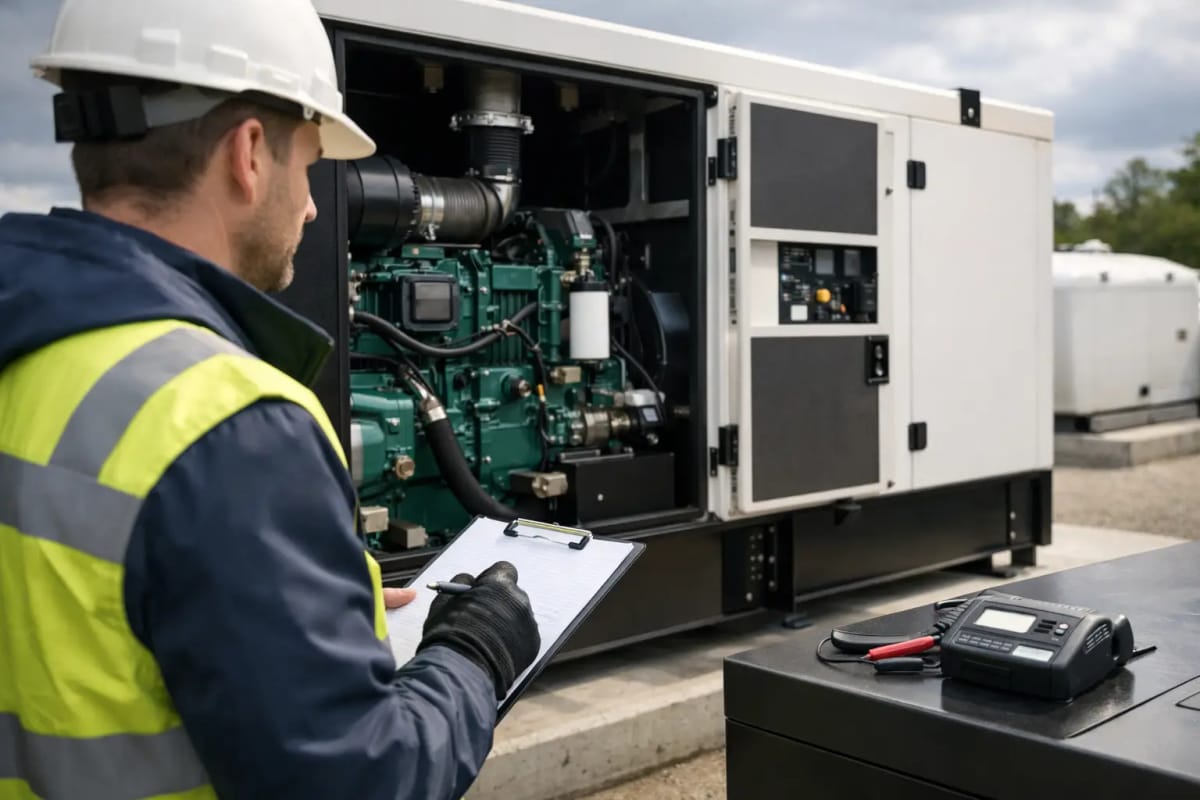
A standby generator that starts but cannot accept site load is not a reliable power system. This backup generator maintenance guide sets out the inspection, testing and servicing work required to keep critical power available when the mains supply fails. For facilities managers, plant engineers and operations teams, the objective is straightforward: identify deterioration while there is still time to correct it.
Generator maintenance should follow the engine and alternator manufacturer's requirements, the duty profile, local operating conditions and the site's risk tolerance. A low-hour set in a clean plant room needs different attention from a generator exposed to construction dust, coastal air or frequent utility failures. However, no standby installation should be treated as maintenance-free simply because it runs infrequently.
Start with the maintenance records
A controlled maintenance programme begins with accurate records. Record run hours, start attempts, alarms, fuel deliveries, load-test results, oil analysis, coolant readings and corrective work. This creates a usable operating history rather than a collection of isolated service sheets.
The log should also identify the generator's standby and prime ratings, engine model, alternator specification, control panel type, battery arrangement, fuel tank capacity and automatic transfer switch configuration. These details matter when setting service intervals and investigating faults. A 500 kVA standby set operating for thirty minutes each month will age differently from a similar-rated unit carrying regular prime power load.
Review every alarm, even if it cleared without intervention. Low battery voltage, low coolant level, charger failure and unsuccessful automatic starts are early warnings. Repeated minor faults often develop into the condition that prevents a set from starting during an outage.
Daily and weekly generator checks
For sites with high consequence of failure, a nominated competent person should complete routine visual inspections. This work is not a substitute for planned servicing, but it identifies obvious problems before they affect availability.
Check the area around the generator for fuel, oil or coolant leaks, loose covers, damaged cabling, obstructions to ventilation and signs of pest activity. Examine the exhaust route, silencer supports and flexible sections for corrosion or damage. On silent generators, confirm that enclosure doors, locks, acoustic seals and air intake paths remain secure and clear.
At the control panel, confirm the set is in automatic mode, with no active fault preventing remote start. Verify battery charger operation, coolant level, engine oil level and fuel level. Check that emergency stop devices have not been left engaged after earlier work.
The transfer arrangement deserves equal attention. A generator may start correctly while the automatic transfer switch fails to move the load. Inspect the ATS status indicators and test its operation according to the approved site procedure. Any test that transfers live critical loads must be planned carefully, especially in healthcare, data, telecoms and process environments.
Exercise the generator under meaningful conditions
A no-load exercise confirms that the engine can start and run, but it does not prove that the generator can support the facility. It places limited demand on the alternator, cooling system, fuel system and exhaust system. For standby systems, regular exercise should be combined with periodic load testing.
Run the generator at the frequency specified by the equipment manufacturer and site maintenance plan. During the run, observe oil pressure, coolant temperature, frequency, voltage, charging performance and exhaust condition. Allow the engine to reach operating temperature. A brief cold start followed by immediate shutdown may create more problems than it solves, particularly where moisture accumulates in the exhaust and crankcase.
Load-bank testing provides a controlled way to assess performance where transferring the building load is impractical or undesirable. It can confirm that the set holds voltage and frequency at increasing load steps, that the cooling system controls temperature, and that the engine responds correctly to demand. It also helps prevent light-load operation from causing carbon build-up and wet stacking in diesel engines.
The required test load and duration depend on the generator rating, normal site demand and manufacturer guidance. Do not assume a single load-bank test proves long-term capability. Fuel quality, batteries, controls and transfer equipment can deteriorate between tests.
Test the whole emergency power chain
A generator is one component in a wider system. Planned testing should consider the mains failure signal, generator controller, starter batteries, fuel supply, engine, alternator, circuit breakers, ATS and essential distribution. The point is to verify the sequence that will occur during a genuine loss of supply.
Where operational risk permits, carry out a documented simulated mains-failure test. Confirm the generator receives the start command, reaches stable output, transfers the agreed loads and returns to normal supply correctly. Check cooldown and stop functions afterwards. If the site uses multiple sets, synchronisation controls or a parallel control panel, testing must also confirm load sharing and failure response.
Manage diesel fuel as a serviceable asset
Stored diesel is a common source of standby generator failure. Water ingress, microbial growth, sediment and fuel ageing can restrict filters, damage injection equipment and reduce starting reliability. This risk increases where a generator has a large tank but low annual running hours.
Inspect bulk and day tanks for water, contamination, corrosion and signs of leakage. Drain water traps where fitted, and ensure tank vents, fill points and bund arrangements are in good condition. Fuel polishing may be appropriate for sites with extended storage periods, significant tank volumes or known contamination history.
Fuel filters should be replaced at the prescribed interval or sooner if differential pressure, poor running or contamination indicates restriction. Following fuel work, check carefully for air leaks and ensure the system is primed correctly. A generator that has been serviced but not test-run after a filter change has not been proven ready.
Cold-weather arrangements also require attention. In exposed UK locations, confirm that the selected fuel grade, tank heater provision and enclosure protection are suitable for expected winter conditions. Fuel waxing or water contamination can prevent reliable operation at the exact time demand is highest.
Protect batteries, cooling and lubrication systems
Starter batteries are often the weakest point in an otherwise well-maintained installation. Inspect battery terminals for corrosion, confirm tight connections, check electrolyte condition where applicable and verify charger voltage. Replace batteries based on condition and age, not only when they fail a start attempt. Battery replacement should be planned so that the generator is never left without an effective starting source.
Check engine oil for level, condition and contamination. Change oil and filters to the engine manufacturer's time and hour-based schedule. Standby engines may reach their calendar service date long before their hour interval. Oil analysis can add value for larger industrial sets, particularly where operating conditions are severe or where maintenance teams need evidence to support service decisions.
Maintain coolant concentration and corrosion protection to the specified standard. Inspect hoses, clips, radiator cores, belts and water pumps for wear or leakage. Clean radiators and enclosure air paths without damaging fins. Restricted airflow is especially problematic in plant rooms, where poor ventilation can raise ambient temperatures and reduce available generator performance.
Planned servicing intervals and competent support
There is no universal service interval that fits every generator. Manufacturer guidance remains the baseline, but the final schedule must account for run hours, starts, load profile, environmental exposure, fuel storage period and the site's required availability. A set supporting a life-safety system warrants more frequent scrutiny than a unit retained for occasional commercial continuity.
A practical programme normally combines routine site inspections with scheduled minor and major services. Minor work commonly addresses oil, filters, fluids, belts, batteries and basic operating checks. Major service activity may include valve clearance inspection, injector or fuel-system assessment, coolant replacement, alternator inspection, control-system updates and comprehensive load testing.
Use competent engineers familiar with the specific engine, controller and generator configuration. Poor maintenance can introduce faults through incorrect fluid selection, loose electrical terminations, unsuitable replacement batteries or untested control changes. For Cummins-powered generator sets and other recognised industrial platforms, use the correct approved consumables and technical data for the installed model.
Act on defects before the next outage
A maintenance report should not end with a list of observations. Each defect needs an owner, a priority, a target completion date and a record of final verification. Categorise faults according to their effect on emergency availability. A failed charger, contaminated fuel supply or ATS fault should receive urgent action; cosmetic enclosure damage may be scheduled, unless it allows water ingress or compromises ventilation.
Keep essential consumables and critical spares proportionate to the site risk. Filters, belts, batteries, coolant, fuses and selected control components can reduce recovery time, but stocked parts do not replace competent diagnosis. For high-capacity or mission-critical installations, a service agreement and a defined escalation route provide clearer control than reacting to an alarm during an outage.
Global Generators can support specification-led buyers who need to match a replacement or additional diesel generator to the actual load, operating duty and installation environment. The correct kVA rating, enclosure format and standby or prime classification are part of maintainability as well as procurement.
A generator earns confidence through evidence: clean fuel, healthy batteries, recorded test results, controlled servicing and a transfer system proven to operate as one. Treat each scheduled inspection as an opportunity to remove uncertainty before the grid supply makes the decision for you.