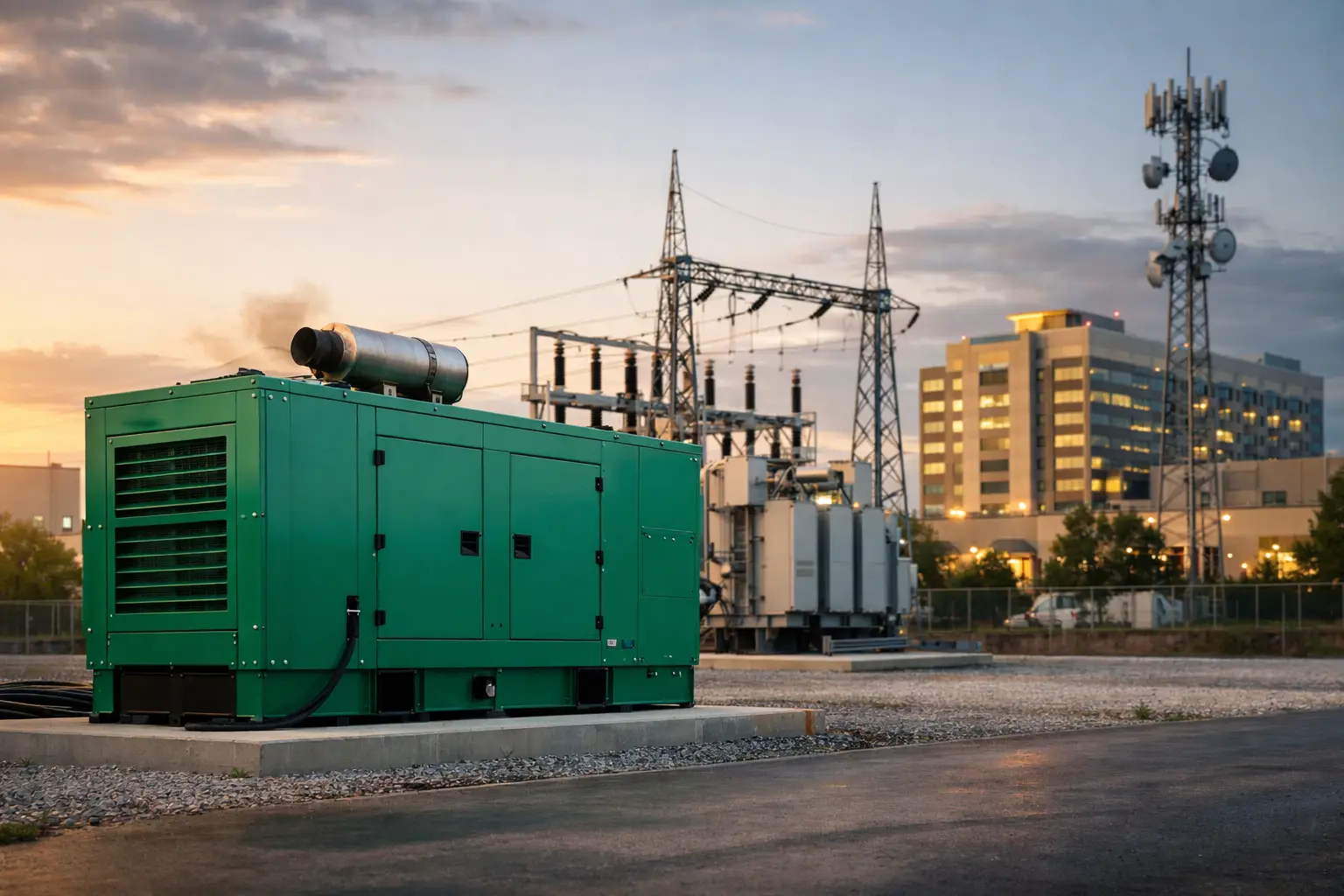
A generator for critical infrastructure is not a contingency purchase. It is a defined part of the site’s operating system, expected to carry essential load when the mains supply fails, grid quality deteriorates or a remote operation requires independent power. For a hospital, telecoms site, water asset, logistics hub or industrial plant, an underspecified set can turn a short utility outage into a safety event, production loss or contractual failure.
The correct specification starts with the consequence of losing power, not with the largest generator available. Buyers need to establish which loads must remain live, how those loads behave when starting, how long the set must run, and what level of resilience the site requires. That process determines the kVA rating, generator configuration, fuel system, controls and installation arrangement.
What critical infrastructure power must achieve
Critical infrastructure covers sites where a loss of electricity has consequences beyond ordinary inconvenience. This may include emergency lighting and life-safety systems, process controls, pumps, communications equipment, security systems, refrigerated stock, data rooms and essential production equipment. Not every load needs generator support. Separating essential from non-essential demand is often the most effective way to control generator size and capital cost.
A standby generator is normally intended to operate during utility failures. A prime power generator is designed for regular or continuous duty where grid power is unavailable, unreliable or insufficient. The distinction is fundamental. Selecting a standby-rated set for frequent operating hours can reduce service life, compromise performance and create avoidable warranty or maintenance issues.
The availability target also matters. A single generator may be suitable where a managed outage risk is acceptable. Sites with life-safety obligations, major financial exposure or no practical downtime window may require redundant generating capacity, duplicated fuel arrangements, automatic transfer equipment and a more rigorous maintenance regime. More equipment increases resilience, but it also increases cost, space requirements and testing responsibilities.
Sizing a generator for critical infrastructure
Generator sizing should be based on a proper load assessment rather than a total of equipment nameplates. Nameplate figures frequently overstate normal demand, while motor starting currents and nonlinear electronic loads can create short-duration demands that are not obvious from a simple kW total.
Start by recording the expected running load in kW, the power factor, the largest individual starting load and the required operating sequence. Pumps, compressors, lifts, fans and other motor-driven equipment can impose significant starting demand. Variable speed drives, UPS systems and rectifiers may also affect harmonic performance and alternator selection.
The relationship between kW and kVA must be handled correctly. Generator sets are generally rated in kVA, but a site consumes real power in kW. At a power factor of 0.8, a 500 kVA generator provides 400 kW of capacity. If the site power factor differs, or if the load profile contains substantial harmonics, the usable capacity may change. A competent specification accounts for these conditions rather than relying on a generic conversion.
Allowing sensible growth margin is good engineering. Excessive oversizing is not. Diesel generators operating at persistently light loads can experience poor combustion and wet stacking, increasing maintenance demands and reducing efficiency. The right approach is to allow for credible future load growth and load steps while keeping the expected operating load within the engine manufacturer’s recommended range.
Load sequencing can reduce required capacity
Where practical, a control strategy can stage large loads after the generator has stabilised. For example, essential controls, communications and lighting may connect first, followed by pumps or mechanical plant in a managed sequence. This reduces the largest instantaneous demand and may avoid specifying a substantially larger generator.
That option depends on the process. A fire pump, critical cooling system or process load may need immediate restoration and cannot be delayed for convenience. The operational requirement always takes priority over a smaller kVA figure.
Select the right generator configuration
Most critical commercial and industrial sites require a 3 phase generator, commonly at 400/230 V and 50 Hz for UK applications. Single phase sets are appropriate for smaller, simpler loads, but they are rarely suitable for substantial infrastructure systems. Phase balancing is also necessary where a three-phase set supports a mix of single-phase and three-phase equipment.
An open generator is typically installed within a purpose-built plant room or protected acoustic enclosure. It can be a cost-effective choice where ventilation, fire protection, exhaust routing and noise control are addressed at site level. A silent generator includes an acoustic canopy and is often better suited to external installations, occupied areas and projects with defined noise limits.
Neither format is automatically better. A canopy adds weather protection and noise attenuation, but it still requires suitable access, cooling airflow, exhaust discharge and clearance for maintenance. A plant-room installation offers protection and controlled access, but poor ventilation can cause high ambient temperatures, reduced output and engine shutdowns. The installation environment must be assessed before the configuration is selected.
For major duty requirements, recognised engine platforms such as Cummins provide established service support, proven performance and clear technical data. Engine brand should be considered alongside alternator quality, control system capability, local service arrangements and the availability of parts. The generator is a complete system, not simply an engine with an alternator attached.
Fuel autonomy and site conditions
Fuel capacity should reflect the required runtime, expected load, refuelling access and credible disruption scenario. A generator may consume considerably more fuel at higher load, so autonomy calculations must be based on the actual anticipated load profile, not just the tank volume. Critical sites should also consider fuel quality, water contamination prevention, filtration and the testing of stored diesel.
External bulk tanks can extend runtime, but introduce requirements around bunding, transfer pumps, leak detection, fire safety and site access for refuelling. In prolonged incidents, the logistics of getting fuel safely onto site may be as important as the generator’s consumption rate.
Environmental conditions can materially affect performance. High ambient temperature, altitude, coastal exposure, dust, flooding risk and restricted ventilation may all require derating, enhanced filtration, weather protection or specialist installation design. Noise restrictions can also determine canopy specification, exhaust silencing and generator location. These details should be resolved before procurement, not during commissioning.
Transfer, controls and monitoring are part of the solution
A generator does not protect a site if it cannot start, transfer and accept load when required. The automatic transfer switch, or ATS, detects a mains failure, starts the set and transfers essential loads to generator supply. Its rating, switching arrangement and interlocking must suit the electrical system and the site’s operating rules.
Controls should provide clear status indication, alarms, event history and remote monitoring where the application justifies it. Remote visibility allows facilities teams to identify low fuel, battery charger faults, abnormal temperatures and failed starts before an emergency exposes the problem. It does not replace routine inspection, load testing and planned maintenance.
For sites with multiple sources, synchronisation and load-sharing controls may be required. These systems can allow generators to operate in parallel, share load, support staged expansion or coordinate with utility supply. They offer operational benefits, but add commissioning complexity and require a supplier with relevant control-panel and application experience.
Procurement questions that prevent expensive errors
Before placing an order, establish the following points with the project team:
- Is the generator standby, prime or continuous-duty equipment?
- What is the measured essential load, including starting and step-load demand?
- How long must the site operate before refuelling is available?
- Is the installation external, in a plant room, or subject to strict acoustic limits?
- What transfer, monitoring, testing and redundancy arrangement is required?
A clear answer to these questions produces a specification that can be priced accurately and delivered without last-minute changes. It also allows buyers to compare quotations on equivalent ratings and equipment scope rather than comparing headline kVA figures alone.
Global Generators supplies industrial diesel generator sets across a wide power range, with silent, open, single-phase and three-phase configurations for standby and prime power applications. For critical projects, the most productive starting point is a technical enquiry supported by load information, duty requirement, site location and required delivery timescale.
The generator should be treated as a maintained operational asset from the first day of ownership. Specify it for the real load, install it for the real environment, and test it under conditions that resemble the failure it is expected to manage.