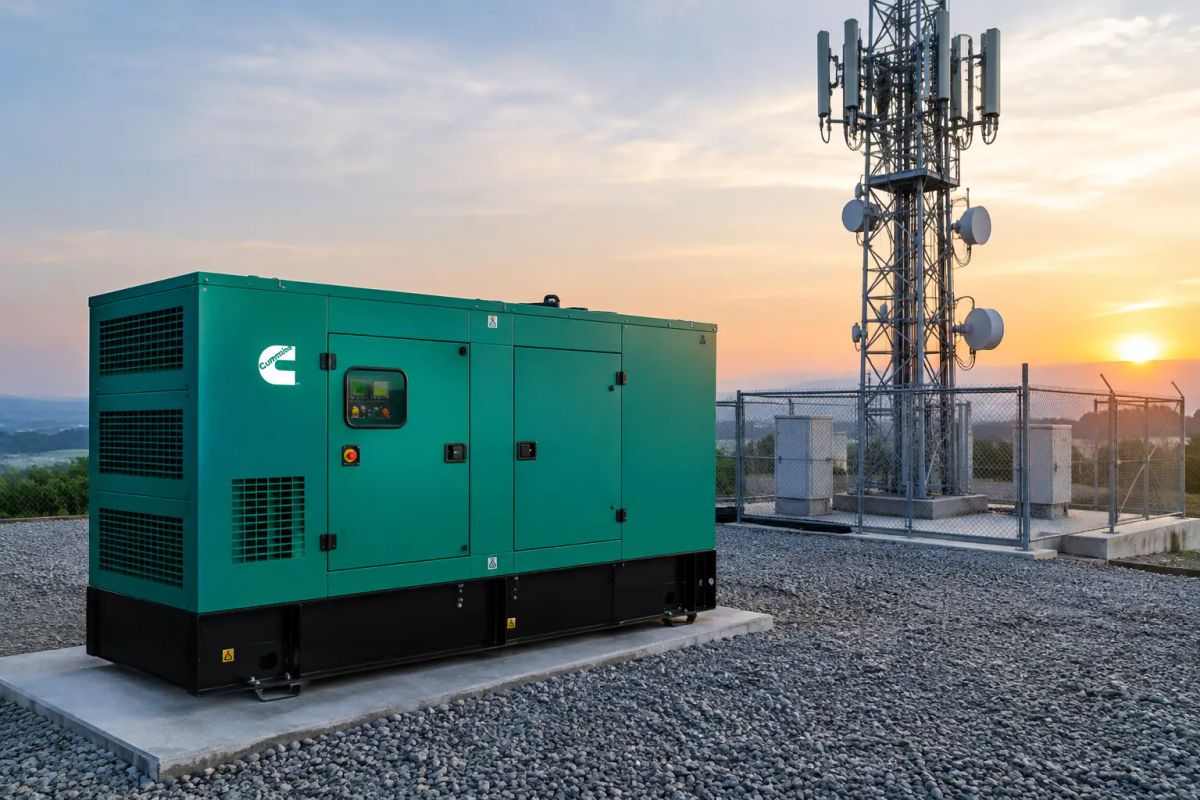
A telecoms site can tolerate neither a slow start nor an uncertain handover. When utility power fails, the generator must carry the DC plant, transmission equipment, cooling and essential site services without voltage instability or prolonged interruption. The best diesel generators for telecoms are therefore not simply the largest sets within budget. They are correctly rated, properly configured and supported by a fuel and maintenance strategy that reflects the site’s real operating risk.
For network operators, contractors and infrastructure managers, generator selection begins with the consequences of outage. A rural mast with a modest radio load has different requirements from a switching centre, data hub or urban rooftop installation. The right solution depends on load profile, runtime, acoustic limits, access, environmental conditions and whether the set is standby-only or expected to operate for extended prime-power periods.
Start With the Telecom Load, Not the Generator Size
Telecoms loads are frequently underestimated because the headline consumption of active equipment does not show the full picture. The generator may also need to support rectifiers and battery chargers, air conditioning or ventilation, security systems, aviation lighting, fire protection, site lighting and auxiliary sockets. Cooling demand can increase sharply during summer operation, exactly when a prolonged grid interruption places the most pressure on the site.
A proper load assessment should distinguish between continuous running load, expected peak load and motor starting demand. Air conditioning compressors, pumps and older fan systems can create short-duration starting currents that affect alternator and engine response. Modern variable-speed equipment may reduce this effect, but it should be confirmed rather than assumed.
Battery autonomy also matters. At many sites, batteries bridge the interval between mains failure and generator start, then recharge once the generator is online. The charging load can be substantial, particularly after an extended outage. Specify the generator around the highest credible combined load, with adequate margin for expansion and for stable performance at low and high load conditions.
Avoid selecting an oversized set solely as a precaution. Diesel generators consistently operated at very light load can suffer from poor combustion, carbon build-up and wet stacking. The objective is sufficient capacity and transient response without creating an engine that rarely reaches an appropriate operating load.
Best Diesel Generators for Telecoms: Key Specification Areas
The best diesel generators for telecoms are selected as complete power systems. The engine rating is critical, but enclosure, controls, fuel arrangement and electrical interface are equally important to uptime.
Standby or Prime Power Rating
A standby-rated generator is intended for emergency use when the normal utility supply fails. It is appropriate where the grid is generally dependable and outage hours are limited. A prime-rated generator is designed for variable load operation over extended periods, making it more suitable for remote sites, weak-grid locations, construction-phase telecoms infrastructure or locations where generators regularly support the network.
Do not treat these ratings as interchangeable. A site that experiences repeated or prolonged outages may exceed the intended duty of a standby set. This can affect service intervals, warranty conditions and long-term engine life. Procurement documents should clearly state expected annual operating hours, anticipated load factor and whether the site must maintain service during extended utility failures.
Engine and Alternator Quality
Proven industrial engines are a sensible choice where access may be restricted and a failure call-out could leave a coverage area exposed. Cummins-powered generator sets are widely specified for mission-critical applications because of established engine capability, service familiarity and availability across substantial power ranges.
The alternator should be matched to the site’s electrical characteristics, including non-linear loads from switch-mode power supplies and rectifier systems. A quality alternator and automatic voltage regulator help maintain voltage stability during step loads and battery recharge demand. For critical sites, request performance information for load acceptance rather than relying on kVA alone.
Three-Phase Supply and Voltage Compatibility
Most larger telecoms facilities require a three-phase generator, commonly configured for 400/230V operation in the UK. However, the site distribution arrangement, automatic transfer equipment and any dedicated DC power plant must be reviewed before ordering. Voltage, frequency, earthing arrangement and neutral configuration all need to match the installed system.
Single-phase sets can suit small ancillary loads or limited remote installations, but they are not a default telecoms answer. Where a site has three-phase cooling, distribution or future expansion plans, a three-phase generator provides a more appropriate basis for the installation.
Enclosure Choice Is an Operational Decision
A silent, weatherproof canopy is normally the preferred format for outdoor telecoms sites. It protects equipment from rain, dust and unauthorised interference while reducing noise exposure for nearby properties. Noise limits can be decisive on urban, rooftop, residential-edge and planning-sensitive locations, so acoustic performance should be assessed at the stated measurement distance and installation condition.
An open generator may be suitable inside a purpose-designed plant room with suitable ventilation, exhaust routing, fire precautions and acoustic treatment. It can offer straightforward service access and may be the right choice for a protected technical facility. It is not, however, a substitute for a properly ventilated generator room. Heat rejection, combustion air and exhaust back pressure must be engineered into the installation.
Physical dimensions deserve the same attention as acoustic figures. Confirm access routes, lifting points, door clearances, crane requirements and service-side space before delivery. A correctly specified set is of little use if routine maintenance cannot be completed safely after installation.
Fuel Runtime Must Match the Recovery Plan
Fuel resilience is often the limiting factor in telecoms backup power. An integral tank may provide several hours of operation, but that does not necessarily protect a site through a regional utility event, severe weather or restricted road access. Runtime should be calculated at the expected operational load, not only at an optimistic low-load figure.
For longer resilience targets, consider a larger base tank, external bulk storage or a managed refuelling arrangement. External tanks introduce further requirements around bunding, transfer pumps, leak detection, fuel polishing, security and compliance. The arrangement should also allow safe refuelling while the generator is operating where the site risk assessment permits it.
Diesel fuel quality needs active management. Water ingress, microbial growth and sediment can block filters and cause avoidable non-start events. Sites with long standby periods should have a planned fuel inspection and conditioning regime, especially where stored fuel is retained for extended periods.
Controls, Remote Monitoring and Automatic Transfer
A telecoms generator should start automatically after a mains failure and transfer the essential load through an appropriately rated automatic transfer switch. The controls package must provide clear alarms for low fuel, low oil pressure, high coolant temperature, battery condition, charger failure, failed start and common fault status.
Remote monitoring allows operations teams to confirm mains status, generator run condition, fuel level and active alarms without visiting the site. This shortens response times and helps prioritise refuelling or maintenance visits during widespread outages. Monitoring does not remove the need for scheduled inspections, but it provides visibility when sites are unattended.
For higher-tier facilities, consider features such as dual starting batteries, battery chargers with alarm outputs, jacket water heaters, remote emergency stop arrangements and load-bank connection points. The appropriate level of redundancy depends on the criticality of the node and the consequences of lost coverage or lost data traffic.
Installation Conditions Can Change the Required Rating
Generator performance is affected by ambient temperature, altitude and the installation environment. High summer temperatures, restricted airflow and poorly designed enclosures can reduce available output or trigger high-temperature alarms. Coastal locations introduce corrosion exposure, while dusty roadside or construction environments place greater demand on filtration and service frequency.
The generator must also be installed on a suitable base with secure fuel connections, correctly sized cabling, compliant earthing and a safe exhaust route. Electrical protection settings should be coordinated with the site distribution system. These details determine whether the equipment performs as expected when called upon, rather than merely passing a no-load commissioning test.
Procurement Should Include a Service Strategy
The purchase price of a generator is only one part of telecoms power resilience. Maintenance intervals, consumables, access to service engineers, availability of filters and belts, and emergency response arrangements all influence lifetime risk. Exercise the set regularly under meaningful load, inspect batteries and fuel systems, and record alarms and runtime trends.
Where a site is being upgraded, allow capacity for planned equipment additions but validate the revised load before making assumptions. A generator that was suitable for a legacy radio installation may be inadequate once cooling, transmission and battery capacity have increased.
Global Generators can support specification-led enquiries across standby and prime-rated diesel generator sets, including silent and open configurations for UK delivery and global export. Provide the anticipated load, voltage, runtime target, operating environment and site constraints at the outset to reach the right kVA and configuration quickly.
The most dependable telecoms generator is the one that has been sized for the actual site, installed for its environment and tested before the network needs it. Treat the specification as part of the network’s continuity plan, not as a separate equipment purchase.