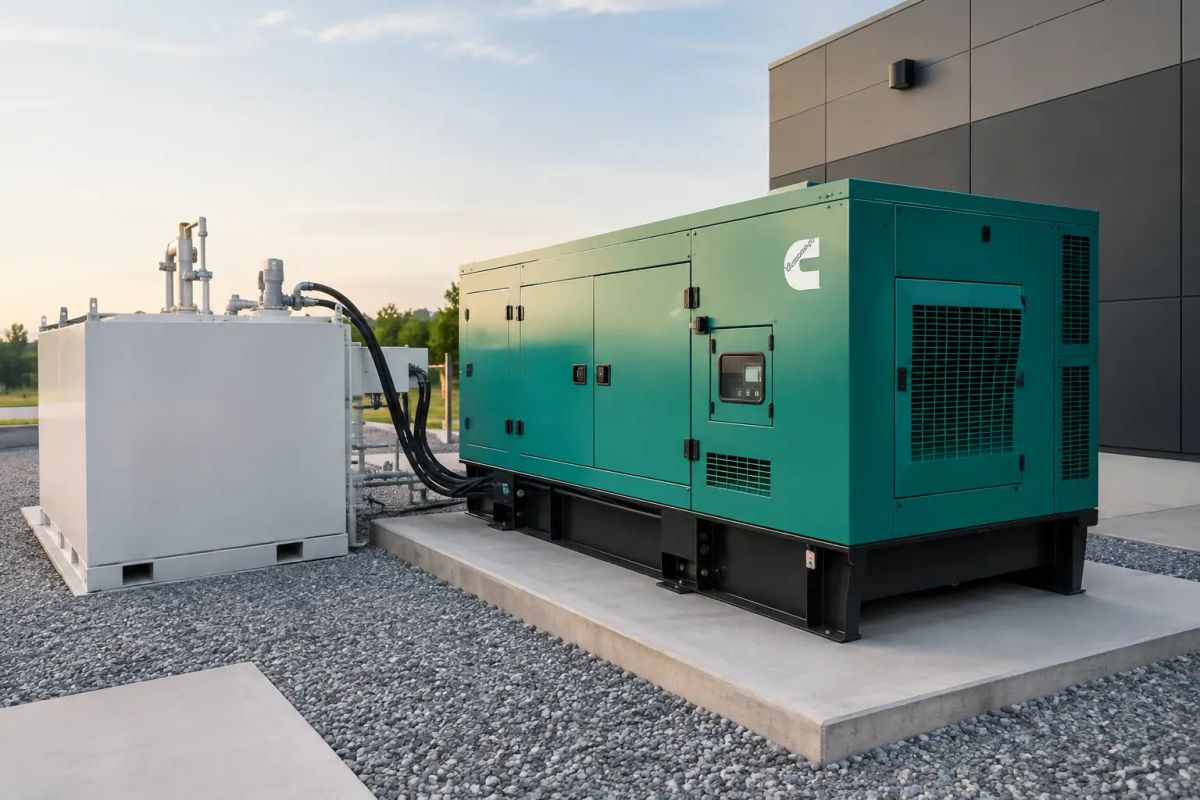
A generator that starts correctly but runs out of fuel before mains power is restored has not protected the site. Generator fuel capacity selection must therefore be treated as part of the power-system specification, not an afterthought once the generator rating has been chosen. The correct tank size depends on actual load, required autonomy, generator duty, refuelling arrangements and the practical limits of storing diesel on site.
For critical facilities, the objective is straightforward: maintain power for the required duration without creating an avoidable fuel-management, safety or capital-cost problem. More storage is not automatically better. An oversized tank can tie up capital, increase fuel ageing risk and demand more from the installation. An undersized tank leaves operations exposed precisely when access to fuel may be restricted.
Start with the required operating hours
The first decision is how long the generator must operate without refuelling. This is often called autonomy. A small commercial standby set may only require eight to 12 hours, particularly where fuel deliveries are dependable and site access is straightforward. A hospital, telecoms installation, logistics hub, utility asset or remote construction operation may require 24, 48 or 72 hours of autonomous running, sometimes longer.
The required runtime should reflect the credible failure scenario rather than a nominal outage. Consider how long local power failures have lasted, whether severe weather could delay tanker access, whether the site has a formal resilience target, and whether other nearby users will be competing for diesel. A generator installed at an urban office with multiple fuel suppliers available has a different fuel strategy from a remote water-treatment site reached by a single access road.
Where uptime requirements are particularly high, a day tank combined with a larger bulk storage tank may be appropriate. The day tank provides an immediate, controlled supply to the generating set, while the bulk tank supports extended operation. This arrangement needs correctly specified transfer pumps, level controls, alarms and containment. Fuel capacity alone does not guarantee runtime if the fuel-transfer system is inadequately designed.
Calculate consumption at the real load, not the nameplate rating
Diesel consumption varies materially with generator load. Fuel-use figures should be assessed at expected operating points, commonly 25%, 50%, 75% and 100% load, using the manufacturer’s data for the specific engine and generator set. Do not assume that a 500 kVA set will consume fuel as though it is continuously supplying 500 kVA.
A useful calculation is:
Required usable fuel volume (litres) = fuel consumption (litres per hour) × required runtime (hours) × contingency allowance
For example, if a generator consumes 72 litres per hour at the anticipated operating load and the site requires 24 hours of runtime, the base requirement is 1,728 litres. Applying a sensible contingency for load variation, weather, degradation and operational margin may take the usable fuel requirement to approximately 1,900 to 2,100 litres.
This is not necessarily the physical tank capacity. Tanks have unusable volume below the pickup point and should not be planned for continuous operation at their absolute maximum fill level. Final tank selection must account for minimum usable volume, fill limits and the requirements of the chosen fuel system.
The expected load profile matters as much as the peak. A set supporting a building’s full connected load may be correctly sized for a short peak but normally run at a much lower demand. Conversely, a site with motor starting, process equipment or major HVAC loads may experience sustained high demand after a mains failure. Load studies, preferably based on measured site data, prevent both poor fuel estimates and incorrect generator sizing.
Generator fuel capacity selection by duty rating
Standby and prime power applications require different thinking. A standby generator is intended for use during utility failure and usually operates for limited annual hours. Its tank capacity is generally set around outage resilience and refuelling access. The priority is assured runtime during an exceptional event.
A prime power generator may run for extended periods or serve as the main source of electricity at an off-grid site. Fuel consumption, delivery frequency and fuel quality become ongoing operating concerns. In this case, tank sizing should be assessed alongside the economics of fuel deliveries, expected loading, operating hours and planned maintenance. A tank that is too small can force frequent deliveries and create unnecessary downtime risk. One that is too large may retain diesel for too long if site demand reduces.
For continuous or highly variable prime-power applications, it may be preferable to specify a fuel-management system with remote monitoring and defined reorder levels rather than rely on infrequent manual checks. Site teams need warning before the fuel position becomes critical, not after a low-level shutdown alarm is triggered.
Allow for load steps, derating and future demand
Fuel calculations based on a single steady-state figure can be misleading. Generators frequently see load steps when pumps, compressors, refrigeration equipment or production machinery starts. The set must have sufficient electrical capacity and transient performance for these events, while the fuel plan must reflect the higher average load that may follow.
Environmental conditions can also affect the usable performance of the generator. High ambient temperature, altitude and restrictive installation conditions may require derating. If the generator is selected with little headroom, real operating load may sit closer to the set’s upper range than expected, increasing fuel consumption and reducing runtime.
Future expansion deserves the same attention. If a distribution centre plans additional racking automation, refrigeration or charging infrastructure, the generator and fuel storage strategy should not be frozen around current demand alone. It is often more cost-effective to provide a sensible allowance in the fuel system at installation than to undertake tank modifications after the site is operational.
Match the tank arrangement to the installation
Base-mounted tanks are a practical option for many standby generator installations. They save space, simplify delivery and can offer a defined runtime suitable for commercial and industrial applications. Their capacity is limited by the generator frame, transport considerations and site requirements, so they may not be sufficient where 24-hour-plus autonomy is required.
Separate external tanks provide greater capacity and flexibility but need careful planning. Tank location affects delivery access, pipe runs, protection from vehicle impact, security, containment and inspection access. The route for a fuel tanker should be reviewed early. A large tank offers little value if a delivery vehicle cannot safely reach the fill point during poor weather or a site incident.
Silent generators installed in acoustic enclosures can be suitable for noise-sensitive sites, while open sets are often selected for plant rooms or protected compounds. In either format, fuel lines, vents and tank fittings must be accessible for maintenance. The generator layout should support safe routine checks rather than make them difficult once the equipment is commissioned.
Protect fuel quality during storage
Diesel quality is a direct uptime issue. Water ingress, microbial contamination and sediment can block filters, damage fuel-system components and prevent a generator from starting or sustaining load. The risk increases where fuel is stored for long periods, tanks see changing temperatures or maintenance responsibility is unclear.
A practical fuel-management plan should include periodic visual inspection, water drainage where applicable, filter changes, sample testing for critical installations and fuel polishing when testing identifies contamination. Stored fuel should be managed to the requirements of the engine manufacturer and site operating procedures. It is also sensible to test the generator under load, because a brief no-load start does not confirm that the entire fuel and transfer system will perform under demand.
Remote level monitoring is valuable for dispersed estates and unmanned assets. It can provide early warning of unexpected consumption, fuel theft, delivery errors or a transfer-system fault. However, the alarm thresholds must be linked to an agreed response process. Monitoring without ownership does not improve resilience.
Specify the system, not just the litres
The final specification should state the required runtime at a defined load percentage, the usable and gross fuel capacities, the duty rating, tank configuration, fuel-transfer equipment, alarm requirements and refuelling access arrangements. This gives procurement teams, installers and operators a common basis for evaluating the solution.
At Global Generators, generator selection can be aligned with the expected load profile, standby or prime duty and practical fuel-storage requirement, from compact commercial sets to large industrial installations. The aim is not simply to supply a generator with a large tank, but to provide a power package that remains operational for the period the site actually needs.
Before placing an order, confirm the required autonomy against a realistic outage scenario and obtain manufacturer consumption figures for the anticipated load. That one discipline turns fuel capacity from a nominal specification into a dependable part of the site’s continuity plan.