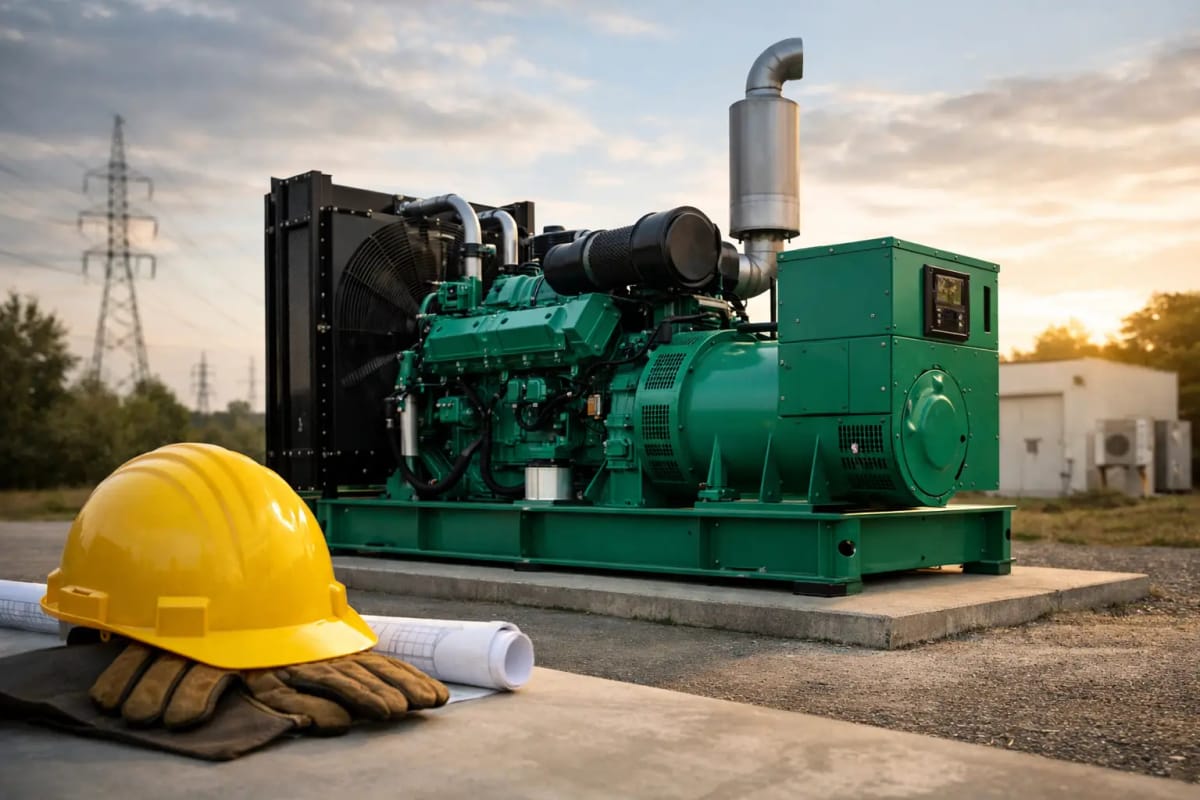
Power loss is rarely a minor inconvenience on a live site. In a factory, data facility, hospital support building or construction compound, the wrong choice of a diesel generator can mean production loss, safety exposure and expensive recovery time. The buying decision is not simply about kVA on a spec sheet. It is about matching load, duty, environment and installation constraints to a machine that will perform when required.
For most commercial and industrial buyers, that means starting with application rather than price. A lower upfront cost can be quickly outweighed by poor load acceptance, undersized capacity, excessive fuel use or the wrong enclosure format. The better approach is to specify around operational need, then compare generator options that meet it.
What a diesel generator needs to deliver
A diesel generator is expected to do one of two jobs. It either supports the site during a mains failure as standby power, or it carries regular operational load as prime power where utility supply is unavailable or unstable. Those two duties affect rating, engine loading, fuel planning and maintenance expectations.
Standby applications usually involve infrequent operation but high consequence if the set fails to start. Prime power duty is different. Here, the generator is part of normal site operation, often running for long periods and requiring stronger consideration of service intervals, fuel storage and load profile over time.
This is why headline output alone is not enough. Buyers need clarity on standby rating, prime rating, voltage, phase, frequency and environmental operating conditions. A unit that appears suitable on paper may be wrong in practice if starting currents, altitude, ambient temperature or future expansion have not been considered.
How to size a diesel generator properly
Sizing errors are one of the most common procurement problems. Undersizing creates immediate operational risk. The set may struggle with motor starting, voltage stability or load step changes. Oversizing is not harmless either. Running too lightly loaded for extended periods can reduce efficiency and create engine issues over time.
The starting point is the actual site load, not an estimate based on floor area or rough equipment count. A proper load schedule should identify running load, peak load and any major starting demands from motors, compressors, pumps or HVAC equipment. Non-linear loads, such as some IT and electronic systems, also need attention because they can affect alternator and control system specification.
Diversity matters. Not every load starts or operates at once, but critical systems often do need guaranteed support under worst-case conditions. Where future load growth is likely, some headroom is sensible. The right margin depends on application. Too much margin can be inefficient, while too little leaves no resilience.
For this reason, serious buyers often work backwards from the operational risk. What must stay live, what can sequence on later, and what is expected from the generator within the first few seconds after a power event? Those answers usually determine the right kVA band far more accurately than generic rules of thumb.
Standby or prime power changes the specification
A standby-rated set that runs only during outages is not specified in the same way as a prime-rated set supporting a remote facility or a continuous process. Prime power applications place greater emphasis on fuel efficiency under sustained load, maintenance planning and engine durability under regular use.
Standby installations, by contrast, often focus on fast start performance, automatic transfer compatibility, emissions compliance and readiness after long periods in reserve. In both cases, buyers should ask how the generator is expected to perform at partial load, during load step changes and over realistic operating cycles rather than ideal test conditions.
This is where recognised engine platforms matter. Proven diesel engine brands remain the preferred choice in critical environments because service familiarity, parts availability and known performance characteristics reduce lifecycle uncertainty. That is especially relevant when uptime is tied to contractual penalties, safety obligations or business continuity requirements.
Open or silent generator set
Enclosure choice should be driven by site conditions rather than preference. An open generator is often suitable for plant rooms, controlled compounds or installations where acoustic treatment is already provided within the building design. It can offer easier service access and may reduce capital cost in the right environment.
A silent generator is generally the better choice where external installation, planning sensitivity or nearby occupied buildings are factors. Acoustic attenuation, weather protection and packaged convenience make enclosed sets attractive for many commercial and infrastructure projects. The trade-off is that access, footprint and ventilation strategy need to be checked carefully.
Noise limits should not be treated as an afterthought. If a site has strict acoustic requirements, the specification may need a higher level of attenuation, revised exhaust design or additional bunding and screening. Solving that after delivery is usually more expensive than getting it right during procurement.
Single phase, 3 phase and site compatibility
Electrical compatibility is basic but critical. Most industrial and larger commercial applications require 3 phase output because of the equipment being supported. Smaller sites, residences and certain light commercial loads may use single phase, but many mixed-load environments still benefit from 3 phase configuration for balanced operation and future flexibility.
Voltage and frequency must align with the installation. Control integration also matters. If the generator will operate with an automatic transfer switch, building management system or synchronising arrangement, these interfaces should be specified early. Retrofitting controls can complicate commissioning and delay handover.
In more complex applications, load bank testing, synchronisation with another set or temporary modular expansion may also influence the control package selected. Buyers should think beyond the first installation phase and consider how the system may evolve.
Fuel, runtime and maintenance planning
Runtime expectations are often underestimated. A generator rated correctly for load still needs enough onboard or external fuel capacity to support the actual outage scenario. For some sites that means a few operational hours. For others, especially remote or resilience-led applications, it means extended autonomy with managed refuelling plans.
Fuel quality is equally important. Poor storage practice can affect reliability at the point of need. Maintenance access, service intervals and consumable availability should therefore be considered alongside output and price. A well-specified set becomes a weak investment if routine servicing is awkward or if the maintenance plan does not match operational duty.
Procurement teams should also consider how often the set will be tested. Regular exercise under load is one of the simplest ways to confirm system readiness. That testing regime should be reflected in both maintenance budget and fuel planning.
Compliance, installation and environment
Industrial buyers are rarely purchasing a generator in isolation. They are procuring an installed power solution. That means emissions requirements, bunded fuel arrangements, ventilation, exhaust routing, cable runs and access for lifting all need early review.
Environmental conditions can also change what looks like a straightforward decision. High ambient temperatures, dusty construction sites, coastal locations and altitude can all affect derating, filtration and enclosure selection. A generator intended for a clean service yard may not be suitable for a quarry, utility compound or export project without adjustment.
Delivery times should be part of the commercial assessment too. When a project has a tight energisation programme, stock availability can matter as much as specification. A supplier with coverage across key kVA ranges is often better placed to support urgent deployment than one relying entirely on long factory lead times.
What serious buyers should ask before ordering a diesel generator
A purchasing conversation becomes more productive when the site requirement is clearly defined. The essential questions are straightforward. What load must be supported, for how long, in what environment, and under what operating duty? Then come the practical points: open or silent set, standby or prime rating, single phase or 3 phase, fixed installation or mobile application, and any constraints around acoustics, emissions or footprint.
At this stage, pricing becomes more meaningful because it is tied to the right specification rather than a broad estimate. Buyers can compare like for like and avoid false savings on under-specified equipment. For enquiry-led procurement, this is usually the point where an experienced supplier adds value by narrowing the field quickly and aligning stock availability with site need.
Global Generators operates in that part of the process, where capacity range, configuration choice and delivery speed matter as much as the machine itself. For buyers securing backup or prime power in critical settings, the objective is simple: specify a generator that will start, carry the load and keep the operation moving when the grid does not.
The right decision is rarely the cheapest set on the page. It is the one that fits the duty, the site and the risk profile without compromise where it counts.