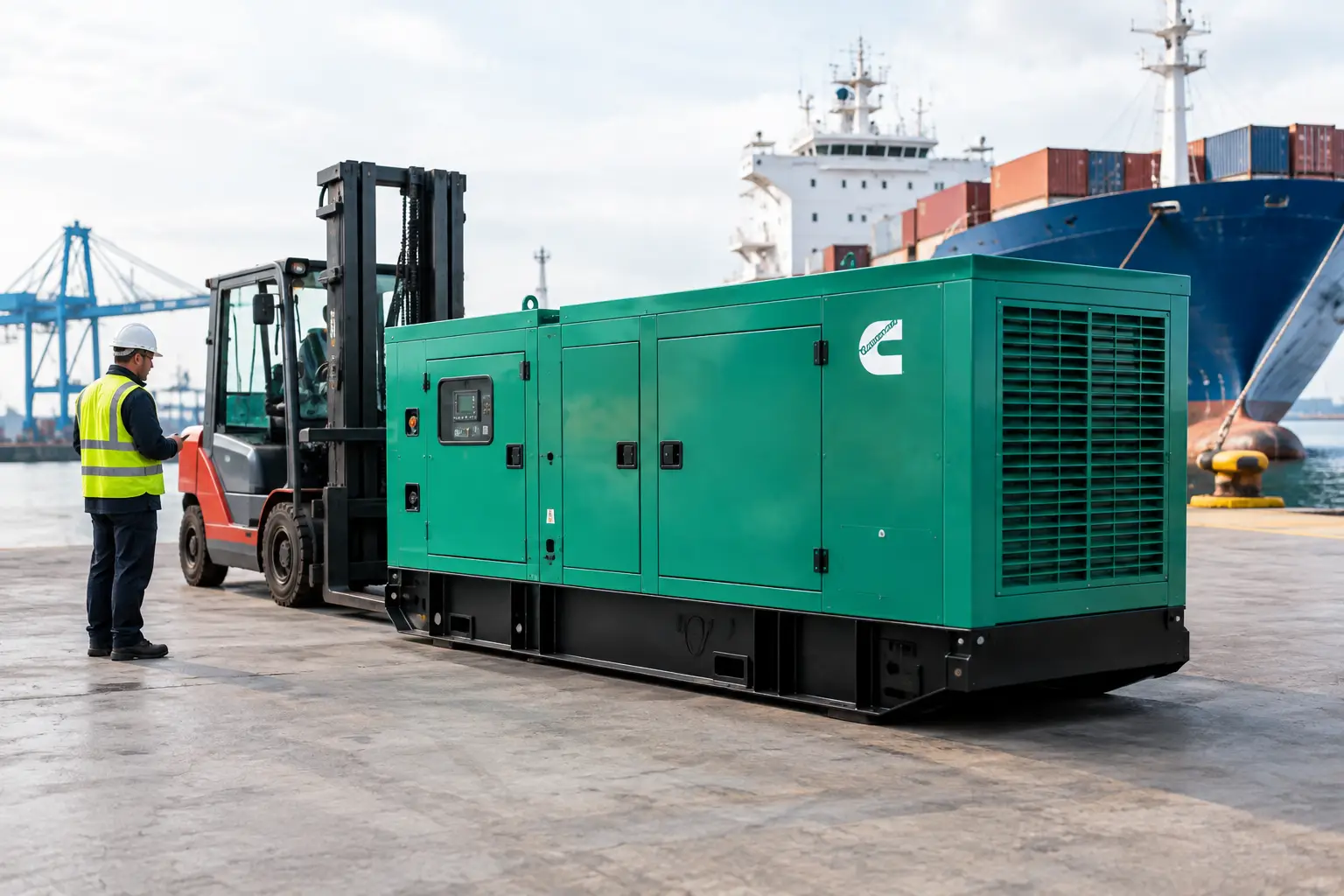
Quick answer
To export a diesel generator from the UK, first confirm the set matches the destination's frequency, voltage and phase (all our generators are 50Hz). Then get a GB EORI number, classify the generator under the right commodity code, check export controls and sanctions for the destination, prepare the invoice and paperwork, make an export declaration so UK customs clear the goods, and arrange shipping. Keep the invoices and customs records afterwards. You can do the customs steps yourself or appoint an agent.
This guide sets out the steps from the UK side, what an overseas buyer should confirm before ordering, and how the process looked on two real projects we supplied: four 1675 kVA sets for the UAE and two for Libya. It is general guidance, not legal or customs advice, and export rules change, so always check the current GOV.UK pages and speak to your freight forwarder or customs agent. Global Generators supplies new diesel generators from 10 to 3000 kVA from stock in Doncaster, for UK delivery and worldwide export.
Step 1: Check the generator suits the destination
Before any paperwork, make sure the generator will actually work on the site's electricity supply.
Frequency: 50Hz or 60Hz
Most countries use 50Hz mains. A smaller group uses 60Hz, including the United States, Canada, South Korea, the Philippines, Taiwan, Saudi Arabia and Brazil, and Japan uses both. Equipment runs at the frequency of the supply, so this is the first thing to confirm.
| Frequency | Examples |
|---|---|
| 50Hz | UK, UAE, Kenya, South Africa, Libya |
| 60Hz | United States, Canada, South Korea, Philippines, Saudi Arabia, Brazil |
| Mixed | Japan (50Hz and 60Hz in different regions) |
Every generator in our range is built for 50Hz power, which suits the UK, Europe and many international markets. If your site runs at 60Hz, you need a set specified for that frequency, so confirm this before ordering. Our 50Hz generators page lists the range.
Voltage and phase
Our three-phase sets supply 400 V and our single-phase sets 230 V. Voltage standards vary by country and sometimes by region within a country, so confirm the supply voltage and whether the site needs single or three phase. Our guide to single phase vs three phase explains the difference, and you can browse our 3 phase generators for the larger sets.
Climate and housing
Check the ambient temperature rating against the site. For example, the Cummins C1675D5A we exported to Libya has a radiator rated for ambient temperatures up to 40°C. Also decide how the set will be housed. Large sets are often supplied as open generators, without an acoustic canopy, and installed in a purpose-built plant room, so the buyer must plan that structure and its ventilation. Our guide to planning generator room ventilation covers the basics.
Step 2: Confirm what your buyer needs to import the goods
GOV.UK advises checking that whoever is receiving the goods can import them. The importer may need to make an import declaration in their own country and may need licences or certificates to receive goods from the UK. Ask your buyer or their customs broker early, because the requirements depend on the destination.
The completed invoice and any licences or certificates must travel with the goods.
Step 3: Get a GB EORI number
You need an EORI number that starts with GB to export goods from England, Wales or Scotland, and one starting with XI if you move goods to or from Northern Ireland. If you appoint a customs agent, ask them to confirm which numbers they need.
Step 4: Classify the generator with the right commodity code
Every export declaration relies on a commodity code. Diesel generating sets fall under heading 8502 of the international Harmonized System, with subheadings based on the output in kVA:
| Subheading | Description | Examples from our range |
|---|---|---|
| 8502 11 | Diesel generating sets of an output not exceeding 75 kVA | Cummins C10D5Q (10 kVA) |
| 8502 12 | Output exceeding 75 kVA but not exceeding 375 kVA | Cummins C220D5EQ (200 to 220 kVA) |
| 8502 13 | Output exceeding 375 kVA | Cummins C500D5 (455 to 500 kVA), Cummins C1675D5A (1500 to 1675 kVA) |
The first six digits are international. The UK tariff and the destination country add more digits, so use the UK Trade Tariff tool or your customs agent to confirm the full code. Our product pages list an HS code, for example 850211 for the C10D5Q. When a set sits close to a band limit, ask your agent which rating the tariff treats as the output, because standby and prime ratings differ.
Step 5: Check export controls and sanctions
GOV.UK states that it is the exporter's responsibility to check whether items need an export licence, and to apply well in advance of shipment if one is needed. Goods that are not on the UK strategic export control lists may still need a licence under end-use controls or because of trade sanctions and embargoes. Some destinations are subject to restrictions, and the extent depends on the destination and the measures imposed.
Read the GOV.UK guidance on UK strategic export controls and check the trade sanctions list for your destination before you commit to a shipment. If you are unsure, contact the Export Control Joint Unit helpline listed on GOV.UK.
Step 6: Decide who handles customs and transport
You can hire someone to deal with customs and transport the goods for you, or you can do it yourself. For a multi-tonne generator most exporters use a freight forwarder, who can make the export declaration and arrange the shipping. Agree the Incoterm, such as ex works or free on board, so everyone knows which party arranges each stage of the movement.
Step 7: Prepare the invoice and documents
GOV.UK explains how to value the goods on the invoice. Use the sale value, or the market value if you are not selling them, and list any freight or export insurance included in the invoice total separately. Exporters also commonly show the commodity code and EORI number on the invoice. You may also need proof of origin if you are exporting to a country that charges a reduced or zero rate of duty on goods from the UK. The GOV.UK guidance on proof of origin for your goods explains the process.
Your forwarder will also need a packing list and transport documents. Make sure the details match across every document, because mismatches are a common reason for delays at customs.
Step 8: Make the export declaration and clear UK customs
You must make an export declaration and get your goods cleared by UK customs. If you have appointed someone to deal with customs for you, they will make the declaration and get the goods through the UK border. The GOV.UK step-by-step guide to exporting goods covers each stage and links to the declaration service.
Step 9: Plan the shipping
Size and weight decide how a generator travels. Use these figures from our product pages as a guide, and ask your forwarder to check the dimensions against the container or transport type:
| Generator | Length × width × height | Dry weight |
|---|---|---|
| Cummins C10D5Q (10 kVA) | 1,960 × 820 × 1,285 mm | 715 kg |
| Cummins C55D5EQ (50 to 55 kVA) | 2,320 × 1,015 × 1,685 mm | 1,235 kg |
| Cummins C220D5EQ (200 to 220 kVA) | 3,195 × 1,180 × 1,940 mm | 2,120 kg |
| Cummins C500D5 (455 to 500 kVA) | 5,095 × 1,564 × 2,441 mm | 5,035 kg |
At the top of the range, each Cummins C1675D5A weighs over 10 tonnes dry, so a smaller shipping footprint helps. Open-type sets reduce shipping weight and volume because they have no acoustic canopy, and this is one reason they suit export projects. Also plan how the sets will be offloaded and lifted at the destination, because the site needs suitable equipment as well as the route in.
Step 10: Keep your records
You must keep commercial invoices and any customs paperwork. GOV.UK notes that you might be able to zero rate the goods for VAT, and that if you are VAT registered you should record the goods in your VAT accounts even if they are zero-rated. Keep evidence that the goods left the UK, and ask your accountant what evidence HMRC expects.
Two real export projects
Four 1675 kVA generators for the UAE. We exported four Cummins C1675D5A open diesel generators to the UAE, a combined 6,700 kVA of standby power for a large regional project. Each set is rated at 1675 kVA standby and 1500 kVA prime at 50Hz and is powered by the Cummins KTA50-GS8 engine. All four came with a Cummins ProtoNode gateway, which links the generator controller to a building management system. The sets were offloaded into storage, to be installed over the following months by the project's appointed contractors. Read the full UAE case study.
Two 1675 kVA generators for Libya. We also exported two C1675D5A sets to Libya for a large electrical contractor's infrastructure projects, a combined 3,350 kVA of standby power. The 400 V, 50Hz output matches the Libyan grid standard according to our case study, and the sets use the PowerCommand 3.3 controller. The Libya case study has the full specification. Our 1000 kVA+ range covers sets of this size.
Common export mistakes
- Ordering the wrong frequency. Check 50Hz or 60Hz before anything else.
- Leaving import rules until late. The buyer's country may need licences or certificates.
- Using the wrong commodity code. It affects the declaration, controls and import rules.
- Skipping export control and sanctions checks. Exporters are responsible for these.
- Not planning the installation. Open sets need a plant room, ventilation and lifting at the destination.
- Mismatched paperwork. Invoice, packing list and transport documents should agree.
- Not keeping records. Keep invoices and customs paperwork after the goods leave.
Warranty and support abroad
Warranty terms do not change because the generator is abroad, but practical support does. Our Libya case study notes that each set is backed by Cummins' standard worldwide warranty, which is two years or 500 hours for standby use or one year with unlimited hours for prime power. Before ordering, ask how servicing and spares will work at the destination, and agree who will commission the set. Our guide to prime versus standby power explains how the two ratings affect cover, and our Cummins generators page lists the range.
Frequently asked questions
Can I export a diesel generator from the UK?
Yes. You need a GB EORI number, the right commodity code, an export declaration cleared by UK customs and the correct paperwork. You must also check export controls and sanctions for the destination, and your buyer must confirm they can import the goods.
Will a UK diesel generator work in my country?
If your country's grid runs at 50Hz, yes, provided the voltage and phase match. Every generator in our range is built for 50Hz power. If your site runs at 60Hz, you need a set specified for that frequency.
What commodity code is used for diesel generators?
Diesel generating sets fall under heading 8502 of the Harmonized System: 8502 11 up to 75 kVA, 8502 12 from over 75 kVA to 375 kVA, and 8502 13 above 375 kVA. The UK tariff and destination country add more digits, so confirm the full code with the UK Trade Tariff or a customs agent.
Do I need an export licence for a generator?
It depends on the goods, the destination and the end-use. GOV.UK says it is the exporter's responsibility to check, and that goods not on the control lists may still need a licence because of end-use controls or sanctions. Check the guidance before you ship.
Who handles customs when you export a generator?
Either you or an agent. GOV.UK says you can hire someone to deal with customs and transport, or do it yourself. For large sets, most exporters use a freight forwarder.
Can you supply generators for export from stock?
Yes. We supply diesel generators from the UK for customers across the UK, Europe and worldwide, and we hold a wide range in physical inventory. Contact us with your destination, frequency and voltage and we will advise on the right set.
Conclusion
Exporting a diesel generator from the UK follows a clear sequence: match the set to the destination's frequency, voltage and phase, then complete the EORI, commodity code, export control checks, paperwork, customs declaration and shipping. Check the details with your buyer and your forwarder early, and keep your records afterwards.
> Planning an export order? Global Generators is an authorised Cummins reseller and an authorised Grupel and Pramac dealer, with new diesel generators in stock for UK delivery and worldwide export. Browse the stock list, then contact our team on +44 1302 700200 or WhatsApp, or email enquiries@global-generators.com with your destination, frequency, voltage and project details.