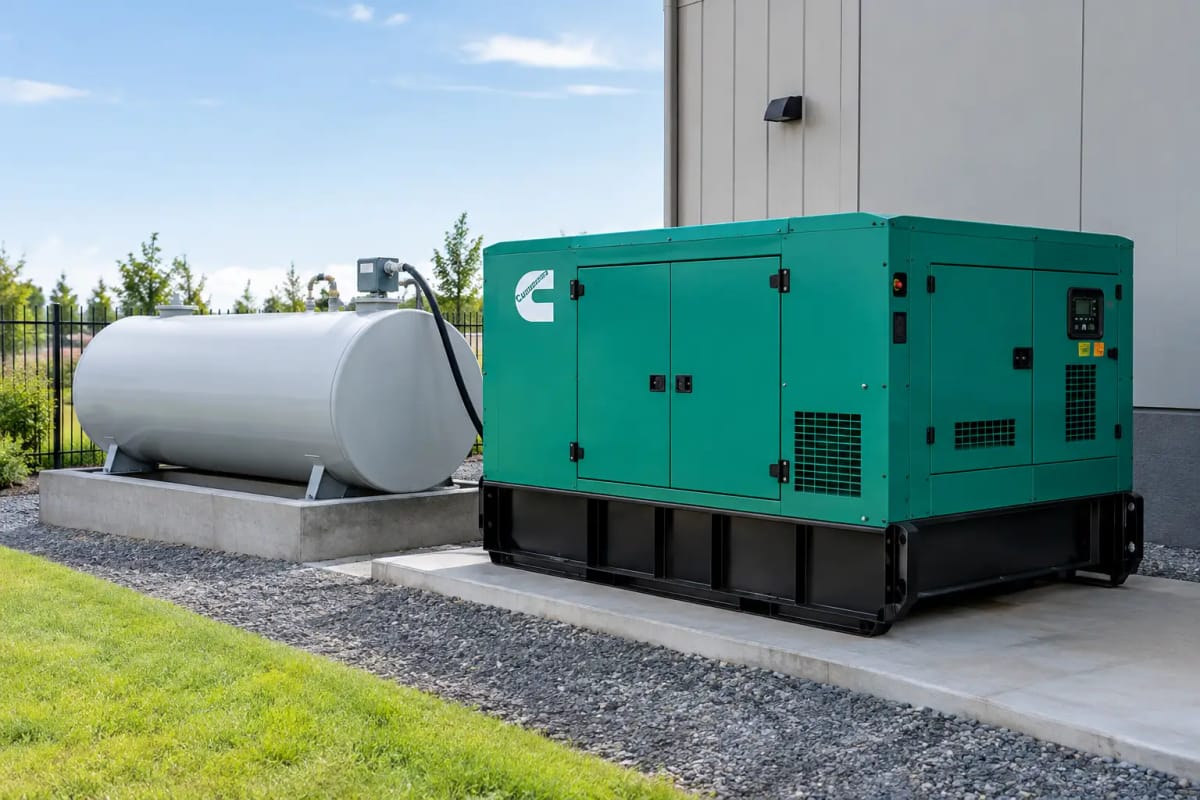
A generator can be correctly sized in kVA and still fail the site requirement if its fuel arrangement is inadequate. Knowing how to choose backup generator fuel tank capacity means assessing the real load profile, required autonomy, fuel logistics and site constraints - not selecting the largest tank that will fit beside the set.
For critical facilities, the fuel tank is part of the power system. It determines how long the generator can support operations during a utility outage, how often fuel deliveries are required, and whether the installation can be safely maintained throughout a prolonged event.
Start with the required runtime
The first question is not tank size. It is how many hours of generator operation the site must sustain without refuelling. A small commercial premises may require eight to 12 hours of standby coverage. A logistics operation, manufacturing plant, telecoms installation or healthcare facility may require 24, 48 or 72 hours, particularly where fuel deliveries could be delayed by weather, road closures or a wider grid incident.
This requirement should be defined by the site risk assessment, business continuity plan and the consequences of losing power. Consider the time needed to restore the mains supply, arrange a fuel delivery and safely refuel the equipment. A nominal 24-hour tank does not provide 24 hours of practical resilience if local access is restricted or deliveries are unavailable outside normal working hours.
Where the generator will operate as prime power rather than occasional standby power, fuel planning needs a different approach. Daily consumption, planned refuelling intervals and secure bulk storage become operational requirements rather than contingency measures.
Calculate fuel consumption at the actual load
Generator fuel use is driven by electrical load, not simply by the generator's nameplate rating. A diesel generator running at 50% load will consume considerably less fuel per hour than the same set at 90% load. However, a lightly loaded generator is not automatically the right answer. Persistent low-load running can lead to poor combustion, carbon build-up and wet stacking.
Use the supplier's fuel consumption figures for the specific generator model and assess the expected operating load in kW. For three-phase installations, this should account for the actual demand across phases, motor starting loads and any planned future capacity. The calculation should be based on the likely outage load, which may differ from the building's normal connected load.
A practical sizing calculation is:
Required usable fuel volume = hourly fuel consumption at expected load x required runtime
Then add a sensible operating reserve. The reserve covers variations in load, lower-than-expected fuel availability and the fact that tanks should not be run to their absolute minimum level. It also allows for the usable capacity of the tank, which may be lower than its gross stated volume.
For example, if a generator consumes 55 litres per hour at the anticipated emergency load and the site needs 24 hours of autonomy, the base requirement is 1,320 litres. A tank specified at exactly 1,320 litres leaves no practical margin. Allowing for reserve and non-usable volume may point to a larger tank or a separate bulk fuel arrangement.
Select the right fuel storage arrangement
Most diesel generator sets are supplied with an integral base fuel tank. This is often the most efficient arrangement for smaller standby sets and sites requiring a limited runtime. The tank is built into the generator baseframe, reduces installation complexity and keeps the fuel supply close to the engine.
An integral tank has limits. It may not provide the required autonomy for a high-output generator, and increasing the tank depth can affect access, transport weight and the overall footprint. For larger installations, a separate external tank can provide substantially more storage without compromising the generator enclosure or service access.
A day tank and bulk tank arrangement is appropriate where extended runtime is required. The day tank supplies the generator directly, while fuel is transferred from a larger main tank by a controlled pump system. This arrangement supports longer operating periods but introduces more equipment to specify and maintain, including level controls, pumps, isolation valves, alarms and spill protection.
For critical applications, consider whether the fuel system needs duty and standby transfer pumps. A single pump is a potential point of failure. The right level of redundancy depends on the site's required availability and the impact of an unplanned shutdown.
Consider tank construction and environmental protection
Fuel containment must suit the installation environment and applicable regulations. A bunded tank provides secondary containment around the primary fuel tank, reducing the risk of a spill reaching the ground or drainage system. For many commercial and industrial sites, double-skinned or integrally bunded construction is the sensible default, especially where tanks are installed outdoors.
Tank material also matters. Steel tanks are widely used for generator applications and provide a durable solution when correctly protected and maintained. The suitability of any tank depends on its location, corrosion exposure, support arrangement and whether it will be installed above ground or within a purpose-designed plant area.
Outdoor installations need protection from unauthorised access, impact damage and weather. Fuel fill points should be accessible to a tanker without requiring unsafe hose runs across vehicle routes or pedestrian areas. The tank must also remain accessible for inspection, cleaning and maintenance. A tank placed in the only available corner may appear convenient at installation, but it can become an expensive problem when filters, gauges or transfer pumps need attention.
Plan the installation around access and safety
Fuel storage should be coordinated with the generator location from the outset. A silent generator enclosure needs clear service space around doors, radiators and control panels. External tanks, bund walls and fuel lines must not obstruct routine maintenance or emergency access.
The fuel tank location should account for fire separation, ventilation, drainage, security and local planning requirements. Requirements vary by site and installation type, so the final design should be checked against the relevant UK regulations, insurer conditions and authority requirements. Particular attention is needed near watercourses, drains, public areas and high-risk industrial processes.
Fuel lines should be routed and supported to avoid abrasion, mechanical damage and air ingress. Where a remote tank is positioned at a different level from the engine, verify the allowable fuel lift and return fuel arrangement with the generator manufacturer. Incorrectly designed return lines or excessive suction lift can cause starting problems, poor running or fuel system damage.
Do not overlook fuel quality and maintenance
Stored diesel degrades over time. Water ingress, condensation and microbial contamination can block filters, corrode tanks and compromise injector systems just when the generator is needed. Larger fuel storage increases autonomy, but it also increases the volume of fuel that must be monitored and managed.
A reliable fuel strategy includes periodic sampling, water checks, filtration and fuel polishing where storage periods are long or site conditions are demanding. Tanks should have clear level indication and low-level alarms that can be monitored as part of the site's maintenance regime. Remote alarm reporting is valuable for unmanned sites, but it should support physical inspections rather than replace them.
The fuel should be exercised as part of generator testing. Regular loaded test runs confirm that the engine, transfer equipment and fuel supply operate together. Where the site cannot accept an interruption, planned load-bank testing may be required to prove performance without relying on the building load alone.
Match tank capacity to the generator duty
Standby and prime-rated generators need different fuel plans. A standby unit may operate only during outages and routine tests, making a base tank suitable where deliveries can be arranged quickly. A prime power unit operating daily requires enough storage to support the operating schedule without creating excessive fuel ageing risk.
There is also a commercial balance. Larger tanks increase purchase cost, installation work and ongoing fuel management. Smaller tanks reduce capital expenditure but can expose the operation to delivery risk during an extended outage. The right decision is the one that meets the required runtime with a realistic reserve and a maintainable fuel supply arrangement.
Before finalising a generator order, provide the expected load, required autonomy, operating duty, site layout and refuelling constraints to the supplier. Global Generators can use this information to align the generator rating, enclosure format and fuel tank configuration with the operational requirement. A correctly specified tank does more than hold diesel - it gives the site the time and certainty needed to keep running when mains power is unavailable.