A failed mains supply is rarely just an electrical event. At a distribution depot, it can stop loading operations and refrigeration. At a manufacturing plant, it can damage work in progress. In healthcare, telecoms and utilities, the consequence can be much more serious. The onsite power resilience outlook for 2026 is therefore being shaped by a practical question: can the site carry its essential load safely, for long enough, when the grid does not?
For facilities teams and project engineers, the answer is not simply to buy the largest available generator. Resilience depends on correct load assessment, the right standby or prime rating, fuel autonomy, switching equipment, maintenance access and proof that the system operates as specified. Generator capacity remains central, but capacity alone does not create uptime.
Onsite Power Resilience Outlook: What Is Changing
Grid interruptions have always been a consideration for critical operations. What has changed is the operating environment around them. More sites now depend on electrically controlled processes, networked building systems, automated handling equipment and temperature-sensitive stock. A short interruption that may once have caused inconvenience can now halt an entire operation or leave a site unable to trade.
At the same time, facilities are carrying more variable and non-linear loads. Variable-speed drives, UPS systems, chargers, compressors, pumps and large motor loads place different demands on a generating set than conventional lighting and resistive loads. The generator must not only support the final running load. It must manage starting currents, load steps and the voltage and frequency response required by connected equipment.
There is also greater scrutiny of resilience plans. Insurers, clients, regulators and internal risk teams increasingly expect evidence that standby arrangements are maintained and tested. A generator that has not been exercised under meaningful load is an asset with unproven availability.
Generator Sizing Starts With the Actual Duty
The first decision is whether the set is intended for standby duty, prime power or continuous operation. These ratings are not interchangeable.
A standby generator is designed to support a site during a mains failure, typically for limited annual running hours and variable loads. This is the appropriate starting point for many offices, healthcare facilities, warehouses and commercial premises with a reliable grid connection but no tolerance for an outage.
Prime power is for locations where the generator is expected to operate for extended periods or as the normal source of electricity, such as remote construction sites, temporary infrastructure and operations in areas with an unreliable supply. Prime-rated duty requires a different assessment of loading, servicing intervals, fuel consumption and engine wear. Specifying standby equipment for repeated prime operation is a false economy that can shorten equipment life and compromise availability.
Assess the Load Profile, Not Just the Site Total
A site’s maximum incoming supply is not automatically its generator requirement. The critical question is which loads must remain live and in what sequence. Life safety systems, controls, essential lighting, IT equipment, cold storage, process plant and security may all have different priorities.
Motor starting must be assessed separately. A pump or compressor may draw several times its running current during direct-on-line starting. If multiple motors start together, an otherwise adequate generator can suffer excessive voltage dip or frequency instability. Soft starters and variable-speed drives can reduce the starting demand, but they may introduce harmonic effects that should be considered during design.
The most dependable approach is to create a load schedule that records running kW, starting method, power factor, load priority and anticipated simultaneous operation. This should be checked against the generator’s kVA rating and its transient performance, rather than relying on a broad rule of thumb.
Allow for Growth, But Do Not Oversize Without Reason
Future capacity matters, particularly where production lines, warehouse automation or cooling plant are likely to expand. However, excessive oversizing creates its own problems. Diesel generators running consistently at very low loads may experience poor combustion conditions, carbon build-up and wet stacking.
The right margin depends on the duty cycle and expansion plan. In some cases, a single larger set is appropriate. In others, two synchronised units can provide better load matching, maintenance flexibility and a measure of redundancy. That approach adds controls and capital cost, so it should be justified by the operational requirement rather than chosen by default.
Resilience Is a System, Not a Generator Alone
A dependable diesel generator is the core of many backup power strategies, but its performance is only as good as the equipment around it. The failure points are often found in the interfaces: fuel transfer, automatic transfer switching, batteries, cabling, ventilation or control settings.
Fuel Autonomy Must Match the Recovery Plan
Fuel storage should be based on expected generator loading, not an assumed litres-per-hour figure at no load. The required runtime also depends on how quickly refuelling can be arranged during a widespread outage, whether deliveries can access the site and whether the generator supports one critical load or the entire facility.
For high-consequence operations, on-site fuel reserves and a documented refuelling arrangement are usually more credible than an assumption that supply chains will operate normally during a regional incident. Fuel quality is equally important. Water contamination, microbial growth and degraded diesel can prevent a correctly specified generator from starting or carrying load. Periodic fuel sampling, tank housekeeping and filtration should sit within the maintenance plan.
Switching and Controls Need the Same Attention
The automatic transfer switch determines how the facility moves from mains to generator supply. Its rating, interlocking, bypass arrangement and transfer sequence must suit the installation. A poorly coordinated transfer scheme can create an interruption that sensitive equipment cannot tolerate, even when the generator starts correctly.
Critical systems may require staged load acceptance. Non-essential loads can remain disconnected until the generator is stable, while essential circuits receive priority. Where short interruptions are unacceptable, a UPS can bridge the transfer period for IT, control systems and selected process equipment. The generator then supports the UPS and the wider essential load for the duration of the outage.
Remote monitoring also has a practical role. It can report alarms, running status, battery condition, fuel level and operating parameters before a minor issue becomes a failed start. Monitoring does not replace inspection, but it gives operations teams earlier warning and a clearer record of performance.
Choose the Physical Configuration for the Site
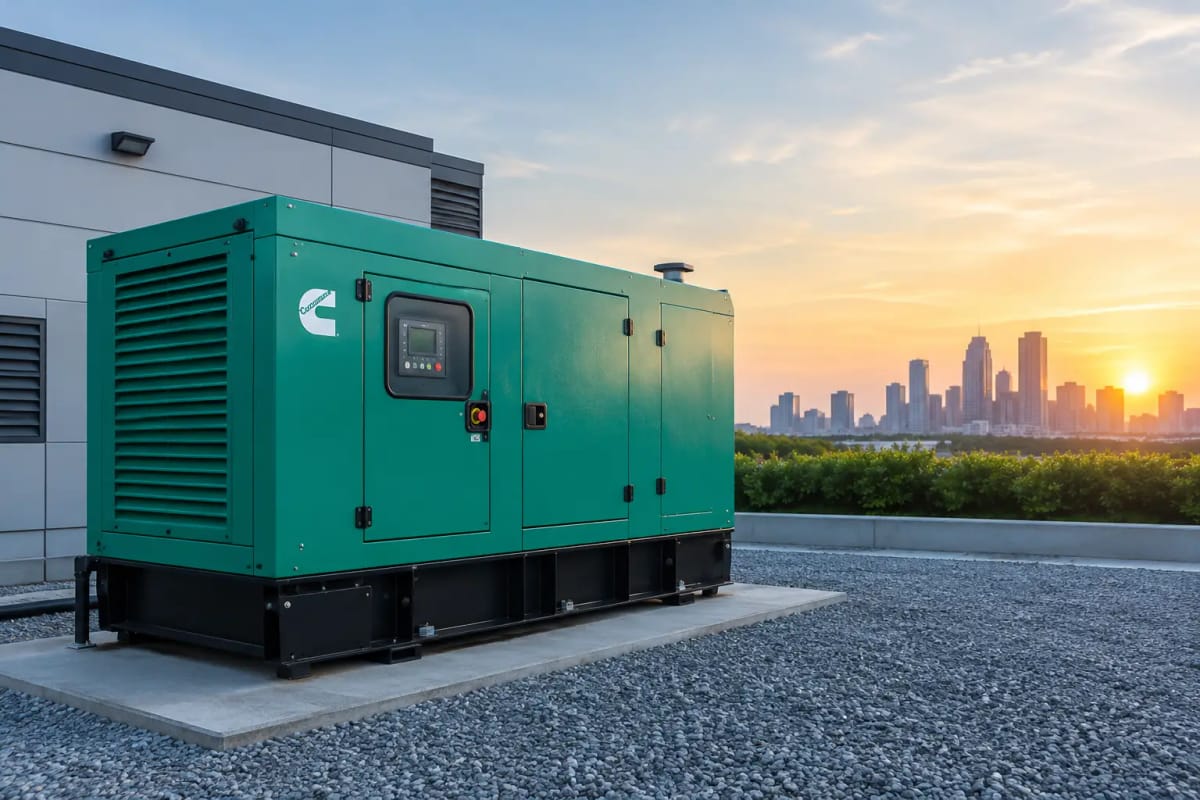
An open generator is often suitable for plantrooms or protected compounds where ventilation, weather protection and access have been engineered into the installation. A silent, weatherproof canopy is normally preferable for external locations, particularly where noise, security and exposure are concerns.
Noise limits, exhaust routing, air intake paths and heat rejection should be resolved before equipment arrives on site. A canopy reduces airborne sound, but it does not remove the need to consider exhaust noise, structure-borne vibration or neighbouring occupiers. Physical layout must also allow safe servicing, fuel delivery and lifting access.
Testing Is the Evidence Behind the Plan
Weekly or monthly no-load starts confirm that the engine can run. They do not fully demonstrate that the system can support the building. Meaningful testing should include an automatic start signal, transfer to generator supply, acceptance of representative load and return to mains operation.
Load-bank testing is valuable where the site cannot safely apply enough live load during routine tests. It allows the generator to be exercised at controlled load levels while technicians assess voltage, frequency, engine temperature, exhaust condition and control response. For facilities with highly variable demand, it is often the clearest way to prove set performance without disrupting operations.
Maintenance intervals should follow the engine manufacturer’s requirements and the actual running pattern. Battery checks, coolant condition, oil analysis where appropriate, belt inspection, fuel system checks and control-panel alarm verification are all part of availability. The service record should show not only that maintenance was scheduled, but that defects were identified, corrected and retested.
Procurement Priorities for 2026 Projects
When specifying a new set or upgrading an ageing installation, technical clarity at enquiry stage prevents expensive changes later. A useful specification should define the required kVA, voltage, frequency, phase configuration, standby or prime duty, load profile, enclosure requirement, fuel runtime and required controls.
It should also state site constraints: delivery route, footprint, lifting restrictions, ambient conditions, acoustic limits and whether synchronisation or an ATS is required. These details determine whether a standard packaged set is suitable or whether the project needs a more tailored arrangement.
For buyers comparing quotations, four questions deserve direct answers:
- Is the quoted rating standby, prime or continuous, and at what ambient conditions?
- What engine and alternator are fitted, and what service support is available for those components?
- Which controls, switching equipment and fuel components are included in the stated price?
- What is the actual lead time for the configured set, not simply the base generator?
Global Generators supports this process with Cummins-powered generator sets across key power ranges, including silent and open configurations for standby and prime power applications. The right equipment is the set that meets the operating duty and site conditions without unnecessary complexity.
The strongest resilience decision is made before the outage: define the essential load, prove the transfer sequence, secure the fuel plan and test the system under conditions close to real operation. That is how backup power becomes a dependable operational safeguard rather than an untested contingency.