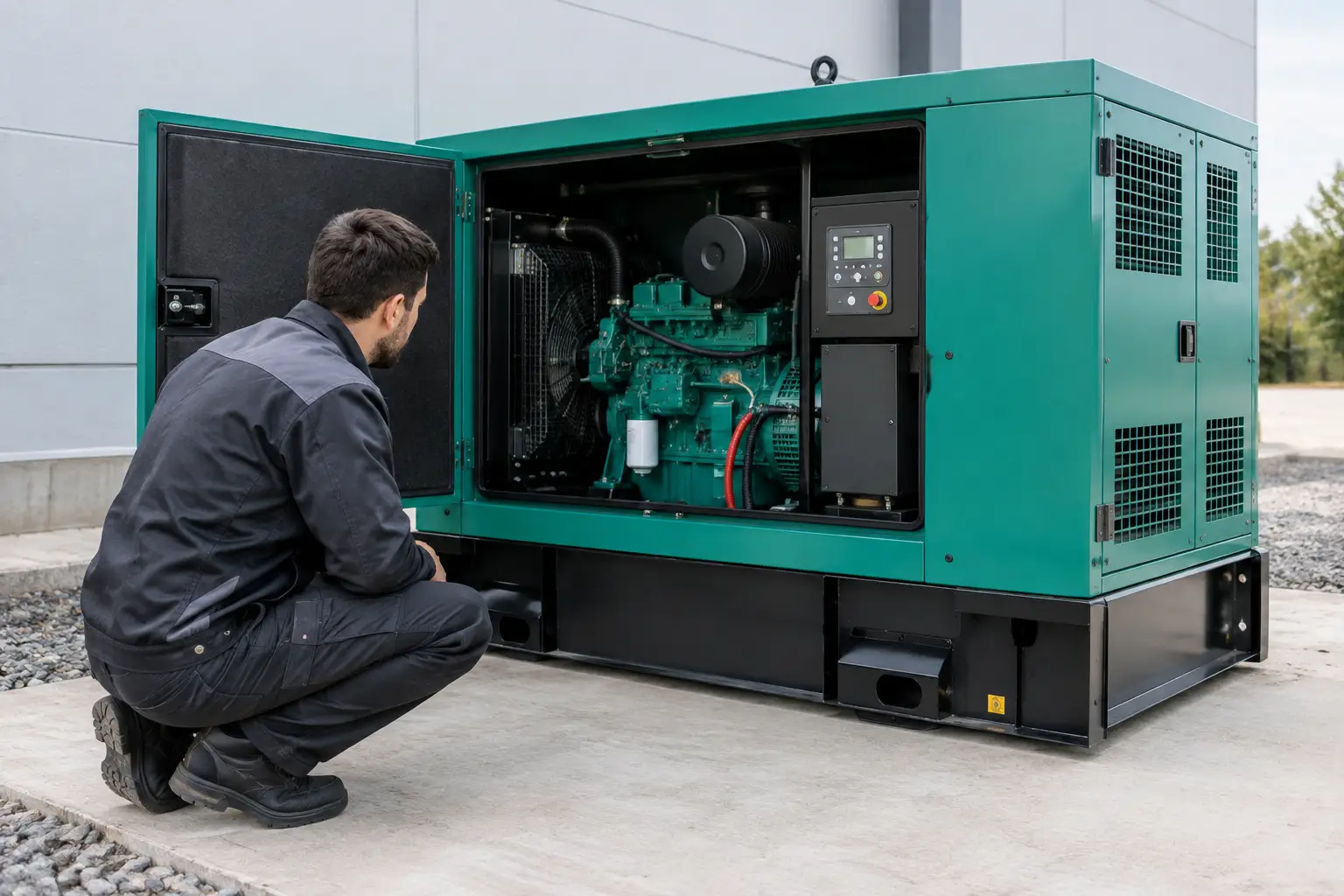
Quick answer
Start with what the generator is doing. A dead display points to the battery supply. A live display with no cranking points to the mode switch, an emergency stop or an unreset fault. Normal cranking that never fires points to fuel or air. A set that starts and then stops points to a protection trip such as low oil pressure. Read the controller first, do not keep cranking, and call a qualified engineer if the cause is not an obvious, safe fix.
This guide works through ten checks in the order that saves the most time, sorted by symptom. It uses the Cummins PowerStart 0600 controller, fitted to many of the smaller Cummins generators we supply, as its working example, because its published behaviour is a good guide to what a modern controller is telling you. Settings such as the number of crank attempts and start delays are configurable, so your set may differ and your controller's manual has the final say. The checks are for people who are competent to carry them out safely. Anything involving live electrics, the fuel injection system or sensor wiring belongs with a qualified engineer.
Start with the symptom
| What you see | Likely area | First thing to check |
|---|---|---|
| Dead display, no lamps | Battery supply | Battery, terminals, isolator and charger |
| Display on, no cranking, no fault | Mode or stop circuit | Mode switch, emergency stop, remote start signal |
| Display on, fault code shown | Active fault or lockout | Read the fault, fix the cause, then reset |
| Slow cranking | Battery or cold conditions | Battery condition and ambient temperature |
| Cranks normally but never fires | Fuel or air | Fuel level, supply, filters, air in the system |
| Starts, then stops | Protection trip | Oil pressure, temperature, voltage and frequency faults |
Industry guides consistently rank battery problems as the most common cause of failed starts on standby generators, which is why the battery appears first below.
Check 1: Read the controller before you touch anything
Look at the display and the lamps first. The PowerStart 0600 shows the active fault code and a description on its screen, and illuminates the matching status lamp. It also keeps a record of recent faults with a time stamp, so you can see what happened on the last failed attempt.
Note three things before you change anything:
- Which lamps are lit, and whether the display is on at all
- Whether the starter clicks, cranks slowly, cranks normally or does nothing
- The ambient temperature
That short record helps you, and it helps an engineer if you have to call one. Our guide to how to repair diesel generator faults covers wider fault finding.
Check 2: Is the battery supply healthy?
The PowerStart 0600 takes its power from the generator's starting batteries and works across a range of 8 to 32 volts DC. A dead or dim display therefore usually means the control is not getting enough battery supply.
The controller also watches the battery for you:
- It tests the battery each time the set is signalled to start and gives a weak battery warning if failure is near.
- It gives low and high battery voltage warnings, which indicate a charging system problem.
On standby sets, the usual cause is a failed charger or an ageing battery, because the generator may sit idle for weeks. If the display shows a battery warning, treat it as the lead. Do not jump-start or replace batteries unless you are competent to do so and follow the manufacturer's safety instructions.
Check 3: Terminals, isolator and fuses
A battery can be healthy and still fail to deliver. Poor or corroded terminal connections leave too little cranking power, and a battery isolator switch left in the off position gives the same symptom as a flat battery. Look for:
- An isolator or disconnect switch that has been turned off after servicing
- Loose, dirty or corroded terminals
- A tripped or blown control fuse
Our own guidance on starting a diesel generator manually notes that a failed charger, a sulphated battery or a poor terminal connection can all leave a standby generator without enough cranking power.
Check 4: The mode switch and remote start
The PowerStart 0600 has an integrated manual, auto and stop function with matching lamps. In Auto mode the generator waits for a remote start signal, from a transfer switch or an auto mains failure panel, and will not start on its own without one. In Stop mode it will not start at all.
If the display is on and nothing happens, check that the switch is in the position you expect. Our guide to starting a generator manually notes that a set left in the wrong control mode after servicing is a frequent reason why a mechanically sound generator will not start. If it starts in Manual but not in Auto, the problem is probably the start signal, the transfer switch or the controller settings. Our guides to automatic versus manual transfer switches and how to test generator transfer switches safely explain that side.
Also remember that the control can be configured with a time delay of up to 300 seconds before starting after a remote start signal, although the default is zero. A delay that has been set and forgotten can look like a failure to start.
Check 5: Emergency stop and external stop circuits
When an emergency stop signal is received, the PowerStart 0600 shuts the generator down immediately and will not let it run or crank while the switch is engaged. An emergency stop that has been pressed, or that has been left engaged by a previous test, gives a set that is live but will not crank.
Check the local emergency stop button, any remote or building emergency stop, and any external interlock that feeds the controller. Release the stop, then clear the fault at the controller. If the controller still shows an emergency stop after you have checked the button, there may be a wiring fault in the stop circuit, which is a job for an engineer.
Check 6: Fail-to-start lockout and unreset faults
A failed start leaves a record. The control supports cycle cranking, which can be configured for between one and seven starting attempts with set cranking and rest times, and it includes starter protection so that the sequence cannot be set to damage the starter. If the engine has not started by the end of the crank sequence, the control shows a fail-to-start fault.
Two practical points follow:
- A fault from an earlier shutdown that has not been reset can stop the next start, so read and clear any active fault once you have understood it.
- Do not keep pressing start. Repeated attempts can flatten the batteries and overheat the starter, and they hide the underlying cause. If the engine does not start after the normal crank sequence, stop and diagnose.
Check 7: Fuel level and fuel supply
If the engine cranks at normal speed but never fires, it is not getting what it needs to run. Start with the obvious:
- Fuel level. Confirm the tank is not empty. The control can also warn on low fuel level where that input is fitted.
- Valves and shut-offs. Check that any fuel valves are open and that nothing has been left closed after maintenance.
- Filters and contamination. Blocked filters, water or degraded fuel starve the engine, and stored standby fuel is a common culprit. Our guide to generator fuel contamination and site uptime explains the risks.
If you suspect contaminated fuel, or filters need changing, that is a job for a trained service engineer.
Check 8: Air in the fuel system
A diesel engine that has run out of fuel, or has had a filter or fuel line disturbed, can draw air into the system and will crank without firing until the air is removed. This is why a set that was fine before servicing may not start afterwards.
Bleeding follows the engine manufacturer's procedure, and it involves flammable fuel and moving parts, so it should be done by someone trained. Our step-by-step guide to how to bleed diesel generator fuel systems explains the principle. If the engine still does not start after bleeding, the problem may be a fuel line leak, a filter that was installed incorrectly or a failing fuel supply, rather than air alone.
Check 9: Cold-start conditions
Cold slows cranking and makes combustion harder. The PowerStart 0600 includes a low coolant temperature warning, which tells you the engine may not be warm enough for a 10-second start or proper load acceptance, and it supports configurable glow plug control where fitted. The control itself operates across ambient temperatures from minus 20 to plus 70 degrees Celsius.
If a set struggles on cold mornings, the fix is usually in the specification, such as engine heating and fuel suitable for the lowest site temperature. Raise it with your supplier and ask about cold-weather options rather than repeating starts in the cold.
Check 10: Protection trips after starting
If the generator starts and then stops within moments, the controller may be shutting it down to protect it. The PowerStart 0600 includes:
- Low oil pressure warning and shutdown
- High engine temperature warning and shutdown
- Sensor failure indication
- Alternator protections for high or low AC voltage, under or over frequency and loss of voltage sensing
Read the fault, then check the basics that the fault points to, such as oil level and coolant level, with the engine stopped and cool. Never bypass or disable a protection to get the set running. Doing so risks serious engine damage, and a sensor fault needs proper diagnosis. If the engine started and ran, the fault history is the best clue for an engineer.
When to stop and call an engineer
Stop and call a qualified engineer if:
- The controller shows a fault you cannot clear, or the same fault returns
- The engine cranks slowly, makes unusual mechanical noises or shows signs of fluid leaks
- You suspect fuel contamination, a failed sensor or damaged wiring
- Work would mean opening the fuel system, touching live electrical parts or bypassing a safety circuit
- The set starts but cannot hold stable voltage or frequency
The HSE's electrical safety guidance covers the general principles for working near electrical equipment. Never work on a generator that could start without isolating it first, and never run one in an enclosed space, because diesel exhaust contains carbon monoxide.
> Generator failed to start and you need help? Tell us the model, what the controller shows and what the set did when you tried to start it, and we will point you in the right direction. Use the contact page or call +44 1302 700200.
How to stop it happening again
Most no-starts are preventable. A few habits make the difference:
- Test regularly and on load. Our guides to how often generators should be tested and generator load bank testing explain a sensible routine.
- Keep to a maintenance plan. See our backup generator maintenance guide and our guide on when generators need servicing.
- Watch the battery and charger, and replace batteries on a schedule, not after they fail.
- Protect your fuel. Keep tanks clean and dry and check the fuel regularly.
- Add alerts. Our guide to generator remote monitoring systems explains how to be warned of a charger or battery fault before an outage.
If you are replacing or specifying a set for critical standby duty, see our standby generators range. The Cummins C33D5, for example, uses the PowerStart 0600 controller described above.
Frequently asked questions
Why won't my diesel generator start?
The most common causes are a weak or flat battery, a charger fault, the controller being in the wrong mode, an emergency stop or unreset fault, and fuel or air problems. Read the controller first, because it normally shows which area to check.
Why does my generator click but not crank?
Usually the battery supply is too weak to turn the starter, or a terminal connection is poor. Check the battery, terminals and isolator, and look for a battery warning on the controller. If the battery and connections are good, the starter itself may need attention from an engineer.
Why does my generator crank but not start?
It is turning over but not getting fuel or air. Check the fuel level, any fuel valves and the filters, and consider air in the fuel system if the set ran out of fuel or was recently serviced. Bleeding the system should follow the engine manufacturer's procedure.
Why does my generator start and then stop?
A protection is probably shutting it down. Common triggers are low oil pressure, high engine temperature, or alternator protections such as under or over voltage. Read the fault on the controller and do not bypass protections.
Can I keep trying to start the generator?
No. The control runs a limited crank sequence and then shows a fail-to-start fault. Repeating attempts can flatten the batteries and overheat the starter, and it hides the cause. Stop, read the fault and diagnose.
How often should I test a standby generator?
Regularly, and on load, because a standby set that sits idle is most likely to fail when it is first needed. Our guide to how often generators should be tested sets out a routine.
Conclusion
A diesel generator that will not start usually has a simple cause that the controller can point to. Work by symptom: battery for a dead display, mode and stop circuits for a live display with no cranking, fuel and air for cranking without firing, and protection trips for a start-then-stop. Keep to the safe checks, never bypass a protection, and call an engineer when the fix goes beyond them.
> Talk to a real person: Global Generators is an authorised Cummins reseller and an authorised Grupel and Pramac dealer, with new diesel generators in stock for UK delivery and export. Browse our diesel generators or the stock list, then contact our team on +44 1302 700200 or at enquiries@global-generators.com and we will help you with the set you need.