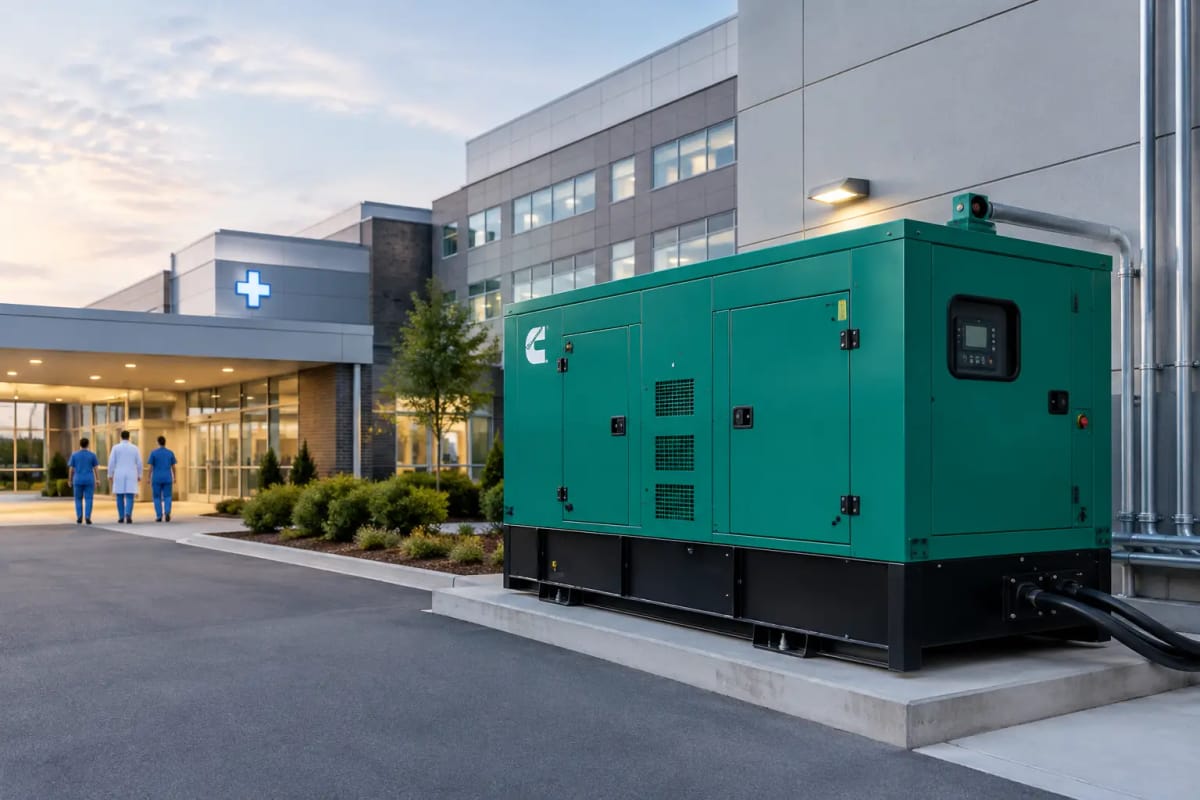
A loss of mains supply at an acute hospital is not a simple facilities issue. It can affect theatres, critical care, imaging, medical gas systems, pharmacy storage, communications and site security within seconds. This hospital backup power case study examines an illustrative UK acute-care project where an ageing standby system no longer reflected the site’s real electrical demand or clinical priorities.
The project demonstrates why generator selection cannot begin and end with a headline kVA figure. Reliable hospital standby power depends on load data, starting characteristics, transfer sequencing, fuel autonomy, physical installation constraints and a testing regime that proves the system will perform under pressure.
Hospital backup power case study: the site brief
The site was a 450-bed hospital with an existing generator installation commissioned in stages over many years. The original arrangement had been suitable when installed, but extensions to diagnostic services, additional cooling plant, upgraded IT infrastructure and new clinical equipment had materially changed the emergency load profile.
Facilities management had identified three concerns. First, the generators were operating close to their available standby capacity during monthly exercises. Second, the automatic transfer arrangement brought too many non-essential loads online at once. Third, the fuel storage strategy had not been reassessed after the hospital’s critical services expanded.
The requirement was not simply to replace an old set with a larger set. The design team needed to maintain power to life-safety and critical clinical loads, prevent generator overload during restoration, provide meaningful resilience during an extended grid failure and retain access for maintenance without disrupting hospital operations.
The load survey changed the specification
A desktop review of electrical drawings suggested that two 1,000 kVA standby generators would be sufficient. A detailed load survey produced a different result. Recorded demand across several operating conditions showed that the apparent total load included equipment with very different priorities, duty cycles and motor starting demands.
The assessment separated essential circuits from loads that could be delayed, shed or restored only after stable generator operation. Critical care, theatres, emergency lighting, fire systems, selected lifts, medical gas plant, essential ventilation, communications and core IT were assigned immediate restoration priority. Some comfort cooling, non-critical catering equipment, elective treatment areas and selected administrative loads could be introduced later or remain off during a prolonged outage.
This distinction reduced the initial step load but did not remove the need for spare capacity. Large motors, chillers and air-handling equipment can produce significant transient demand when started. A generator that appears adequately rated on a steady-state calculation may still experience unacceptable voltage and frequency dip when multiple motors start together.
The final design allowed for the measured essential load, future service growth, motor starting performance and the practical limits of the generators’ standby rating. It also accounted for the fact that hospital electrical demand can change by season and by clinical activity. Sizing from a single maximum demand figure would have been a weak basis for a critical installation.
Generator arrangement and rating selection
The preferred solution was a parallel standby plant comprising three diesel generator sets rather than two larger units. This provided N+1 resilience for the identified essential load. If one set was unavailable for planned servicing or developed a fault, the remaining sets could carry the priority load with controlled load shedding.
There is a commercial trade-off here. A multiple-set system has higher initial capital cost, more controls and more installation work than a single large generator. For a hospital, however, the value lies in maintainability and fault tolerance. A generator cannot be considered fully resilient if taking it out of service for routine work leaves the site exposed.
Each generator was specified with a standby rating appropriate to emergency use, rather than being selected on a prime-power figure that did not match the duty profile. The engine and alternator package also had to be compatible with the proposed load steps and harmonic content from modern electronic equipment. This is where proven industrial engine platforms and clear alternator data matter more than an attractive headline price.
The sets were housed in weatherproof acoustic enclosures, with attenuation selected around the hospital boundary and neighbouring residential properties. A silent enclosure is not only an amenity issue. It can determine whether a generator can be exercised at meaningful load without creating avoidable complaints or operational restrictions.
Transfer systems and staged load restoration
The existing automatic transfer system treated the emergency board as one large block of load. On mains failure, it attempted to restore major services almost simultaneously. That created a predictable risk: high inrush currents, unstable generator loading and unnecessary demand on the first available set.
The revised arrangement used staged transfer and load priority control. Life-safety circuits were restored first, followed by critical clinical services, essential building systems and finally agreed secondary loads. The controls monitored available generator capacity before permitting the next stage to connect.
This sequence was tested against realistic operating scenarios, including the loss of one generator after initial transfer. The control philosophy then shed lower-priority circuits automatically if available capacity fell below the agreed threshold. It is a harder design task than fitting a larger generator, but it makes better use of installed capacity and protects the sets from avoidable overload.
Protection settings, breaker coordination and earthing arrangements also required review. A standby generator installation must operate safely as an electrical system, not merely start when the utility supply fails. The final commissioning plan included functional testing of interlocks, alarms, remote indications, emergency stop circuits and transfer timing.
Fuel autonomy is part of the power strategy
Generator capacity is irrelevant if the fuel supply cannot support the required outage duration. The hospital had day tanks sized for short-term operation and a bulk storage arrangement that had not been assessed against the revised emergency load.
The project team calculated fuel consumption at realistic load points rather than relying only on a full-load catalogue figure. They then established the autonomy target with hospital management, taking account of local grid reliability, severe-weather exposure, fuel delivery access and the likelihood of regional disruption affecting multiple sites.
The solution included increased bulk fuel capacity, duty and standby transfer pumps, monitored tank levels and a defined refuelling procedure. Fuel quality management was equally important. Stored diesel can degrade, accumulate water and support microbial contamination. Regular sampling, filtration and tank housekeeping were included in the operating plan because a full tank of unsuitable fuel is not resilience.
Commissioning must prove the failure mode
A no-load start test confirms only that an engine starts. It does not prove the hospital can carry critical services through a mains failure. The commissioning programme therefore included witnessed transfer tests, staged load application, simulated generator unavailability and alarm verification.
Testing was planned around clinical operations, with clear communications to department leads and contingency arrangements for sensitive equipment. Where a full load-bank test was required, it was used to verify generator output and engine performance without placing unnecessary demand on clinical systems. Site load testing then confirmed that the real transfer sequence performed as designed.
Ongoing maintenance was built into the procurement decision. The hospital required accessible service points, reliable parts availability, remote monitoring capability and documented procedures for weekly checks, periodic loaded exercises and annual review of the essential-load schedule. Hospital estates teams should revisit that schedule whenever new high-demand clinical equipment or building services are installed.
Procurement lessons for critical power buyers
This hospital project reinforces a straightforward point: a generator is only one component of the emergency power system. Buyers should provide suppliers with actual load information, existing single-line diagrams, proposed future expansion, required autonomy and constraints around noise, space, delivery and maintenance access.
They should also confirm whether the requirement is standby or prime power, the required voltage and frequency, enclosure format, synchronisation requirements and the capacity that must remain available during maintenance. These details determine whether an open set, silent set or containerised solution is appropriate, and whether one generator or a parallel system offers the right balance of cost and resilience.
For hospitals and other mission-critical sites, Global Generators can support early-stage discussions around kVA range, generator configuration and availability before a final technical specification is issued. The right enquiry includes the operating requirement, not just the preferred generator size.
A dependable hospital power system is established long before a mains failure occurs. It is established when the essential load is understood, the plant is sized for real conditions, and every transfer and maintenance decision is tested against the question that matters most: what remains powered when the grid does not?