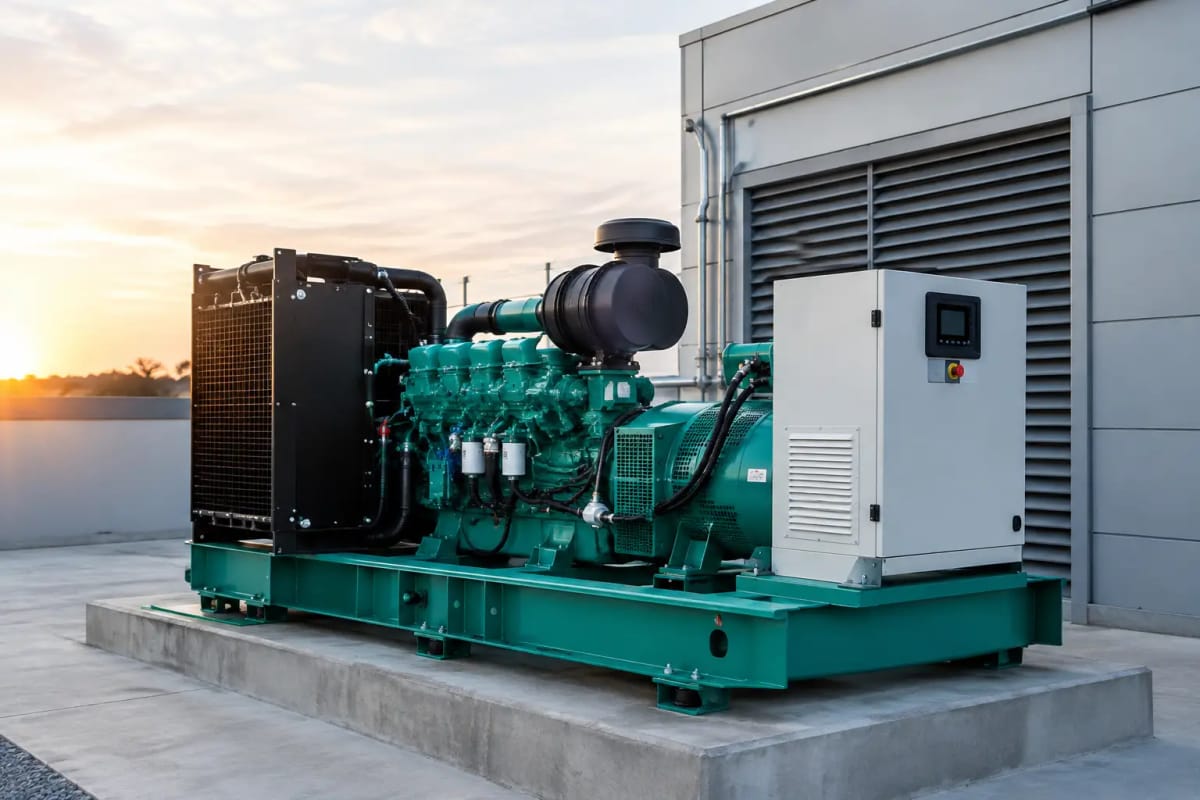
A production line with multiple motors, a distribution centre with automated handling equipment, or a healthcare facility with essential plant cannot rely on a power source designed for light, uneven demand. The principal three phase generator benefits are higher power capacity, more stable load handling and efficient distribution across demanding commercial and industrial installations.
For buyers specifying standby or prime power, three-phase generation is often the practical starting point rather than an upgrade. It supports the electrical systems most commonly found in larger premises, including pumps, compressors, refrigeration, machine tools, lifts and three-phase distribution boards. The correct decision still depends on the site load profile, voltage requirements and future expansion plans.
Why three-phase power suits industrial loads
A three-phase generator produces three alternating currents, each separated by 120 degrees. This arrangement delivers power more consistently than a single-phase supply, where the voltage rises and falls through a single waveform. In operational terms, that consistency matters when equipment must start, run and recover from load changes without compromising the wider electrical system.
Three-phase motors are a clear example. They are common in industrial and commercial plant because they operate efficiently and provide reliable torque. A correctly sized three-phase generator can support these loads directly, while a single-phase set may require additional conversion equipment or prove unsuitable for the duty altogether.
This does not mean every site needs a three-phase generator. A small office, domestic property or basic retail unit with only single-phase circuits may be better served by a single-phase set. However, where the site has a three-phase incoming supply or substantial motor loads, matching the generator to that infrastructure normally produces the most dependable result.
Three phase generator benefits in daily operation
The value of three-phase generation is not limited to a higher kVA figure on a specification sheet. It affects how the generator carries load, how the electrical installation can be arranged and how readily the power system can grow with the operation.
Greater capacity for major plant
Three-phase generators are available across a broad output range, making them suitable for applications from substantial commercial premises to heavy industrial and infrastructure projects. At higher ratings, they provide a practical route to supporting several large loads at once, provided the system is properly designed.
This is particularly relevant where standby power must carry essential services during a mains failure. A site may need to keep process pumps, extraction systems, refrigeration, security, communications and selected lighting operational at the same time. A three-phase set allows these loads to be distributed across the phases rather than concentrated on one supply path.
Capacity should not be judged by connected load alone. Starting currents, load sequence, power factor and transient response all influence the generator size required. A motor that runs at a modest kW demand can draw significantly more current during starting. The alternator, engine and control system must be specified to manage that event without unacceptable voltage or frequency drop.
Better load balancing
Load balancing is one of the most significant practical benefits. When loads are spread evenly across all three phases, the generator operates more efficiently and with less stress on individual windings. Voltage regulation is generally more stable, and the usable capacity of the set is better utilised.
An imbalanced installation can create problems even when the total demand appears to be within the generator rating. One phase may become overloaded while the others remain lightly loaded. This can lead to voltage imbalance, nuisance trips, poor equipment performance and unnecessary wear.
Most larger sites will have a mixture of three-phase and single-phase loads. Single-phase circuits can be supplied from a three-phase generator, but they must be allocated carefully across the phases. The electrical contractor or generator supplier should review the distribution board schedule, not simply the total site consumption.
Efficient power distribution
For a given power requirement, three-phase systems can distribute energy efficiently using smaller conductor sizes than an equivalent single-phase arrangement. This can simplify cable selection and reduce losses across longer runs, although final cable sizing must always follow applicable standards, installation conditions and fault protection requirements.
The benefit is especially relevant on construction sites, logistics yards, processing facilities and remote installations where generator-to-load distances are considerable. Efficient distribution can reduce installation complexity and help maintain acceptable voltage at the equipment terminals.
Generator location remains important. Long cable runs, poor connections and undersized conductors can undermine the performance of an otherwise correctly specified set. A dependable power solution considers the generator, fuel arrangement, changeover equipment, cabling, earthing and downstream distribution as one system.
Reliable motor performance
Three-phase motors typically offer smooth operation and consistent torque, making them well suited to pumps, fans, compressors, conveyors and production machinery. A three-phase generator supports these loads without the compromises associated with running motor-driven equipment from a single-phase supply.
The key qualification is motor starting method. Direct-on-line starting creates the highest inrush current and may require a larger generator than the running load suggests. Star-delta starters, soft starters and variable speed drives can reduce starting demand, but they introduce their own considerations, including harmonics and load acceptance behaviour.
For sites with several motors, staged starting is often as valuable as additional generator capacity. Controls can prevent multiple high-inrush loads from starting simultaneously after a power outage. This allows the set to recover progressively while maintaining priority services.
Standby and prime power require different decisions
A three-phase generator used for emergency backup is not specified in the same way as one running a site for extended periods. Standby-rated sets are intended for operation during utility failure, whereas prime-rated sets are designed for variable load operation where the generator may be the primary source of power.
For standby applications, the priority is dependable automatic starting, correct synchronisation with the changeover system and sufficient capacity for the agreed essential load. Buyers should establish which circuits are genuinely critical. Carrying non-essential loads can inflate the required kVA, fuel consumption and capital cost without improving resilience.
For prime power, fuel autonomy, service access, operating hours, environmental conditions and load factor become more prominent. A generator that spends long periods lightly loaded can experience poor combustion conditions, while persistent overloading shortens component life and reduces available performance. The target is a specification that reflects the realistic operating profile, not the maximum figure ever recorded on site.
Choosing the right configuration
Generator format affects more than appearance. An open set may suit a purpose-built plant room with appropriate ventilation, attenuation and exhaust provisions. A silent canopy set is often better suited to external installation where noise control, weather protection and site security matter. Both options require adequate airflow, exhaust routing, safe access and compliant fuel storage.
Voltage and frequency must also match the installation. For most UK commercial and industrial applications, this means 400/230V, 50Hz three-phase power, but export projects may require a different voltage, frequency or control arrangement. Assumptions at this stage can lead to expensive changes later.
A proper enquiry should include the existing supply characteristics, load schedule, largest motor, starting method, intended duty, installation environment and required running time. It should also identify whether an automatic transfer switch, remote monitoring, synchronisation or load-sharing capability is required. These details turn a broad power requirement into a dependable generator specification.
Where buyers can lose capacity
The advertised kVA rating is essential, but it is not the whole story. Available capacity can be affected by ambient temperature, altitude, fuel quality, power factor, harmonic loads and the operating condition of the generator. Non-linear loads such as some UPS systems, variable speed drives and IT equipment may require alternator and control consideration beyond a straightforward kW calculation.
Future growth is another frequent issue. Selecting a set with no allowance for planned machinery, additional refrigeration or a site extension can force a replacement sooner than expected. Excessive oversizing, however, is not automatically safer. It raises acquisition and operating costs and can create issues where generators repeatedly run at very low load. The right margin is informed by the load plan and duty cycle.
Global Generators supports buyers with three-phase diesel generator options across major power categories, helping match standby or prime requirements to the practical demands of the site.
A specification built around uptime
Three-phase generation delivers its strongest advantage when it is integrated into a complete power continuity plan. The generator must be correctly rated, the loads balanced, the transfer arrangement tested and the maintenance regime maintained. Fuel management, battery condition and periodic load testing are just as relevant to uptime as engine and alternator selection.
For critical sites, the most useful next step is to review the actual load profile with the people responsible for plant operation, not just the building's nominal electrical supply. That conversation usually reveals which equipment must run immediately, which loads can be delayed and where a three-phase generator will provide the most dependable protection against interruption.