A generator that is too small will trip under starting loads. One that is oversized without a realistic load profile can run inefficiently, consume more fuel than necessary and create avoidable capital cost. The best generators for construction sites are therefore not defined by one headline kVA figure. They are correctly specified for the site’s actual demand, operating pattern, environment and programme.
For contractors, site managers and procurement teams, temporary power is an operational requirement. It supports welfare facilities, lighting, security, cranes, pumps, temporary offices, charging equipment and specialist plant. A failure can stop work, delay subcontractors and compromise safety. Selecting the right diesel generator set before mobilisation is considerably cheaper than responding to a power shortfall once the site is live.
What Makes the Best Generators for Construction Sites?
Construction sites place demanding conditions on generating equipment. Loads change through the day, equipment is connected and disconnected regularly, dust and weather are unavoidable, and access for refuelling or servicing may be limited. The right set must provide sufficient capacity, stable output and a practical format for the location.
A diesel generator is usually the preferred choice for medium and large construction applications because it is well suited to continuous site duty, readily fuelled and available across a broad range of ratings. For a small compound or temporary office, a compact single-phase unit may be sufficient. Larger projects normally require three-phase power for distribution boards, site machinery and high-starting-current loads.
The specification should distinguish clearly between standby power and prime power. Standby-rated sets are intended for emergency use during a mains failure, with restricted annual hours and variable loading. A construction site running from generator power for extended periods needs a prime-rated generator. Prime power recognises regular operation under variable load and is the appropriate basis for most off-grid site installations.
Start With the Load, Not the Generator Size
The first task is to establish the expected load in kW and convert it accurately into the required generator capacity. Generator sets are commonly rated in kVA, while site equipment may be listed in kW, amps or horsepower. The power factor of the connected load matters. A simple kVA figure without an understanding of power factor, load diversity and starting current is not a reliable specification.
List fixed loads first: cabins, welfare blocks, lighting, security systems, heating, dewatering pumps and charging stations. Then identify intermittent and high-demand equipment, such as hoists, compressors, welders, tower cranes and large electric tools. Consider what may run at the same time rather than adding every nameplate rating together. Equally, do not assume that plant will be managed perfectly during a busy shift.
Motor starting is often the issue that catches sites out. Pumps, compressors and other induction motors can draw several times their normal running current during start-up. If the generator has insufficient transient response, voltage may dip, breakers may trip and sensitive equipment may reset. Variable-speed drives, soft starters and staged starting can reduce the peak, but these measures must be confirmed rather than assumed.
It is sensible to allow controlled headroom for growth and transient demand. Excessive oversizing, however, is not automatically safer. A diesel set operating at persistently low load can suffer from poor combustion, wet stacking and unnecessary fuel use. As a working principle, the generator should spend much of its operating time at a healthy load level while retaining capacity for known peaks. The precise target depends on the engine, duty cycle and load characteristics.
Three-phase or single-phase power
Most active construction sites require a three-phase generator, typically supplying 400/230V at 50Hz. This supports standard site distribution and larger plant while allowing single-phase loads to be fed through the distribution system. Phase balancing still matters. A heavily loaded single phase on an otherwise lightly loaded three-phase set can affect voltage quality and reduce usable capacity.
Single-phase generators have a place on smaller works, remote inspection tasks and low-demand site compounds. They are not a substitute for three-phase capacity where cranes, large pumps or extensive temporary distribution are involved. Confirm the voltage and frequency requirements of every critical item before ordering.
Select the Right Format for the Site Environment
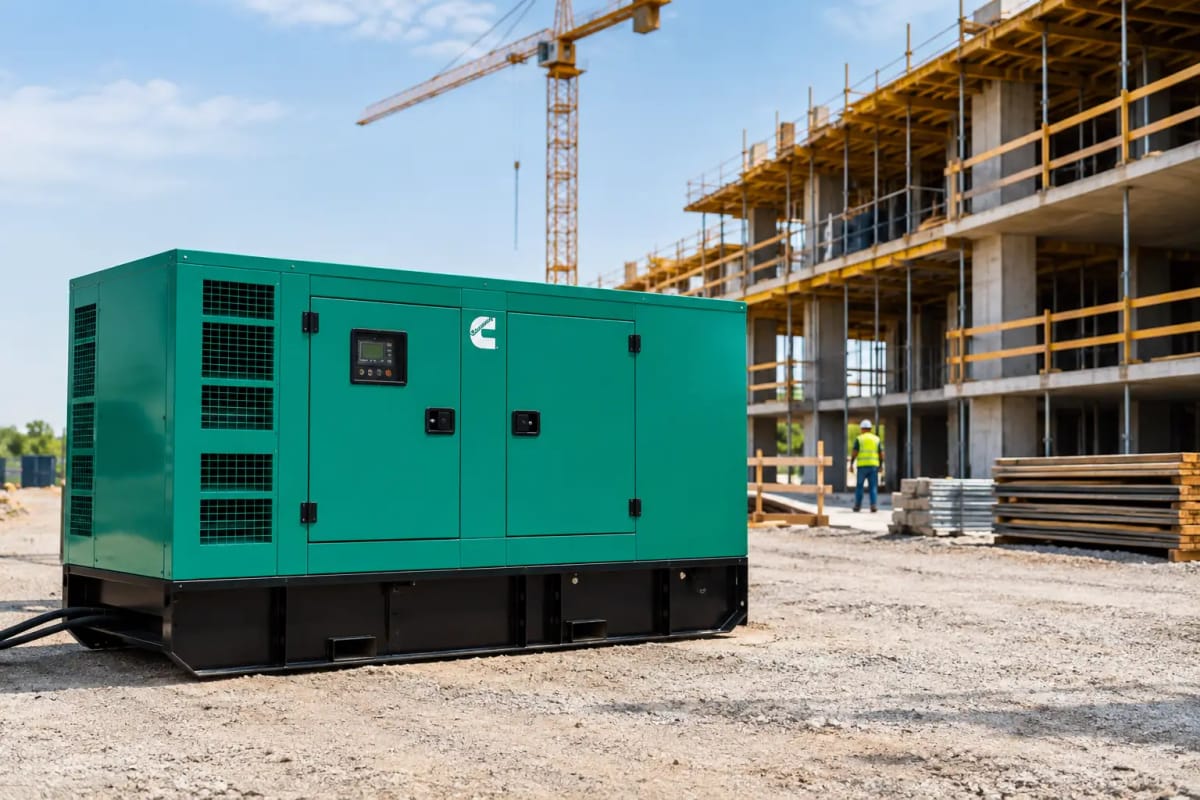
Generator format affects installation, noise management, security and service access. A silent canopy generator is normally the practical choice for construction work near occupied buildings, residential areas, hospitals, schools or restricted working hours. The acoustic enclosure also provides weather protection and helps secure the equipment.
Open generators can be suitable where the set will be installed in a purpose-designed plant room or protected compound with appropriate ventilation. They are generally less suitable when exposed directly to weather, unauthorised access or stringent noise limits. The lower initial equipment cost must be weighed against the cost of enclosure, acoustic treatment and site protection.
Positioning is as important as enclosure type. The generator needs firm, level ground, clear airflow, safe exhaust discharge and adequate space for maintenance. Avoid placing the set where exhaust can enter cabins, public areas or neighbouring properties. Fuel tanks, cable routes and distribution boards should be planned as one installation rather than added piecemeal after delivery.
Fuel Autonomy and Refuelling Must Be Planned
A generator is only as dependable as its fuel supply. Calculate expected consumption at representative load, not simply at full load or no load. A site operating 10 or 12 hours daily may require an extended-run tank, scheduled refuelling or both. For round-the-clock work, the fuel plan should include delivery access, safe storage, spill control and monitoring of remaining fuel.
Fuel theft is a material risk on unsecured sites. Lockable fuel caps, protected tanks, telematics and controlled access procedures can reduce exposure. More importantly, responsibility for checking levels must be clear. Relying on an occasional visual inspection is not an acceptable approach for a generator supporting critical dewatering, safety lighting or security systems.
Cold weather also changes the operating picture. Batteries, fuel quality and starting performance need attention during winter projects. A professionally maintained set with the correct fuel management arrangements will start more reliably than a unit left idle until the first frost or mains interruption.
Distribution, Protection and Power Quality
The generator is one part of the temporary power system. Cables, distribution boards, earthing arrangement, breakers and changeover equipment must be rated and installed for the intended duty. Undersized cables can create voltage drop; inadequate protection can create safety risks and nuisance trips.
Sites using electronic controls, IT equipment, battery chargers or variable-speed drives should consider power quality. Non-linear loads can introduce harmonics, while sudden load changes can affect voltage and frequency regulation. A quality industrial generator with suitable alternator sizing and automatic voltage regulation is a strong starting point, but the load profile still needs technical review.
Where mains power may become available later in the programme, decide early whether the generator will remain as standby, operate alongside another source or be removed. An automatic transfer switch is appropriate where uninterrupted changeover to a backup source is required. Paralleling systems may be justified for larger sites with changing demand, planned redundancy or a need to avoid taking the entire installation offline during maintenance. They add complexity, so they should be selected for a defined operational reason rather than specification prestige.
Reliability Is a Procurement Requirement
The cheapest available set can become the most expensive option if parts, service support or technical information are unavailable when the site is under pressure. For critical construction duty, specify recognised engine and alternator components, clear prime and standby ratings, and a control system that gives operators meaningful alarms and operating data.
Check delivery lead time, commissioning requirements, warranty terms and access to routine servicing before placing an order. A generator that cannot be delivered when the project starts has no value, regardless of its stated specification. Buyers should also confirm physical dimensions, weight, lifting points and transport requirements, particularly where access is constrained or the unit must be positioned by crane.
Global Generators supplies diesel generator sets across a wide power range, including silent and open configurations for three-phase and single-phase requirements. For construction procurement, the useful discussion starts with the load schedule, operating hours, site constraints and required delivery date - not with a generic recommendation.
A Practical Specification Brief for Enquiries
A clear enquiry reduces delay and helps ensure like-for-like quotations. Provide the required voltage, estimated running and peak load, major motor loads, anticipated operating hours, preferred duty rating and whether the site has mains power. Include noise restrictions, location conditions, delivery access, fuel autonomy expectations and any requirement for distribution, changeover or remote monitoring.
If the project programme will increase demand in phases, say so. It may be more economical to select a scalable arrangement or plan a generator changeover at a defined stage than to operate a substantially oversized set from day one. Conversely, a site with critical pumps or safety systems may justify additional capacity or a standby set even if average demand is modest.
The right generator protects programme certainty. Establish the electrical demand, select a prime-rated set where continuous site power is required, and treat fuel, distribution and servicing as part of the same uptime plan. That approach gives the project team dependable power when it is needed, rather than a last-minute solution when work has already stopped.