Quick answer
A 20 kVA generator delivers about 16 kW on a three-phase supply (at the standard 0.8 power factor), or 20 kW on a single-phase set such as the Cummins C28D5-1P. That is enough for a typical house, a small shop or office, a small farm, or a workshop that starts its largest motor on its own. The catch is single-phase loads: on a three-phase set each phase carries only about a third of the total, so one large single-phase appliance can overload it long before the generator reaches 20 kVA.
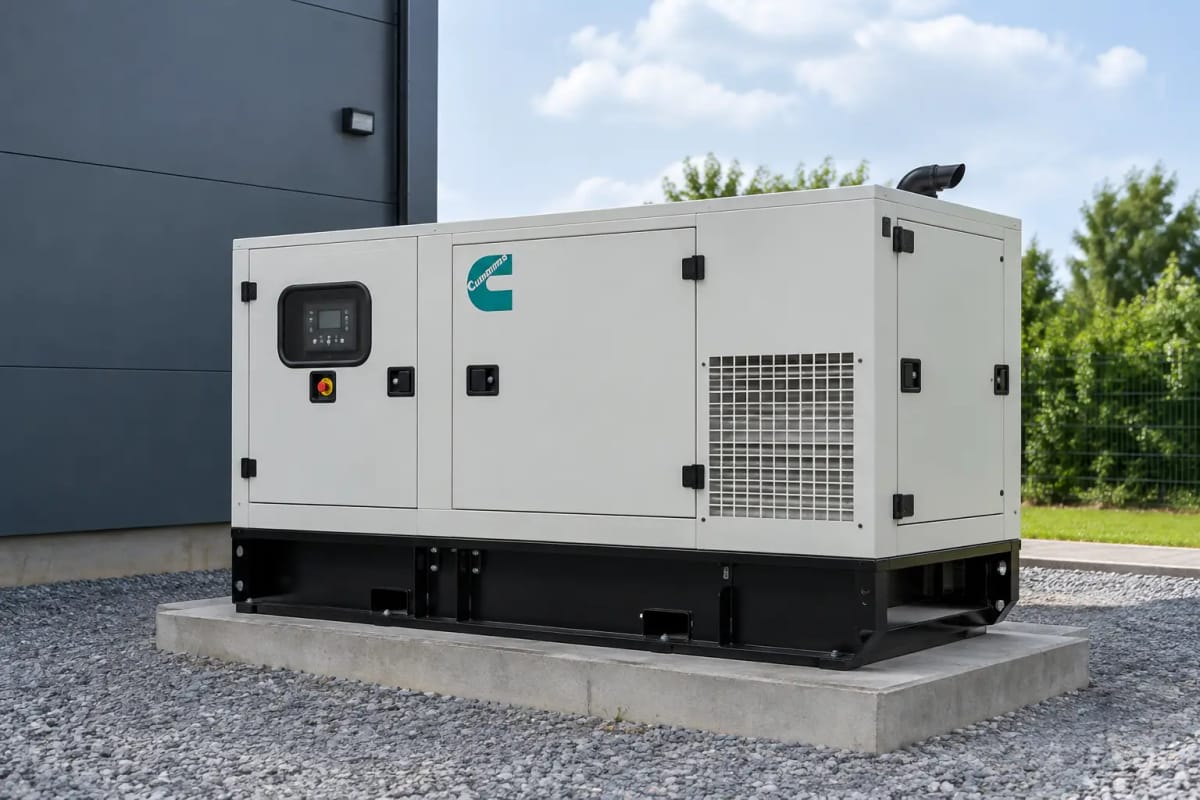
This guide uses datasheet figures from the 20 kVA generators in our range, together with real installations, to show what a 20 kVA set can run and where its limits are. If you are choosing between sizes, our guides to what a 15 kVA generator can power and what a 60 kVA generator can run cover the neighbouring sizes.
What does 20 kVA actually mean?
kVA measures apparent power, while most equipment is labelled in watts or kW. On a three-phase set, multiply kVA by the power factor of 0.8: 20 kVA × 0.8 = 16 kW. Plan around kW, not kVA.
Three 20 kVA-class models in our range show how the labels work:
| Model | Supply | Standby rating | Prime rating |
|---|---|---|---|
| Cummins C22D5 | Three phase, 400 V | 22 kVA / 18 kW | 20 kVA / 16 kW |
| Pramac GBW22P | Three phase, 400 V | 22 kVA / 17.6 kW | 20 kVA / 16 kW |
| Cummins C28D5-1P | Single phase, 230 V | 22 kVA / 22 kW | 20 kVA / 20 kW |
Two points stand out:
- "20 kVA" usually describes the prime rating. All three sets are 22 kVA on standby and 20 kVA on prime. Standby is for emergency use only, so plan around the prime figure if you will run the generator often.
- Single phase lists more kW. The three-phase sets deliver 16 kW prime, while the single-phase C28D5-1P lists 20 kW prime, so its listed kW equals its kVA.
> Expert tip: Always ask which rating a quoted kVA refers to, and whether the supply is single or three phase. Two "20 kVA" generators can differ by 4 kW of usable power.
Single phase or three phase: the limit that catches people out
Most homes in the UK have a single-phase supply, while workshops, farms and commercial premises often use three phase. On a three-phase generator, single-phase equipment draws from one phase only.
For a 20 kVA three-phase set that means:
- Each phase carries roughly one third of the total, about 6.7 kVA on the prime rating. At 230 V that is around 29 A per phase.
- The Pramac GBW22P, for example, has a maximum output current of 31.76 A per phase and a 32 A circuit breaker.
- Its single-phase 230 V sockets (two 16 A CEE and one 16 A Schuko) should be spread across the phases to keep the load balanced.
So a three-phase 20 kVA set is a poor match for a single-phase house with an electric shower. A single-phase set, such as the C28D5-1P, is the right tool for that job. Browse our single phase generators and 3 phase generators to compare.
Why starting loads matter
Motors, compressors, pumps and fridges draw several times their running current for a moment as they start. As a rough guide, a motor started direct-on-line should be no more than about a third of the generator's kW rating, which on a 16 kW set is around 5 kW. Soft starters or star-delta starters allow larger motors, and the alternator's design matters too. The GBW22P datasheet notes an auxiliary winding that can supply 300% current for up to 20 seconds to help with short motor starts, but each motor's starting method still needs checking.
What can a 20 kVA generator run in a home?
For a single-phase house, the 20 kW single-phase C28D5-1P has room for the loads that overwhelm smaller sets. Typical running loads:
| Appliance | Typical running load | Notes |
|---|---|---|
| Fridge-freezer | 100 to 300 W | Higher surge on start |
| LED lighting (whole house) | 100 to 300 W | Very light load |
| Gas boiler, pump and controls | 100 to 250 W | Keeps heating running |
| TV, router, laptops | 200 to 400 W | Light load |
| Kettle | 2 to 3 kW | Short bursts |
| Electric oven | 2 to 3 kW | Cycles on and off |
| Washing machine | 0.5 to 2.2 kW | Peaks when heating water |
| Electric shower | 7.5 to 10.5 kW | Large single load |
| EV charger (home type) | About 7 kW | Continuous while charging |
A worked example. The essentials (fridge-freezer, lighting, boiler, TV and router, kettle) come to about 4.3 kW. Add an 8.5 kW electric shower and a 3 kW oven and the total is about 15.8 kW, roughly 79% of the 20 kW prime rating. That is a comfortable result on the single-phase set. On a three-phase 16 kW set, the same shower alone would exceed what one phase can supply.
A house generator should be connected through a properly installed changeover switch by a qualified electrician, never plugged into a socket. If you are looking at options for a property, see our generators for homes, and our case study of a 28 kVA Cummins home backup installation in Devon shows a real example.
What can a 20 kVA generator run in a shop, office or small business?
Small commercial premises combine many light loads with a few heavy ones, mainly air conditioning and refrigeration.
| Equipment | Typical running load | Notes |
|---|---|---|
| Air conditioning or VRF unit | 3 to 6 kW | High start-up surge |
| LED lighting | 1 to 2 kW | Steady load |
| IT, comms and tills | 1 to 2 kW | Keep on a stable supply |
| Display fridges and freezers | 0.3 to 0.8 kW each | Compressor surge on start |
| Small power (PCs, printers) | 2 to 4 kW | Varies through the day |
| Automatic door or shutter | 0.5 to 1 kW | Short bursts |
A worked example. A small office or retail unit with 5 kW of air conditioning, 1.5 kW of lighting, 1.5 kW of IT, 3 kW of small power, 1.5 kW of refrigeration and a 0.5 kW automatic door totals about 13 kW. That is about 81% of a 16 kW three-phase set, which works for backup but leaves limited headroom for growth.
What can a 20 kVA generator run in a workshop or on a farm?
Three-phase machinery suits a three-phase set, as long as the biggest motor starts on its own.
| Equipment | Typical running load | Notes |
|---|---|---|
| Air compressor (4 kW motor) | 4 kW | Biggest starting load |
| Dust or fume extractor | 2 to 2.2 kW | Start it first |
| Machine tools (lathe, saw) | 2 to 3 kW each | Surge on start |
| Inverter welder (200 A) | 5 to 9 kVA at full output | Check the input rating |
| Milking vacuum pump | 4 to 5.5 kW | Start before other motors |
| Milk cooling compressor | 3 to 5.5 kW | Priority load |
| Water heater | 3 to 6 kW | Steady load |
A worked example for a workshop. A 4 kW compressor, a 2.2 kW extractor, 0.5 kW of lighting and two 3 kW machines total about 12.7 kW, around 79% of a 16 kW set. Start the compressor first, then the extractor, then the machines.
A worked example for a farm. A small dairy with a 4 kW vacuum pump, a 3 kW milk cooler, a 3 kW water heater and 1.5 kW of lighting comes to 11.5 kW, about 72% of the prime rating.
> Expert tip: On a three-phase generator, spread single-phase equipment evenly across the phases. Loading one phase can trip the generator long before the total reaches its rating.
Can a 20 kVA generator support an EV charging hub or a solar and battery site?
Yes, but the generator's role is usually to top up energy storage rather than supply rapid chargers directly. We supplied a Pramac GBW22P to a new EV rapid charging hub at a padel club in Manchester, and the site's case study shows how it works. The system pairs a 30 kWp solar canopy with about 200 kWh of usable battery storage and a 100 kW inverter. The generator runs roughly 10 hours overnight at about 80% load and produces around 129 kWh.
Two practical points follow. A charger rated at 22 kW cannot be fully supplied by a generator with a 16 kW prime rating, while a 7 kW charger fits comfortably. For another real example, see our case study of a 22 kVA Cummins generator for telecoms at a UK solar and battery site.
What a 20 kVA generator will not run comfortably
- Several large motors starting at the same moment.
- A single-phase house with an electric shower, on a three-phase set.
- A motor above about 5 kW started direct-on-line.
- A 22 kW EV charger running at full output.
- A full commercial kitchen alongside other loads.
- Continuous running at close to 100% load with no headroom.
How to size a 20 kVA generator for your site
- List everything that must keep running. Be strict and include only essentials.
- Find each running load on the rating plate, in watts, kW or amps.
- Identify the largest starting load and check its starting method.
- Decide single or three phase from your supply and your largest single-phase load.
- Add 20 to 25% headroom and aim for a typical load of 40 to 80%, because diesel engines run lightly loaded for long periods can suffer from wet stacking.
> Not sure your load list adds up? Send us your equipment list, your supply type and how often the generator will run, and we will check it against a set from stock. Use the contact page or call +44 1302 700200.
Fuel use and run times
The Cummins C22D5 datasheet gives fuel consumption at each load on its prime rating, and the 165-litre tank sets the run time.
| Load | Output | Fuel use | Tank run time (165 litres) |
|---|---|---|---|
| 25% | 4 kW | 2.5 litres per hour | About 66 hours |
| 50% | 8 kW | 3.2 litres per hour | About 52 hours |
| 75% | 12 kW | 4.1 litres per hour | About 40 hours |
| 100% | 16 kW | 5.2 litres per hour | About 32 hours |
For comparison, the single-phase C28D5-1P is listed at 6 litres an hour at 100% prime load, with 27.5 hours of autonomy on its 165-litre tank. The Pramac GBW22P uses about 4 litres an hour at 75% prime load and 5.5 at 100%, and its 51-litre tank gives roughly 9 hours at full load. Run times use nominal tank capacity, so allow a reserve in practice. For ways to run a generator efficiently, see our guide to fuel saving methods for generators.
Standby or prime, manual or automatic start?
Standby versus prime. Standby is for emergency use during a mains failure and prime is for regular running. The warranty terms reflect that. On the Cummins sets, standby cover is two years or 500 hours and prime cover is one year with unlimited hours. On the Pramac GBW22P, standby cover is two years or 1,000 hours and prime cover is one year or 3,000 hours. For the full explanation, read our guide to prime versus standby power.
Manual or automatic start. The Cummins sets use the PowerStart 0600 controller, and the C28D5-1P page lists automatic mains failure functionality. The Pramac GBW22P in this range is a manual key-start model with socket outlets. It is not intended to start automatically when the mains fails, so for standby use it needs suitable changeover equipment installed by a competent electrician.
Noise, size and weight
| Specification | Cummins C22D5 | Pramac GBW22P | Cummins C28D5-1P |
|---|---|---|---|
| Canopy noise level | 77 dB(A) at 1 m | 66 dB(A) at 7 m | 77 dB(A) at 1 m |
| Length × width × height | 2,082 × 987 × 1,524 mm | 1,645 × 870 × 1,060 mm | 2,082 × 987 × 1,524 mm |
| Dry weight | 970 kg | 546 kg | 1,014 kg |
| Fuel tank | 165 litres | 51 litres | 165 litres |
Noise figures at 1 m and at 7 m are not directly comparable, so read our guide to how quiet a silent generator really is before choosing.
Safety and regulations
- Connection and earthing. Our generator earthing requirements guide explains what applies on UK sites.
- Ventilation and exhaust. Diesel exhaust contains carbon monoxide. Never run a generator indoors or in an enclosed space.
- Permits. Environmental permit rules for medium combustion plants and specified generators apply to far larger installations than a 20 kVA set. You can confirm the thresholds in the GOV.UK guidance on medium combustion plants and specified generators.
Frequently asked questions
How many kW is a 20 kVA generator?
On a three-phase set at a 0.8 power factor, 16 kW. The single-phase Cummins C28D5-1P lists 20 kW prime, so its listed kW equals its kVA.
Can a 20 kVA generator run a house?
Yes. On a single-phase set it can run the essentials plus an oven and an electric shower with room to spare. A three-phase set is less suitable, because a single-phase house can only draw from one phase. Have it connected through a changeover switch by a qualified electrician.
How much diesel does a 20 kVA generator use per hour?
On the Cummins C22D5 datasheet, 2.5 litres an hour at 25% prime load, rising to 5.2 litres an hour at full prime load. The C28D5-1P is listed at 6 litres an hour at full prime load.
Is a 20 kVA generator single phase or three phase?
Both exist. Our three-phase models run at 400 V and our single-phase model at 230 V. Choose by the supply you need and your largest single-phase load.
Why are many 20 kVA generators sold as 22 kVA?
Because 22 kVA is the standby rating and 20 kVA is the prime rating of the same machine. Always check which rating a listing quotes.
Can a 20 kVA generator run an EV charger?
It can run a 7 kW charger, but not a 22 kW charger at full output. On sites with rapid charging, a generator of this size is typically used to charge battery storage, as in our Manchester EV hub case study.
Conclusion
A 20 kVA generator is a flexible size for homes, small businesses, farms, workshops and hybrid energy sites, delivering 16 kW on three phase or 20 kW on single phase. Choose the phase type first, plan around the prime rating, start big motors one at a time and keep a sensible margin.
> Talk to a real person: Global Generators is an authorised Cummins reseller and an authorised Grupel and Pramac dealer, with new diesel generators in stock for UK delivery and export. Browse our full 20 kVA generator range or the stock list, then contact our team on +44 1302 700200 or at enquiries@global-generators.com and we will help you match a set to your load.