6th Aug 2026|Written by Sam Dexter
Prime power for an EV hub waiting on a grid connection
Rapid charging hubs are being built faster than the grid can connect them. Sites are finished, surfaced and signed, then sit idle for months or years waiting on a DNO connection date.
A UK company that installs rapid charging hubs at workplaces, hotels and leisure venues came to us with exactly that problem. Its latest site is a new padel club in Manchester, with 2 x 50 kW DC rapid chargers ready to go and no supply behind them.
Rather than wait, the company built an off-grid system: solar through the day, battery storage in the middle, and a Pramac generator charging the battery overnight.
The equipment supplied
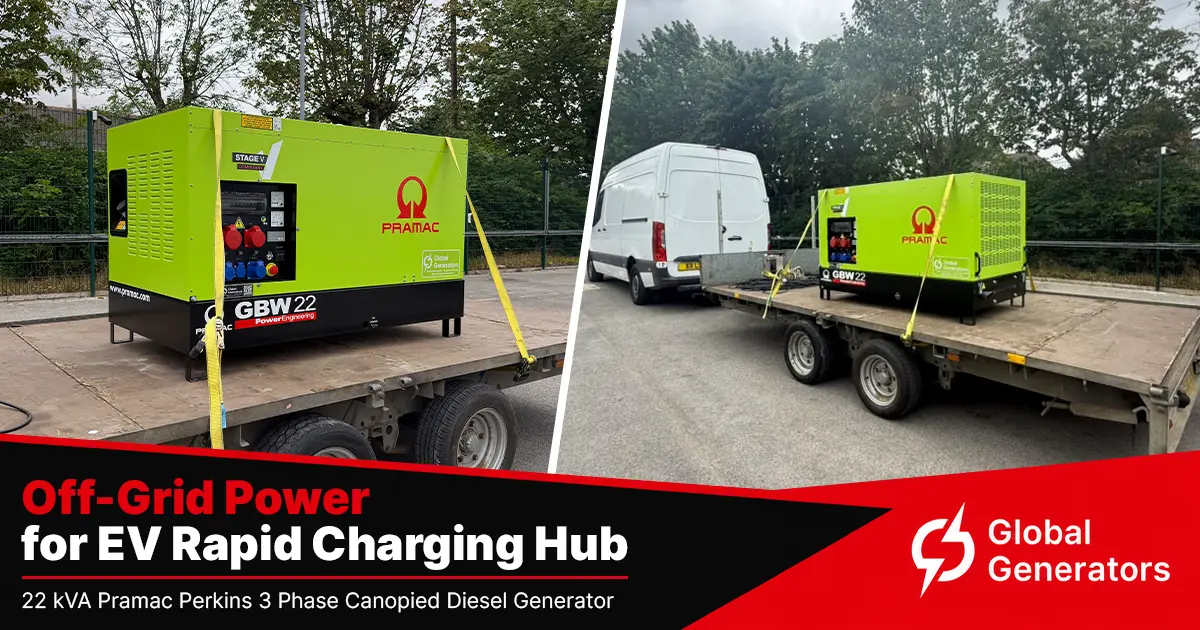
We supplied a single Pramac GBW22P diesel generator, a compact 3 phase set in a weatherproof acoustic canopy.
How the numbers stack up
A 16 kW generator cannot run 100 kW of rapid chargers directly. It does not need to. The battery delivers the burst, and the generator and solar replace the energy over 24 hours.
The system uses a 30 kWp solar canopy, around 200 kWh of usable battery storage and a 100 kW inverter. The generator runs roughly 10 hours overnight at about 80% load, producing around 129 kWh. Solar adds around 74 kWh on an annual average, rising to 130 kWh in June and falling to almost nothing in December.
After losses, that delivers around 173 kWh per day to vehicles: about 220 kWh in summer and 166 kWh in winter, where longer generator hours make up the shortfall. In practice that is 6 to 9 rapid sessions a day.
Two lessons for anyone sizing a similar system
First, the second charger does not double throughput. Daily energy is fixed by the generator and the solar array. What the second charger buys is availability, so two drivers are served at once instead of one queuing. At a padel club with clustered arrivals, that matters.
Second, winter sizes the battery. In December all the energy arrives overnight with no daytime solar behind it, so the battery must hold a full day's supply. Size on the summer case and the system runs flat by mid-afternoon come November.
Why Stage V matters here
Stage V is the emissions standard for non-road mobile machinery. A generator that stays on one site under a fixed installation falls under a different regime. This one moves on to the next hub once the grid connection lands, so it is mobile machinery.
That affects site access in low emission zones, compliance with main contractor plant policies, and the set's residual value across a rolling programme of hubs. At 66 dB(A) at 7m, the acoustic canopy also keeps overnight running acceptable at a leisure venue close to housing.
Why customers choose Global Generators
- Authorised Pramac dealer - full access to the Pramac diesel generator range, including Stage V sets
- A leading stockist - a wide range of generators held in our own physical inventory, so rollout programmes are not held up waiting on a factory build slot
- Over 50 years of combined experience - we help EV infrastructure installers match the right set to the real load, not the headline charger rating
- Fast delivery from the UK and efficient global export - for one site or a full programme of hubs
Building EV charging hubs ahead of the grid?
Workplace, hotel, leisure or destination charging: if your sites are ready before your connection date, our team will help you size the right generator for a solar and battery system. We supply diesel generators from the UK, with fast nationwide delivery from stock and worldwide export available.
Talk to our power generation experts today. Call us, message us on WhatsApp, or send us an email, and we will be happy to assist.