Quick answer
A 15 kVA generator delivers about 12 kW of usable power (at the standard 0.8 power factor). That is enough to run the essential circuits of a typical UK home, a small shop with refrigeration and tills, or a small workshop with a few three-phase machines, provided the biggest motors are started one at a time. It will not run everything at once: an electric shower, oven and hob together, or several large motors starting together, will overload it.
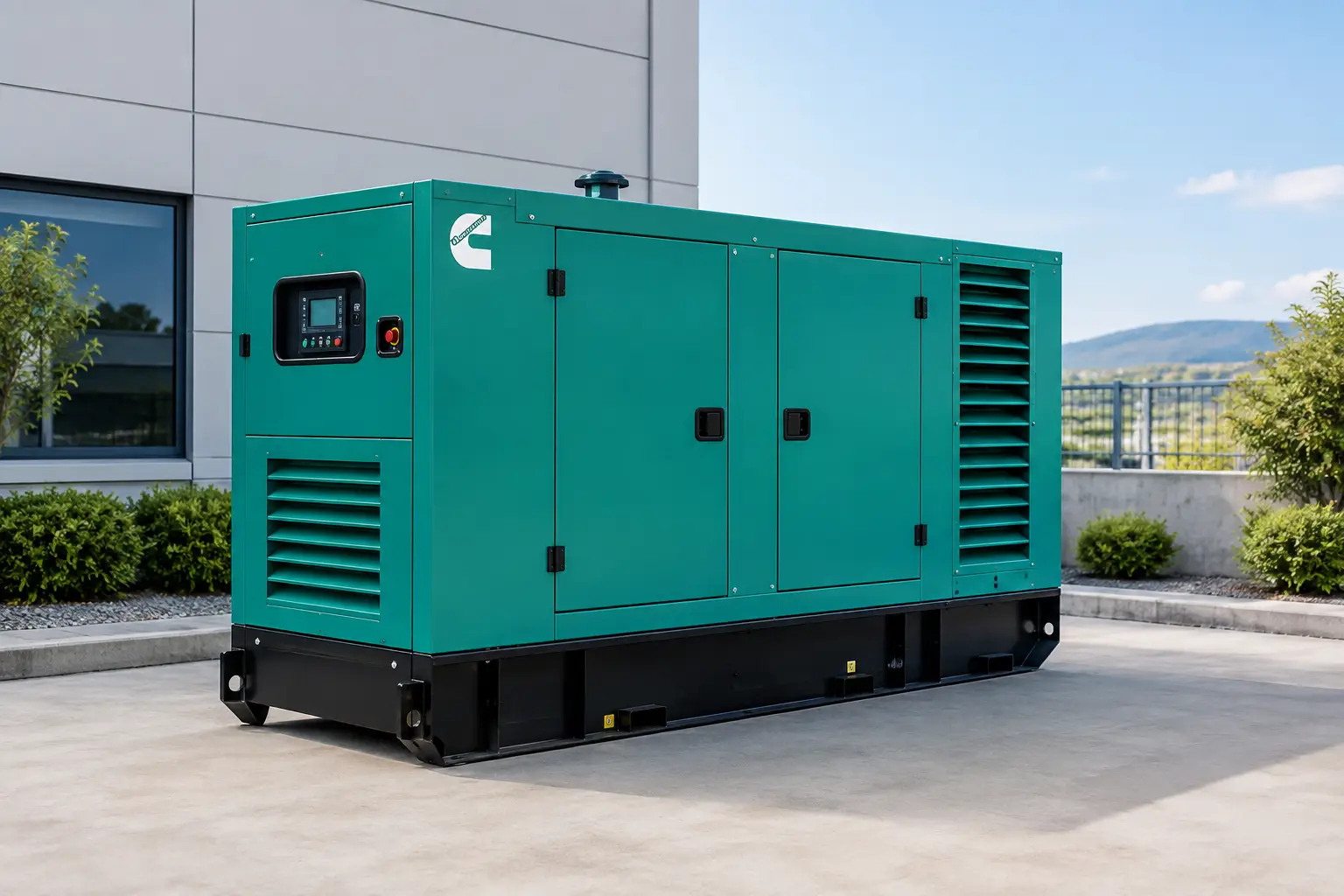
A 15 kVA diesel generator sits in a useful middle ground. It is large enough to keep a household, a corner shop or a small workshop working through an outage, yet small enough to fit on a modest base and run on an ordinary fuel tank. Global Generators supplies new diesel generators from 10 to 3000 kVA, so this guide comes from the practical side of the counter: real appliances, real starting loads and the mistakes that tend to catch people out when they size by kVA alone.
What does 15 kVA actually mean?
kVA measures apparent power. Most of your equipment is labelled in watts or kW, which is real power. To convert, multiply kVA by the power factor. Generator sets are normally rated at 0.8, so 15 kVA × 0.8 = 12 kW. Some manufacturers quote kW on the rating plate, so check before you compare sets.
| 15 kVA diesel generator | Typical figure | | --- | --- | | Apparent power | 15 kVA | | Real power at 0.8 power factor | About 12 kW | | Standby rating (emergency use only) | Often around 10% higher, e.g. 16 to 17 kVA | | Full-load current, single phase 230 V | About 65 A | | Full-load current, three phase 400 V | About 22 A per phase | | Diesel use at full load | Roughly 3.5 to 4.5 litres per hour |
Standby versus prime. A standby rating is for emergency use only. A prime rating is what the set can deliver for regular running with a varying load. If you plan to run the generator often, plan around the prime figure. The examples below use the more cautious 12 kW.
> Expert tip: Always check which rating a listing refers to. A generator sold as "15 kVA standby" gives you less for regular use than one sold as "15 kVA prime", even though the headline number is the same.
Why starting loads matter
Motors, compressors, pumps, fridges and air conditioners draw several times their running current for a second or two when they start, often three to seven times. A diesel generator can absorb that surge, but only within limits. This is why a 4 kW compressor can run happily on a 12 kW set, yet the same generator may struggle when the compressor, an extractor and a fridge all start together.
What can a 15 kVA generator run at home?
For a home, a 15 kVA diesel generator comfortably covers the circuits that keep the house safe and comfortable. Typical running loads look like this:
| Appliance | Typical running load | Notes | | --- | --- | --- | | Fridge-freezer | 100 to 300 W | Higher surge on start | | LED lighting (whole house) | 100 to 300 W | Very light load | | Gas boiler, pump and controls | 100 to 250 W | Keeps heating running | | TV, router, laptops | 200 to 400 W | Light load | | Kettle | 2 to 3 kW | Short bursts | | Microwave | 0.8 to 1.5 kW | Short bursts | | Washing machine | 0.5 to 2.2 kW | Peaks when heating water | | Electric oven | 2 to 3 kW | Cycles on and off | | Induction hob (two zones) | 3 to 7 kW | Use one or two zones | | Immersion heater | About 3 kW | Steady load | | Electric shower | 7.5 to 10.5 kW | Uses most of the generator |
Two realistic set-ups show how this works in practice:
- Essentials (about 4 to 5 kW): fridge-freezer, lighting, boiler and pump, TV and router, and a kettle. The generator runs at around 40% load, which suits a diesel engine well.
- Comfortable (about 9 to 10 kW): the essentials plus the oven and a washing machine cycle. This is near the upper end of what is sensible.
- Not realistic: an electric shower, oven and hob at the same time. The shower alone can take most of the generator.
Connection matters as much as size. A house generator should be wired through a properly installed changeover switch by a qualified electrician, never plugged into a socket, which can send power back into the network and endanger anyone working on it. The HSE's guidance on generator electrical safety explains why earthing and correct connection are so important.
> Expert tip: Most UK homes have a single-phase supply, so choose a single-phase 230 V generator. A three-phase 15 kVA set only provides roughly 5 kVA per phase, which is far less useful for a house. If you are comparing options for a property, see our range of generators for homes.
What can a 15 kVA generator run in a shop, café or salon?
Small commercial sites usually have a lot of light loads and a handful of heavier ones. Refrigeration is the priority, because stock loss builds up quickly once the compressors stop.
| Equipment | Typical running load | Notes | | --- | --- | --- | | Display fridge or chiller | 300 to 800 W each | Compressor surge on start | | Chest freezer | 200 to 500 W | Low, steady load | | LED lighting | 0.5 to 1.5 kW | Whole shop floor | | Tills, card machines, CCTV | 0.3 to 0.6 kW | Keep on a stable supply | | Air conditioning unit | 2 to 3.5 kW | High start-up surge | | Coffee machine | 2 to 3.5 kW | Heating element cycles | | Automatic door or shutter | 0.5 to 1 kW | Short bursts |
A worked example. A small convenience store with three display fridges (1.5 kW), two chest freezers (0.6 kW), lighting (1.2 kW), tills and CCTV (0.5 kW), an automatic door (0.5 kW), an air conditioning unit (2.5 kW) and a coffee machine (2.5 kW) comes to about 9.3 kW. That fits inside 12 kW with a little headroom for surges.
If the business has a walk-in cold room, get the condensing unit's rating and starting current from the installer before choosing. Cold storage is a common reason that a 15 kVA set turns out to be too small.
What can a 15 kVA generator run in a small workshop?
Workshops are where starting loads make the difference. A three-phase 400 V set suits fixed machinery, while a single-phase set is better for power tools and lighting.
| Equipment | Typical running load | Notes | | --- | --- | --- | | Table saw | 2.2 to 3 kW | Surge on start | | Dust extractor | 1.5 to 2.2 kW | Start it first | | Lathe or pillar drill | 0.75 to 2.2 kW | Modest load | | Air compressor (4 kW motor) | 4 kW | Biggest starting load | | Inverter MIG/MMA welder | 5 to 9 kVA at full output | Check the welder's input rating | | Workshop lighting | 0.3 to 0.6 kW | Negligible |
As a rough guide, a motor started direct-on-line should be no more than about a third of the generator's kW rating. On a 12 kW set that points to a motor of around 4 kW. With a star-delta starter, soft starter or variable speed drive, a larger motor becomes possible. Alternator design varies, so confirm the figure with the supplier for the exact set.
> Expert tip: On a three-phase generator, single-phase equipment draws from one phase only. With 15 kVA split three ways, that is roughly 5 kVA per phase. Spread sockets and lighting circuits across all three phases rather than loading one, or the generator may trip long before it reaches its nameplate rating.
What a 15 kVA generator will not run comfortably
- Several large motors starting at the same time.
- An electric shower, oven and hob all running together.
- A 7.5 kW or larger compressor started direct-on-line.
- Multiple air conditioning units or a large cold room alongside other loads.
- Continuous operation at close to full load with no headroom.
How to size a 15 kVA generator for your site
- List everything you must keep running. Be strict: essentials only, not everything you own.
- Find the running load of each item on its rating plate, in watts, kW or amps. For single phase, watts = volts × amps.
- Identify the largest starting load and check it against the generator's motor-starting capability.
- Add 20 to 25% headroom for future equipment and surges.
- Aim for a typical load of 40 to 80%. Diesel engines that run lightly loaded for long periods can suffer from wet stacking, where unburnt fuel builds up in the exhaust.
Not sure your list adds up? Send us your equipment list and we will check it against a set from stock. Speak to our team through the contact page or call +44 1302 700200.
Fuel use and running costs
A modern diesel generator is efficient because it burns fuel in proportion to the load. Typical figures for a 15 kVA set look like this, although each model differs, so check the datasheet:
| Load | Power output | Approx. diesel use | | --- | --- | --- | | 25% | About 3 kW | 1.3 to 1.6 litres per hour | | 50% | About 6 kW | 2.2 to 2.6 litres per hour | | 75% | About 9 kW | 3.1 to 3.5 litres per hour | | 100% | About 12 kW | 3.9 to 4.5 litres per hour |
As an example, a 60-litre tank at half load would last roughly a day. To estimate cost, multiply the litres per hour by your current diesel price. Our guide to fuel saving methods for generators covers load management and tank sizing in more detail.
Silent or open, single phase or three phase?
Silent (canopied) sets are enclosed to reduce noise and protect the engine from weather. They suit sites near neighbours, shops and homes. Canopied sets in this size are commonly rated at somewhere around 60 to 70 dB(A) at 7 metres, but check the datasheet. If people will work close to the generator, the HSE's noise at work guidance sets out the employer's duties as daily exposure rises. Browse our silent generators to compare enclosures.
Open sets cost less and are easier to service, but they are noisy and need a plant room or weatherproof housing.
Single phase or three phase. Choose single phase for homes and small premises. Choose three phase if you run fixed machinery or need a balanced supply.
A real example from our range. The Pramac GBW22Y-1P is a silent, single-phase, Yanmar-powered set rated at 14.3 kVA standby and 13 kVA prime, close to the 15 kVA class and well suited to a house or a small shop. Check the product page for current pricing and availability.
When should you step up to 20 kVA?
If your realistic load is above about 10 kW, or you have a large motor to start, look at the next size up. A 20 kVA generator costs more but gives you headroom that is often worth having. It is generally cheaper to size correctly at the start than to replace an overworked set later.
Siting, safety and regulations
- Ventilation and exhaust. Diesel exhaust contains carbon monoxide. Never run a generator indoors or in an enclosed space, and keep exhausts away from doors, windows and air intakes.
- Earthing. Correct earthing and neutral arrangements protect people and equipment. Our generator earthing requirements guide explains what applies on UK sites.
- Fuel and refuelling. Stop the engine and let it cool before refuelling, and store diesel in approved containers.
- Permits. Environmental permit rules apply to medium combustion plants and specified generators, which are far larger than a 15 kVA set. You can confirm the thresholds on the GOV.UK guidance on medium combustion plants and specified generators.
- Servicing. Regular servicing and a monthly on-load test keep a standby set reliable.
Frequently asked questions
How many kW is a 15 kVA generator?
At the standard power factor of 0.8, a 15 kVA generator produces about 12 kW. Some sets quote a slightly different figure, so check the rating plate.
Can a 15 kVA generator run a house?
Yes, for most essential circuits and several larger appliances at once. It will not run every high-power appliance together, such as an electric shower with an oven and hob. Have it connected through a changeover switch by a qualified electrician.
How much diesel does a 15 kVA generator use per hour?
Roughly 1.3 to 1.6 litres per hour at 25% load, rising to around 4 litres or slightly more at full load. The exact figure depends on the engine and model.
Can a 15 kVA generator run a welder or air compressor?
Often yes, within limits. Check the welder's input rating, and for compressors keep the motor to roughly a third of the generator's kW rating when started direct-on-line, or use a soft starter or star-delta starter for larger motors.
Is a 15 kVA generator single phase or three phase?
Both types exist. Single-phase 230 V sets suit homes and small premises. Three-phase 400 V sets suit machinery, though single-phase loads on a three-phase set are limited to roughly one third of the total on each phase.
How long can a 15 kVA diesel generator run continuously?
A well-maintained diesel generator can run for many hours or days if refuelled and kept within its rated load. For regular running rather than emergency use, check that the set is rated for prime power and follow the manufacturer's service intervals.
Conclusion
A 15 kVA generator is a practical size for many homes, shops and small workshops. It can carry roughly 12 kW of real load, so long as you know your biggest starting loads and leave a sensible margin. Measure what you need, allow for motors, and choose the right phase, enclosure and rating before you buy.
> Talk to a real person: Global Generators is an authorised Cummins reseller and an authorised Grupel and Pramac dealer, with new diesel generators in stock for UK delivery and export. Browse our full 15 kVA generator range, or contact our team on +44 1302 700200 or at enquiries@global-generators.com and we will help you match a set to your load.