Quick answer
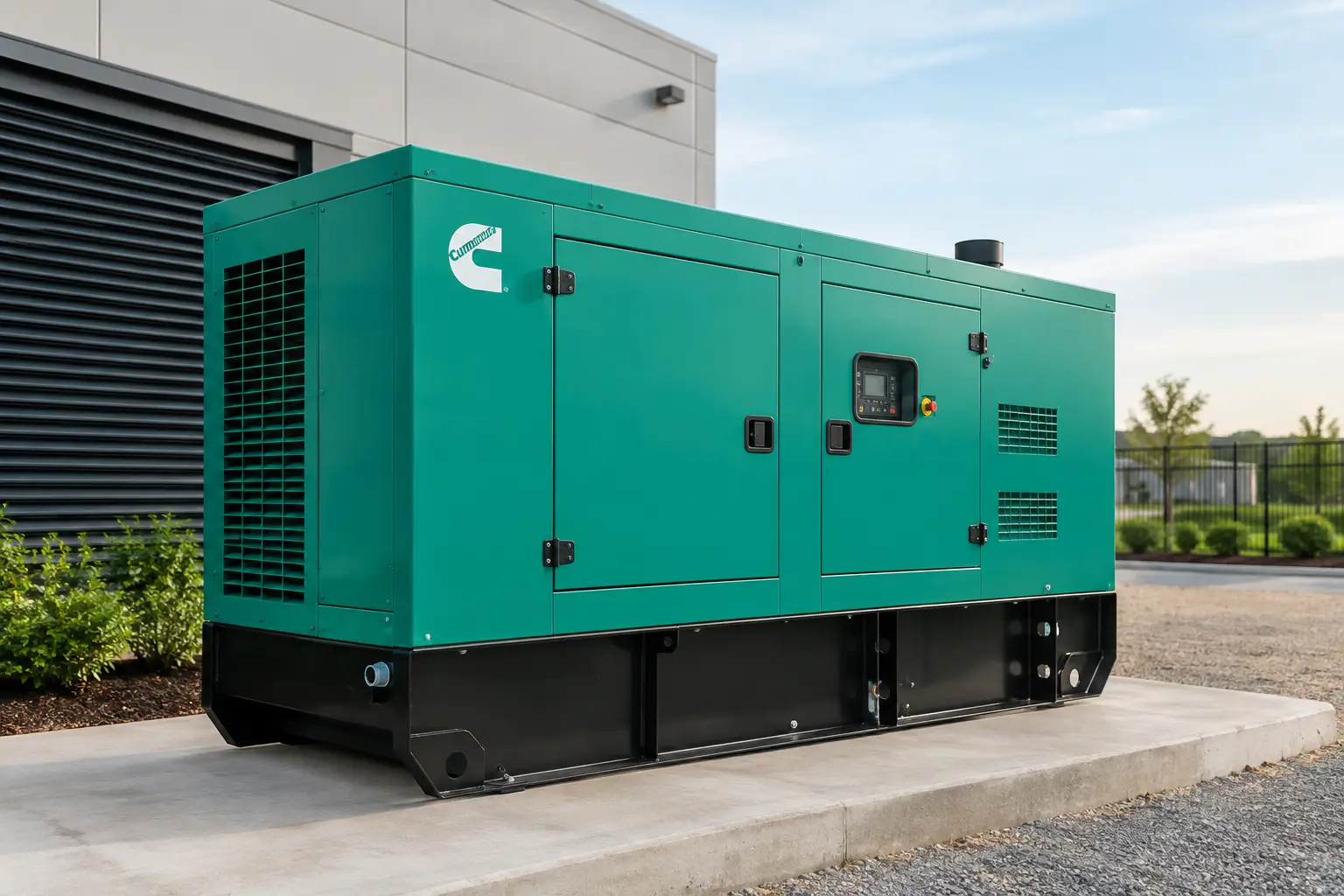
A 100 kW generator is the size band served by 150 to 170 kVA sets. In our range that means the Cummins C150D5 (109 kW prime, 120 kW standby) and the C170D5 (124 kW prime, 136 kW standby). 100 kW is about 125 kVA at the standard 0.8 power factor. The catch is headroom: to run a 100 kW load regularly you need a set rated above 100 kW, because you should keep your typical load under about 80% of the prime rating. That is roughly 87 kW on the C150D5 and 99 kW on the C170D5, so a true 100 kW load sits at the limit of the larger one.
This guide explains what a 100 kW generator can run, how kW converts to kVA, which sets in our 100 kW generator range suit a 100 kW load, and how to read the ratings, using datasheet figures and worked examples.
What does 100 kW mean in kVA?
Generators are rated in kVA, while most equipment is labelled in kW. On a three-phase set, kVA = kW ÷ 0.8, the standard power factor. So 100 kW is 125 kVA.
| kW | kVA at 0.8 power factor |
|---|---|
| 80 kW | 100 kVA |
| 100 kW | 125 kVA |
| 120 kW | 150 kVA |
| 124 kW | 155 kVA |
| 136 kW | 170 kVA |
A 100 kW load at 0.8 power factor draws about 181 A per phase at 400 V (calculated). Note that 100 kW and 100 kVA are different: a 100 kVA generator delivers only 80 kW.
Which sets in our range are "100 kW" generators?
Our 100 kW range contains two Cummins sets, and a third that shares the same rating:
| Model | Standby rating | Prime rating | Built in |
|---|---|---|---|
| Cummins C150D5 | 150 kVA / 120 kW | 136 kVA / 109 kW | India |
| Cummins C170D5 | 170 kVA / 136 kW | 155 kVA / 124 kW | India |
| Cummins C170D5Q | 170 kVA / 136 kW | 155 kVA / 124 kW | Europe |
All supply 400 V, 50 Hz three-phase power through a four-pole circuit breaker and are supplied in a silent canopy. You can also see them in our 150 kVA generators range.
Why a 100 kW load needs more than a 100 kW set
Plan around the prime rating and keep your typical load under about 80% of it. Here is what exactly 100 kW of load looks like on each set:
| Model | Prime rating | 100 kW as a share of prime | 100 kW as a share of standby |
|---|---|---|---|
| Cummins C150D5 | 109 kW | About 92%, too tight | About 83% |
| Cummins C170D5 / C170D5Q | 124 kW | About 81%, at the limit | About 74% |
Standby is for emergency use only, so the standby percentage matters only if the generator will run for a few hours a year. For regular running, the prime figure decides.
As a guide:
- Up to about 87 kW of typical load: the C150D5 (80% of 109 kW).
- Up to about 99 kW: the C170D5 or C170D5Q (80% of 124 kW).
- Around 100 to 128 kW, or if you expect growth: look at a 200 kVA generator, which gives 160 kW on its prime rating on our Cummins sets, with 128 kW at 80%.
> Expert tip: Check the average load as well as the peak. ISO 8528-1 sets a permissible average output of 70% of the prime rating over 24 hours, which is about 76 kW on the C150D5 and 87 kW on the C170 sets. See our guide to standby versus prime rating on a 500 kVA generator for how the hours and average limits work, which apply at any size.
Check the frequency: 50 Hz or 60 Hz
Not every listing that says "100 kW generator" is comparable. Some listings online quote 100 kW prime at 60 Hz, on an engine running at 1,800 rpm. Our generators are all 50 Hz sets running at 1,500 rpm, which is the standard for the UK and most of Europe. Before you compare ratings between suppliers, check the frequency, the speed and whether the figure is prime or standby. Our 50Hz generators page explains the range.
What can a 100 kW generator run?
A set of this size can carry the essential services of a food or light manufacturing plant, a school or college, a care home, a retail unit with refrigeration or a large farm. Typical running loads:
| Equipment | Typical running load | Notes |
|---|---|---|
| Air compressor (22 kW motor) | 22 kW | Biggest starting load |
| Production line motors | 20 to 40 kW | Start in sequence |
| Refrigeration compressors | 10 to 20 kW each | Priority load, starting surges |
| Air conditioning or VRF | 15 to 40 kW | High start-up surge |
| Lighting | 10 to 25 kW | Steady load |
| Kitchen (refrigeration plus cooking) | 25 to 45 kW | Cooking cycles on and off |
| IT, servers and comms | 10 to 20 kW | Critical, constant |
| Lifts | 8 to 15 kW | Starting surge |
| Fire, security and access control | Under 5 kW | Always include these |
Worked example 1: a light manufacturing unit
A 22 kW air compressor, 35 kW of production line motors, 10 kW of extraction, 10 kW of lighting and 8 kW of offices and IT total 85 kW. That is about 78% of the C150D5's 109 kW prime rating and 69% of the C170D5's 124 kW. Either works, but the C170 leaves more headroom for the compressor to start.
Worked example 2: a convenience supermarket
Refrigeration packs (40 kW), lighting (20 kW), air conditioning (20 kW), bakery ovens (15 kW) and tills and IT (5 kW) total exactly 100 kW. That is 92% of the C150D5's prime rating and 81% of the C170's. The C150D5 would be too tight for regular running, and even the C170 is at the limit, so shedding the bakery ovens during an outage brings the load to 85 kW.
Worked example 3: a school or care home
Lighting (20 kW), heating pumps (10 kW), a kitchen (30 kW), IT (12 kW), lifts (8 kW), ventilation (8 kW) and fire and security (3 kW) total 91 kW. That is about 83% of the C150D5's prime rating and 73% of the C170's. The C170 is the comfortable choice.
We supplied a Cummins C170D5Q to a Doncaster food manufacturer for emergency standby power, and the case study lists the loads it protects, including cookers, chillers, freezers, mixers, packing lines and extraction.
Motor starting on a 100 kW set
Compressors, pumps, fans and production motors draw several times their running current as they start. As a rough guide, a motor started direct-on-line should be no more than about a third of the generator's kW rating. That is around 36 kW on the 109 kW set and 41 kW on the 124 kW set. Soft starters, star-delta starters or variable speed drives allow larger motors, and the alternator's design decides the real limit, so ask for the motor-starting curve if you have large machines.
On a three-phase set, single-phase equipment draws from one phase only. Spread single-phase circuits evenly across the phases. Browse our 3 phase generators for the full range.
What a 100 kW generator will not run comfortably
- A whole site that totals more than about 99 kW of typical running load.
- A motor above about 36 to 41 kW started direct-on-line.
- Several large motors starting at the same moment.
- Large single-phase loads concentrated on one phase.
- Continuous running at close to 100% load with no headroom.
How to size for a 100 kW load
- List everything that must keep running, and find each running load on its rating plate in kW or amps.
- Find the largest starting load and check its starting method.
- Add up what runs at the same time, not the connected total.
- Decide standby or prime from the hours the set will run each year.
- Keep the typical load under about 80% of the prime kW, check the 24-hour average against 70%, and choose the set that fits.
Our guide to sizing a generator around critical loads explains how to build the load list, and our guide to optimising generator load profiles explains why very light loads cause problems.
> Not sure your load list adds up? Send us your equipment list, your largest motor and how often the generator will run, and we will check it against a set from stock. Use the contact page or call +44 1302 700200.
Fuel use and run times
The Cummins C170 D5 datasheet gives fuel consumption at each load on its prime rating. The 448-litre tank sets the run time.
| Load (prime) | Output | Fuel use | Run time (448 litres) |
|---|---|---|---|
| 25% | 31 kW | 12.1 litres per hour | About 37.0 hours |
| 50% | 62 kW | 20.0 litres per hour | About 22.4 hours |
| 75% | 93 kW | 30.6 litres per hour | About 14.6 hours |
| 100% | 124 kW | 36.0 litres per hour | About 12.4 hours |
A 100 kW load sits between the 75% and 100% points, so an interpolated estimate for the C170D5 is about 32 litres an hour, or roughly 14 hours on a full 448-litre tank. The C150D5 product page lists 31.2 litres an hour at its full 109 kW prime load and 14.4 hours of autonomy. Run times use nominal tank capacity, so allow a reserve in practice. Our guide to how to calculate generator runtime shows how to work out your own figures.
If your site needs longer autonomy, we supply separate free-standing fuel tanks. The base tanks on these sets are larger than 200 litres, so check whether the oil storage rules apply to your installation using the GOV.UK guidance on oil storage.
Standby, prime and how it starts
Warranty. On all three Cummins models, cover is two years or 500 hours for standby, and one year with unlimited hours for prime. For the general explanation, see our guide to prime versus standby power.
Starting and controls. The C150D5 and C170D5 use the Cummins PowerCommand 1.2 controller. The C170D5Q uses the PowerStart 0600, whose product page lists automatic mains failure functionality, remote start and stop, fault logging and Modbus communications. A standby generator that must start without anyone on site needs the generator, the mains supply and the changeover equipment designed as one system, and our guide to generator ATS installation covers the switching side.
Size, weight and noise
| Specification | Cummins C150D5 | Cummins C170D5 | Cummins C170D5Q |
|---|---|---|---|
| Length × width × height | 3,460 × 1,090 × 2,387 mm | 3,460 × 1,090 × 2,387 mm | 3,100 × 1,185 × 1,950 mm |
| Dry weight | 2,390 kg | 2,390 kg | 1,891 kg |
| Wet weight | 2,400 kg | 2,400 kg | 1,973 kg |
| Fuel tank | 448 litres | 448 litres | 400 litres |
| Canopy noise | 76 dB(A) at 1 m | 79 dB(A) at 1 m | 79 dB(A) at 1 m / 68 dB(A) at 7 m |
The European-built C170D5Q is about 500 kg lighter and 360 mm shorter, which can matter for access and lifting. The 1 m and 7 m noise figures are not directly comparable, so read our guide to how quiet a silent generator really is before choosing, or browse our silent generators.
Safety and regulations
- Connection and earthing. The HSE's electrical safety guidance covers the general principles of working safely with electricity, and any generator connection should be made through a changeover arrangement fitted by a qualified electrician.
- Ventilation and exhaust. Diesel exhaust contains carbon monoxide. Never run a generator indoors or in an enclosed space.
- Environmental permits. GOV.UK says specified generator controls apply, unless excluded, to generators with a rated thermal input between 1 MWth and 50 MWth, and generators on the same site are aggregated. As a rough estimate, the datasheet fuel figures of 36 and 39.6 litres per hour at about 10 kWh per litre give around 0.36 and 0.40 MW for one set, well below the threshold. If you have several generators on a site, check the total in the GOV.UK guidance on when you need a specified generator permit.
Frequently asked questions
How many kVA is a 100 kW generator?
About 125 kVA at the standard 0.8 power factor. A 100 kVA generator, by contrast, delivers 80 kW.
Can a 100 kW generator run a 100 kW load?
Only briefly or with no headroom. For regular running, keep your typical load under about 80% of the prime rating, which means a prime rating of at least 125 kW. Our largest set in this band, the C170D5, is rated at 124 kW prime, so a 100 kW load is right at its limit.
What can a 100 kW generator power?
The essential services of a food or light manufacturing plant, a school, a care home, a retail unit with refrigeration or a large farm, with large motors starting in sequence and some headroom kept in reserve.
How much diesel does a 100 kW generator use per hour?
On the Cummins C170 D5 datasheet, 12.1 litres an hour at 25% prime load, rising to 36 litres an hour at full prime load. A 100 kW load on that set works out at about 32 litres an hour by interpolation.
Is a 100 kW generator three phase?
Yes. Our 100 kW sets supply 400 V, 50 Hz three-phase power. On a three-phase set, single-phase loads are limited to roughly a third of the total on each phase.
Is 100 kW the same as 100 kVA?
No. At a power factor of 0.8, 100 kVA is 80 kW, and 100 kW is 125 kVA. Always check which unit a rating uses.
Conclusion
A 100 kW generator suits factories, schools, care homes, retail units and large farms, but a 100 kW load needs a set rated well above 100 kW. In our range that means the C170D5 or C170D5Q at 124 kW prime for loads up to about 99 kW, and a 200 kVA set above that. Check the prime kW, the frequency and the average load, start big motors in sequence and leave a sensible margin.
> Talk to a real person: Global Generators is an authorised Cummins reseller and an authorised Grupel and Pramac dealer, with new diesel generators in stock for UK delivery and export. Browse the stock list, then contact our team on +44 1302 700200 or at enquiries@global-generators.com and we will help you match a set to your load.