Quick answer
A trailer-mounted generator is a canopied diesel generator fixed to a braked, road-towable trailer. The four sets in our range weigh between about 854 kg and 1,784 kg fully set up, on trailers rated at 1,300 kg or 1,800 kg. In Great Britain, a car licence with category BE lets you tow a trailer of up to 3,500 kg MAM, so the licence is rarely the limit. The limit is usually your vehicle's own towing capacity or gross train weight, which you must not exceed. A trailer that weighs over 750 kg when loaded must have working brakes, and all of ours are braked. Always check your vehicle, licence and the trailer plate before you tow.
The practical questions come before the electrical ones. Can my vehicle tow it? What licence do I need? Does the trailer need brakes? This guide answers those using the real weights of the four trailer-mounted sets we supply and the current GOV.UK rules for Great Britain. It is general guidance, not legal advice, and you should check the plates on your own vehicle and trailer.
What is a trailer-mounted generator?
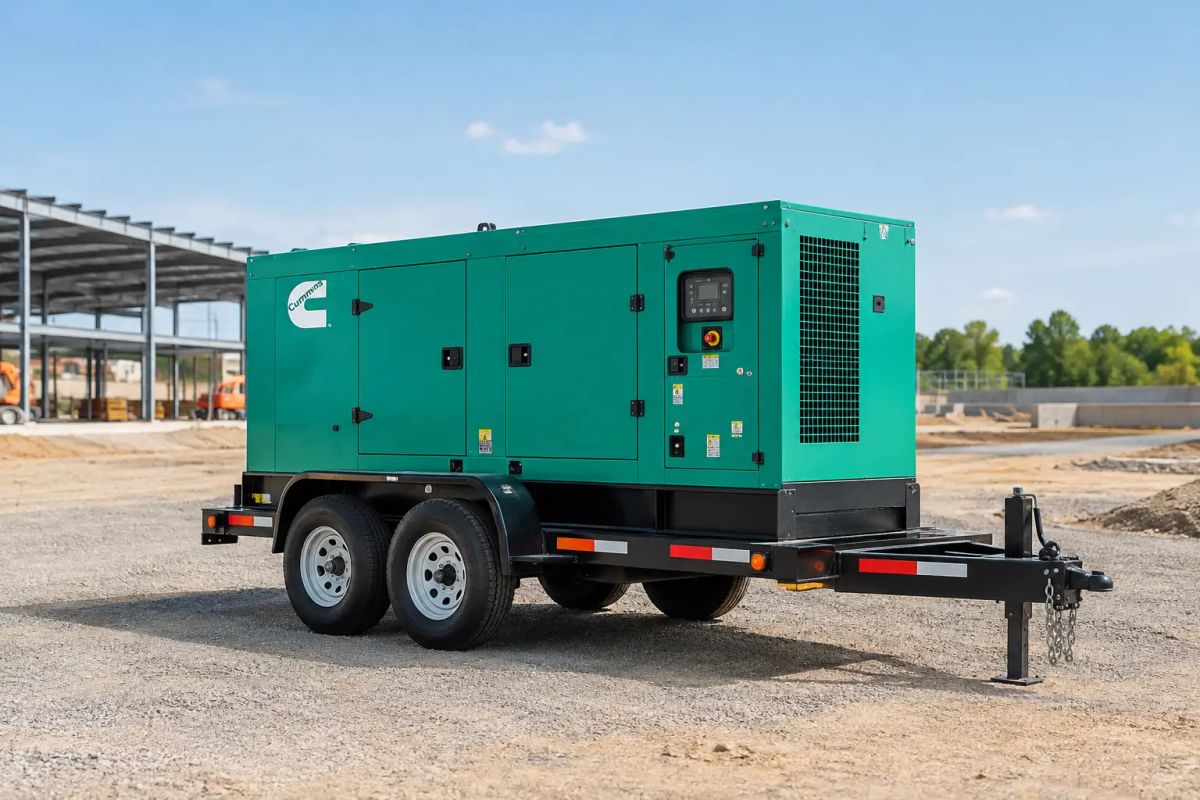
It is a diesel generator set, normally in a silent canopy, mounted on a road trailer so that it can be towed behind a suitable vehicle. All four of our trailer-mounted sets are supplied on braked, single-axle Knott trailers with the generator mounted internally on the trailer bed. The trailers are also available separately, sized by payload, and our generator trailers page lists them.
Compared with a static set, a trailer-mounted generator trades some convenience in permanent installation for easy movement between sites. It suits mobile standby and prime power, rather than a permanent plant-room installation.
The four trailer-mounted models
| Model | Rating (standby / prime) | Trailer | Fuel tank |
|---|---|---|---|
| Pramac GBW22P | 22 / 20 kVA (17.6 / 16 kW) | 1,300 kg Knott | 51 litres |
| Cummins C22D5Q | 22 / 20 kVA (18 / 16 kW) | 1,300 kg Knott | 55 litres |
| Cummins C38D5Q | 38 / 35 kVA (30.4 / 28 kW) | 1,300 kg Knott | 55 litres |
| Cummins C66D5EQ | 66 / 60 kVA (53 / 48 kW) | 1,800 kg Knott | 200 litres |
The Pramac GBW22P has a UK-built Perkins Stage V engine, a manual key-start panel and a set of sockets. The Cummins sets use the PowerStart 0600 controller and a four-pole circuit breaker output.
Towing rules in Great Britain
The rules below come from the GOV.UK guidance on towing with a car. They apply in Great Britain. In Northern Ireland, check the nidirect guidance on towing trailers.
Do you need a special licence?
If you got your car licence before 1 January 1997, you can usually drive a vehicle and trailer with a combined weight of up to 8,250 kg MAM. If you got your licence from 1 January 1997, you can tow a trailer of up to 3,500 kg MAM, which is category BE. If category BE is not on your physical licence, DVLA will add it the next time you renew. You can check your entitlement by viewing your driving licence information on GOV.UK.
All four of our trailers are rated at 1,800 kg or less, well within the 3,500 kg trailer limit. Many online guides still describe the old 750 kg licence limit, which no longer applies. The 750 kg figure that still matters is the weight above which a trailer must have brakes.
Weights: MAM, plated weights and gross train weight
You need to know the weight of both the vehicle and the trailer. The maximum authorised mass (MAM) is shown on a plate or sticker on each. Most vehicles also have a maximum towing weight in the handbook, or a gross train weight on the VIN plate, which is the fully loaded vehicle plus the fully loaded trailer. GOV.UK says the gross train weight must not be exceeded, and that if the VIN plate does not list a train weight, you should not use the vehicle for towing.
Here is how the real outfit weights compare with the trailer ratings:
| Model | Trailer rating | Weight with genset and full fuel | Margin to trailer rating |
|---|---|---|---|
| Pramac GBW22P | 1,300 kg | 854 kg (dry, including fuel) | About 446 kg |
| Cummins C22D5Q | 1,300 kg | 1,068 kg | About 232 kg |
| Cummins C38D5Q | 1,300 kg | 1,153 kg | About 147 kg |
| Cummins C66D5EQ | 1,800 kg | 1,784 kg | About 16 kg |
The GBW22P's wet weight is not listed on its product page, so its figure is dry weight including fuel, and the margin is approximate. The C66D5EQ has the narrowest margin. Its trailer payload is 1,495 kg and the generator weighs 1,479 kg wet with fuel, so there is almost no spare capacity for tools, cables or a socket box. Weigh the whole outfit if you plan to add anything.
> Expert tip: The trailer rating is only half the story. Your towing vehicle's own limit usually decides what you can tow. As an illustration only, if a vehicle's VIN plate shows a gross train weight of 5,500 kg and the loaded vehicle weighs 3,000 kg, the trailer in that case can weigh at most 2,500 kg, and the handbook's maximum towing figure may be lower still. Use the lower number.
Brakes, couplings, mirrors and number plates
GOV.UK sets out the equipment rules for trailers:
- Brakes. A trailer must have a working brake system if it weighs over 750 kg when loaded. All four outfits above weigh more than that, and all use braked trailers.
- Breakaway cable or secondary coupling. You must use one in case the trailer becomes detached.
- Number plate. Display the same number plate on the trailer as on the towing vehicle.
- Tow bar. It must be type approved, with exceptions for vehicles first used before 1 August 1998.
- Mirrors. Fit suitable towing mirrors if the trailer is wider than the rear of the towing vehicle.
- Size. The maximum trailer width is 2.55 metres. If your vehicle's MAM is 3,500 kg or less, the trailer cannot be longer than 7 metres. Our trailers are 1.65 to 1.8 metres wide and 3.5 to 3.975 metres long.
GOV.UK also provides a list of safety checks for towing a trailer with a car, which is worth working through before every journey.
Which model suits which job?
| Model | Prime output | What it suits |
|---|---|---|
| Pramac GBW22P | 16 kW | Small sites, tools, hire fleets, with socket outlets ready to use |
| Cummins C22D5Q | 16 kW | Small sites and standby needing a circuit breaker connection |
| Cummins C38D5Q | 28 kW | Larger tool loads, site cabins, off-grid power |
| Cummins C66D5EQ | 48 kW | Larger sites, longer run times and bigger motors |
For what each size can run, see our guides to what a 20 kVA generator can run and what a 60 kVA generator can run, and browse the 30 kVA generators for the size around the C38D5Q.
Uses for trailer-mounted generators
- Hire fleets. We supplied a trailer-mounted Pramac GBW22P to a tool and construction equipment hire company in Derbyshire, chosen for its simple key-start panel, lift-up canopy for quick servicing and Stage V engine. Read the Derbyshire hire fleet case study.
- Construction sites. Cabins, lighting and tools, with the set moved as the site changes.
- Events and temporary supplies. A quiet canopied set that can be positioned and removed quickly.
- Mobile standby. A set that can be moved to wherever the mains has failed.
The Pramac GBW22P has socket outlets for direct connection: one 32 A 400 V three-phase, one 16 A 400 V three-phase, two 16 A 230 V and one 16 A 230 V Schuko. The Cummins sets have a circuit breaker output, so they need a socket box or a proper connection. We also supply socket boxes in various configurations.
Fuel use and run times
Mobile sets carry modest tanks, so run time matters. Figures at full prime load:
| Model | Fuel tank | Fuel at 100% prime load | Run time |
|---|---|---|---|
| Pramac GBW22P | 51 litres | 5.5 litres per hour | About 9.3 hours |
| Cummins C22D5Q | 55 litres | 5.2 litres per hour | About 10.6 hours |
| Cummins C38D5Q | 55 litres | 9 litres per hour | About 6.1 hours |
| Cummins C66D5EQ | 200 litres | 14 litres per hour | About 14.3 hours |
Most real loads are lower, so run times are longer. If you need longer autonomy, we supply separate free-standing fuel tanks from 450 to 9,750 litres. Our guide to how to calculate generator runtime shows how to work out your own figures.
Emissions and site rules for mobile generators
Towing rules and emissions rules are separate. Mobile generators are treated as non-road mobile machinery, and some sites set their own minimum emissions standards. As our Derbyshire case study explains, main contractors ask for proof of Stage V compliance and low emission zones enforce it. The product pages list the standard for each set: the Pramac GBW22P has a Stage V Perkins engine, the Cummins C66D5EQ is listed as Stage IIIA, and the Cummins C22D5Q and C38D5Q are listed as unregulated.
Check the requirements for the sites you work on before choosing a set, because a generator that does not meet a site's standard cannot be used there. Greater London, for example, applies its own non-road mobile machinery low emission zone, with its own requirements for generators.
Setting up and running on site
- Follow the trailer manufacturer's instructions for parking, securing and supporting the trailer.
- Never run a generator in an enclosed space. Diesel exhaust contains carbon monoxide.
- Earth it correctly. Our generator earthing requirements guide explains what applies on UK sites, and the HSE's electrical safety guidance covers the general principles.
- Think about noise. The canopied sets are rated at 65 to 68 dB(A) at 7 m, according to their product pages. Our guide to how quiet a silent generator really is explains how to read the figures.
Buying a trailer on its own
Our trailers are sold on their own or as part of a trailer-mounted generator. The Knott 1300 kg braked single-axle trailer has a maximum payload of 1,035 kg, and the 1800 kg version has 1,495 kg. Both have internal mounting. Check your generator's wet weight, including fuel, against the payload before you buy. The Knott 1300 kg trailer and Knott 1800 kg trailer pages have the full specifications.
Frequently asked questions
Can I tow a trailer-mounted generator with a car?
Possibly, but only if your vehicle's towing limit and gross train weight allow it. The fully loaded generator outfits weigh from about 854 kg to 1,784 kg, so check the handbook or VIN plate first. If the VIN plate does not list a train weight, GOV.UK says you should not use the vehicle for towing.
Do I need a special licence to tow a generator trailer?
In Great Britain, a licence with category BE allows a trailer of up to 3,500 kg MAM. If you got your licence from 1 January 1997, DVLA adds category BE when you next renew. Licences from before 1997 usually allow a combined vehicle and trailer weight of up to 8,250 kg MAM. Our trailers are rated at 1,800 kg or less.
Does a generator trailer need brakes?
Yes, if it weighs over 750 kg when loaded. All four outfits in our range exceed that weight and all are on braked trailers. GOV.UK also requires a breakaway cable or secondary coupling.
How heavy is a trailer-mounted generator?
From about 854 kg for the Pramac GBW22P to about 1,784 kg for the Cummins C66D5EQ, with generator, trailer and full fuel tank. The two Cummins sets in between weigh 1,068 kg and 1,153 kg.
Can I run the generator while it is on the trailer?
Yes. These sets are supplied for mobile standby or prime power on the trailer. Follow the trailer manufacturer's instructions for parking and securing it, and never run it in an enclosed space.
How long will a trailer-mounted generator run on one tank?
At full prime load, about 6.1 hours on the Cummins C38D5Q up to about 14.3 hours on the Cummins C66D5EQ. Real loads are usually lower, so run times are longer, and separate free-standing fuel tanks are available for longer autonomy.
Conclusion
A trailer-mounted generator gives you power wherever you can tow it, but only if the outfit is legal and safe to tow. Check your licence, the weights on the vehicle and trailer plates, the brakes and the equipment rules, and weigh the whole outfit if you load anything extra. Then match the generator to the job and to the site's emissions requirements.
> Choosing a trailer-mounted generator? Global Generators is an authorised Cummins reseller and an authorised Grupel and Pramac dealer, with new diesel generators in stock for UK delivery and export. Browse the stock list, then contact our team on +44 1302 700200 or at enquiries@global-generators.com with your vehicle, load and site details, and we will help you choose a set and trailer that suit them.