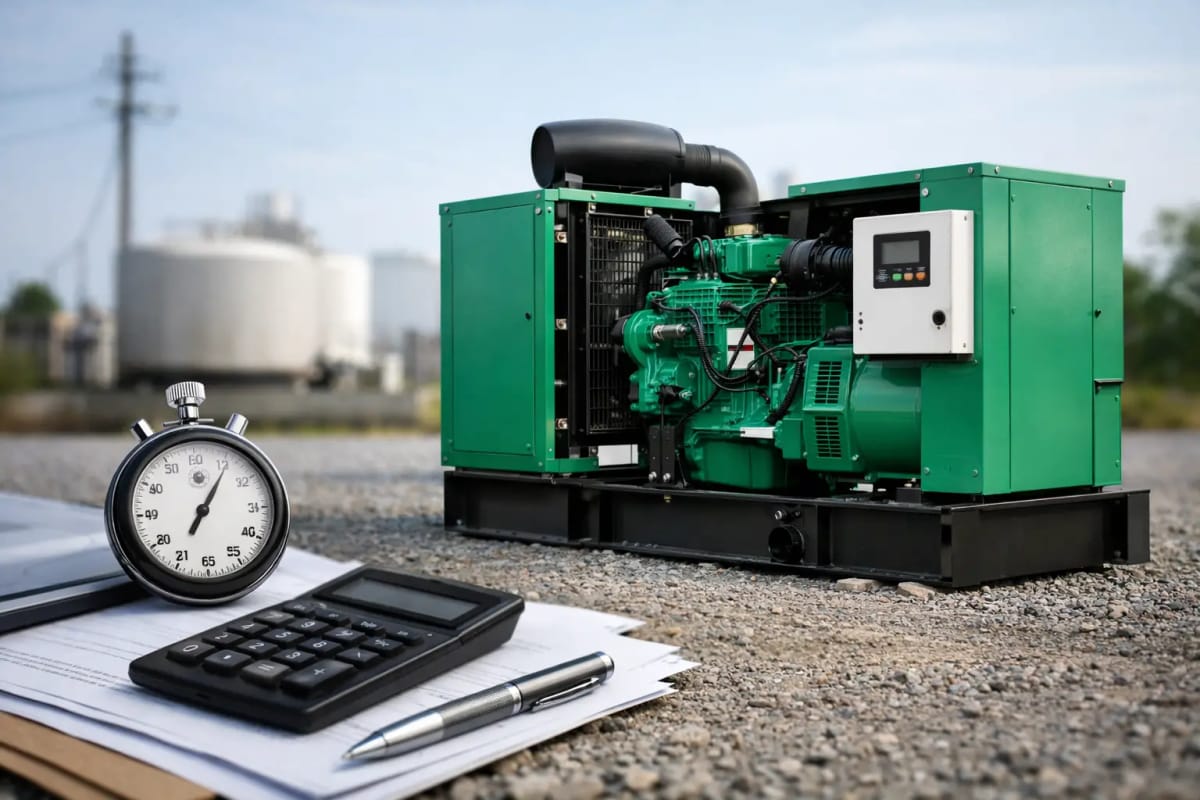
A generator that runs out of fuel before the mains supply is restored is not a backup system. It is a single point of failure. Knowing how to calculate generator runtime allows facilities teams, contractors and procurement managers to specify the right tank size, refuelling plan and generator duty rating before an outage exposes a weakness.
Runtime is not a fixed number printed against a generator set. It changes with the actual electrical load, the fuel consumption curve, available fuel capacity, site conditions and the way the generator is intended to operate. A sound calculation starts with the application, not the fuel tank.
How to calculate generator runtime
The core calculation is straightforward:
Generator runtime (hours) = usable fuel capacity (litres) ÷ fuel consumption at actual load (litres per hour)
The critical phrase is at actual load. A diesel generator may consume substantially more fuel at 75% load than at 25% load, but its consumption does not rise in exact proportion to kW demand. The engine must still overcome friction, drive cooling systems and maintain operating speed at lighter loads. As a result, a set running at low load can use fuel inefficiently while also creating operational issues associated with prolonged underloading.
Use the manufacturer’s fuel consumption figures for the specific engine and generator configuration wherever possible. These figures are normally stated in litres per hour at defined load points, commonly 25%, 50%, 75% and 100% of rated output. Do not base a critical runtime assessment on a generic litres-per-kVA estimate.
Establish the usable fuel capacity
Start with the fuel that is genuinely available to the engine, rather than the nominal tank volume. A 1,000-litre integral base tank should not automatically be treated as 1,000 litres of usable fuel.
A sensible calculation allows for a reserve, tank geometry, fuel pickup position and a margin to prevent the system being run to empty. Depending on the installation and operating procedure, 90% to 95% of nominal capacity may be considered usable. For critical sites, a more conservative reserve is often justified so that operators have time to arrange refuelling without risking fuel starvation.
For example, a 1,000-litre tank with 90% usable capacity provides 900 litres for the runtime calculation. If the set consumes 90 litres per hour at the expected load, the estimated running time is:
900 litres ÷ 90 litres per hour = 10 hours
That is the planning figure before any allowance for changing site demand, fuel transfer limitations or adverse operating conditions.
Calculate the expected load, not the generator’s full rating
A generator’s rating is its capability, not a prediction of the load it will carry. First establish the normal outage load in kW, including essential services, starting requirements and any loads that will be shed during generator operation.
Where loads are recorded in kVA, account for power factor:
kW = kVA × power factor
For a 500 kVA generator at 0.8 power factor, the corresponding output is 400 kW. If a site expects to draw 240 kW during an outage, it is operating at approximately 60% of the generator’s kW capacity. The fuel consumption figure should therefore be selected from the manufacturer’s curve at, or conservatively above, the 60% load point.
Avoid assuming that a site’s utility maximum demand will match generator demand. During a mains failure, some non-essential equipment may be isolated, while other equipment, such as smoke extraction, pumps or cooling systems, may start automatically. The load study should reflect the actual emergency operating sequence.
Worked generator runtime example
Consider a 500 kVA diesel generator configured for standby duty. The site’s emergency load assessment identifies a normal running load of 250 kW. At 0.8 power factor, the set has a 400 kW capacity, so the anticipated load is 62.5%.
The manufacturer’s data states fuel consumption of 78 litres per hour at 50% load and 108 litres per hour at 75% load. Rather than interpolate aggressively, use the 75% figure for a conservative resilience calculation, particularly where loads may increase during the outage.
The generator has a 1,500-litre tank. Applying a 10% fuel reserve gives 1,350 litres usable fuel.
1,350 litres ÷ 108 litres per hour = 12.5 hours of estimated runtime
In operational terms, this should not be interpreted as permission to wait 12.5 hours before arranging fuel. A critical facility may set a refuelling trigger at 50% tank level or earlier, depending on supplier response times, access restrictions and the duration risk attached to the utility outage.
If the same set were loaded closer to 50%, its calculated runtime would be approximately 17.3 hours using the 78 litres-per-hour figure. That difference demonstrates why a single advertised runtime figure can be misleading without a stated load percentage.
Fuel consumption factors that change the result
Manufacturer data provides the correct starting point, but site conditions can affect real-world performance. Fuel consumption may increase where the generator is operating in high ambient temperatures, at altitude, with frequent load steps or with additional auxiliary equipment. Cooling fans, battery chargers, fuel transfer pumps and enclosure ventilation all contribute to the installation’s overall electrical demand, although their effect is often modest compared with the main site load.
Load profile matters as much as average load. A site with a stable 60% load is easier to assess than a site where large motors, compressors or pumps cycle throughout the day. Motor starting can create high transient demand, even when the steady-state load appears modest. The generator must be sized to accept those starts, and runtime should be calculated against the likely sustained load after each event.
Poor fuel management can shorten practical runtime even where the arithmetic is correct. Water contamination, blocked filters, restricted fuel lines and air entering a nearly empty system can stop a generator before its theoretical usable fuel quantity has been consumed. Fuel quality, tank maintenance and routine load testing are part of runtime assurance, not separate housekeeping tasks.
Do not run diesel generators persistently at very low load
Selecting an oversized set purely to obtain a long runtime can create another problem. Diesel generators operated for extended periods at very low loads can suffer from wet stacking, bore glazing, carbon build-up and inefficient fuel use. The precise acceptable loading range depends on the engine manufacturer and duty cycle, but a practical design should aim to keep the generator operating within its recommended range during expected running conditions.
Where a facility has a small overnight load but major daytime demand, consider the operating strategy. Options may include load banking, staged generation or a smaller set for low-load periods, subject to resilience requirements. The appropriate solution depends on the site’s risk profile and whether parallel operation is required.
Standby and prime power ratings affect runtime planning
Runtime must be considered alongside the generator’s rating classification. Standby power is intended for emergency use during utility failure, generally with limited annual operating hours and variable load. Prime power is intended for applications where the generator may serve as the main source of power for extended periods, subject to the manufacturer’s stated conditions.
A generator should not be assumed to deliver its standby rating continuously simply because the tank is large enough for a long run. For extended operation, use the applicable prime rating and confirm the permitted load profile. This is particularly relevant for construction projects, remote sites, utilities work and premises facing prolonged grid constraints.
The rating also affects procurement decisions. A set sized solely for a peak standby event may not be the appropriate choice for repeated or continuous operation. Engine rating, alternator capacity, cooling arrangement, fuel storage and maintenance intervals all need to match the intended duty.
Build a runtime plan, not just a calculation
For mission-critical installations, the final runtime number should become part of a documented fuel resilience plan. Record the tank capacity, reserve level, expected load, fuel burn at key load points, refuelling trigger and the responsible contact for fuel delivery. Test the assumptions under representative load where possible.
Consider whether refuelling can take place safely while the generator is running, how fuel vehicles will access the site during severe weather or disruption, and whether a day tank, bulk tank or automated fuel transfer system introduces additional failure points. A nominal 24-hour fuel supply is only valuable if the fuel can reach the engine reliably.
Global Generators can support this assessment by matching generator output, duty rating, enclosure configuration and fuel autonomy to the operational requirement. For sites where interruption is not acceptable, specify from measured load data and confirmed engine consumption figures, rather than relying on headline tank capacity.
The most useful runtime calculation is the one that gives your team enough time to act. Set the fuel reserve and replenishment trigger around real delivery lead times, realistic site access and the consequences of losing power, then verify the plan before the next outage tests it for you.