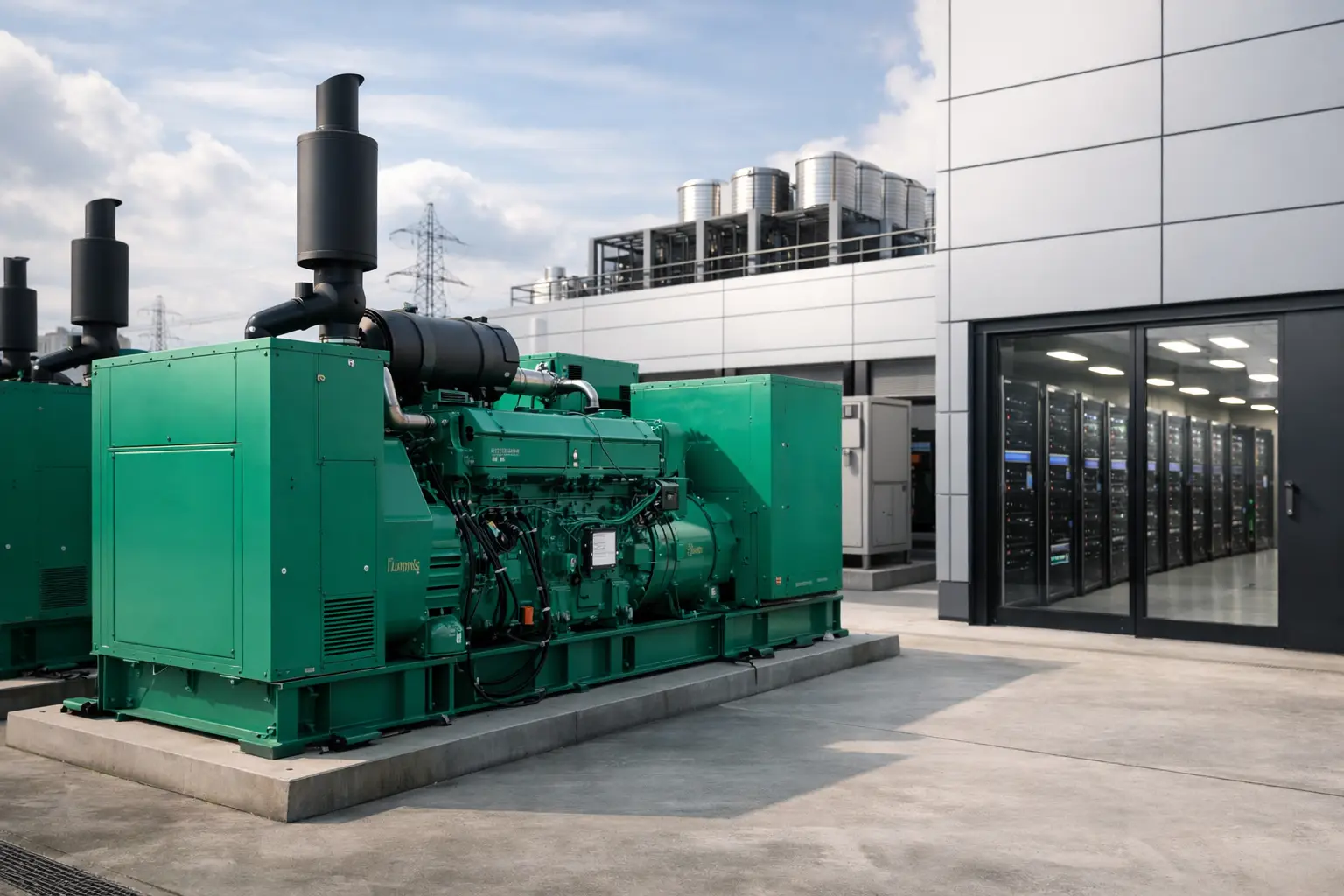
A data centre generator is not simply a large standby set. It is part of a coordinated critical-power system that must accept load quickly, operate predictably and remain available after months of inactivity. When assessing the best generators for data centres, the priority is not a headline kVA figure. It is assured performance across the generator, fuel system, controls, switchgear and maintenance regime.
For facilities managers, consultants and project teams, the correct specification starts with the site’s resilience target. A generator that suits a small edge facility may be wholly inadequate for a high-density colocation site with multiple IT halls, cooling plant and strict customer service commitments.
What Makes the Best Generators for Data Centres?
The best specification is the one that supports the required uptime tier, operating profile and expansion plan without creating unnecessary complexity. Diesel generator sets remain the established choice for most data centre standby applications because they deliver high power density, rapid starting and dependable operation from proven industrial engines.
A suitable set must perform under the conditions it will actually face. That includes large initial load steps, non-linear IT loads, high ambient temperatures, restricted plant-room ventilation and extended operation during a utility outage. The generator should also integrate cleanly with uninterruptible power supplies, automatic transfer switches and, where required, a paralleling control system.
For mission-critical installations, recognised engine platforms matter. Cummins-powered generator sets are widely specified where buyers require established service support, clear ratings and a proven record in demanding standby and prime power environments. However, the engine badge alone does not make a system resilient. Alternator selection, control compatibility, fuel resilience and commissioning standards are equally significant.
Start With the Correct Power Rating
Generator capacity should be based on a detailed load study, not a simple calculation of the building’s incoming electrical supply. Data centre demand includes IT equipment, UPS losses, cooling systems, pumps, fire systems, lighting, security and essential ancillary loads. Some of those loads start at different times and impose very different electrical characteristics on the generator.
Standby power is normally the correct rating where the public supply is the primary source and the generator operates only during outages and planned testing. Prime power may be appropriate for sites with an unstable utility connection, remote locations or a planned operating model that requires extended generator use. These ratings are not interchangeable. Selecting a standby-rated set for routine prime operation can compromise both performance and warranty conditions.
The relationship between kVA and kW also requires attention. Generator sets are commonly quoted at a 0.8 power factor, while modern data centre electrical systems may present a different effective power factor. UPS systems, harmonic filters and cooling equipment can influence the actual demand seen by the alternator. The design team should confirm kW demand, power factor, harmonic content and expected future load rather than relying on a nominal kVA allowance.
Oversizing is not always the safe answer. A lightly loaded diesel generator can suffer from poor combustion, carbon build-up and wet stacking if it runs for sustained periods below its recommended load level. The better approach is to specify capacity and redundancy that maintain acceptable loading during test runs and real outage conditions.
Redundancy Is a System Decision
Data centres usually use either N+1 or 2N generator architecture. Under N+1, the site has enough generation capacity to support the required load with one additional set available if another unit is unavailable. Under 2N, two independent generator paths can each support the full critical load. The appropriate model depends on the commercial commitments of the facility, maintenance requirements and the consequences of a single failure.
Multiple smaller generator sets can offer better scalability and maintenance flexibility than one very large unit. With a correctly designed paralleling system, sets can be added as the data hall load grows, and individual units can be isolated for service while remaining capacity supports the site. This approach does add controls, switchgear and commissioning complexity, so it must be designed and tested as one complete power system.
For smaller edge data centres, a single standby generator with appropriate UPS ride-through and a well-maintained bypass arrangement may be sufficient. For larger facilities, generator redundancy should be aligned with the UPS topology, distribution routes, cooling strategy and fuel infrastructure. A redundant generator does not provide resilience if it depends on a single fuel transfer pump, shared control panel or common exhaust route.
Load-Step Performance and UPS Compatibility
A utility failure is a dynamic event. The generator starts, reaches rated speed and voltage, accepts the building load and then responds as UPS systems recharge and cooling plant restarts. Poor transient response can cause unacceptable frequency or voltage deviation, leading protective systems to operate or sensitive equipment to behave unpredictably.
Specify the required load-step acceptance in clear terms. The supplier and consultant should agree the size of the first block load, the sequence of subsequent loads, allowable voltage and frequency dip, and recovery time. Large chillers, fans and pumps may need staged starting or variable-speed drives to avoid a sudden demand that exceeds the generator’s transient capability.
UPS compatibility needs equally close scrutiny. Modern UPS equipment can present non-linear loads and may draw high input current when batteries recharge after an extended outage. Alternator sizing, excitation design and harmonic tolerance should be assessed against the selected UPS arrangement. This is particularly relevant where generator capacity has been tightly optimised to reduce capital cost.
Fuel Autonomy Must Match the Risk Profile
Generator runtime is determined by both fuel storage and fuel delivery reliability. A data centre may require several hours of on-site autonomy, while higher-resilience facilities often plan for 24 hours or more before refuelling. The right target depends on local utility reliability, access during severe weather, contractual obligations and the availability of emergency fuel deliveries.
Bulk tanks, day tanks, transfer pumps, filtration and leak detection should be treated as critical equipment. Fuel contamination, water ingress and failed transfer components are common causes of generator non-availability. Long-term stored diesel requires a fuel quality plan, including periodic sampling, polishing where necessary and a clear procedure for replenishment after tests or outages.
Physical security and environmental compliance also need consideration. Tank location, bunding, fire protection and access for fuel lorries can influence the overall plant layout. These details are often easier and less costly to resolve at the design stage than after the generator has been delivered.
Enclosure, Cooling and Site Conditions
The generator format must match the installation. A weatherproof silent generator is often suitable for external compounds where noise limits and weather protection apply. An open generator can be effective within a purpose-built plant room, but it requires engineered ventilation, acoustic treatment and safe exhaust routing.
Ambient temperature has a direct effect on available output. A generator set rated at standard conditions may need derating in a hot plant room, at altitude or where radiator airflow is restricted. Do not assume that a large enclosure resolves cooling requirements. Air intake, discharge paths, louvre sizing and recirculation prevention must be considered alongside the set’s radiator capability.
Noise limits may also shape the selection. Acoustic enclosures, hospital-grade silencers and attenuated ventilation systems can reduce sound levels, but each measure can increase back pressure, restrict airflow or affect access for maintenance. The target should be compliant noise performance without compromising the generator’s operating environment.
Controls, Testing and Maintainability
Data centre generator controls must provide clear status, alarm reporting and reliable interaction with transfer and paralleling equipment. Remote monitoring should give operations teams visibility of key parameters such as battery condition, fuel level, coolant temperature, operating hours and active faults. It does not replace physical inspection, but it improves response time when a condition begins to deteriorate.
Regular testing is the proof of availability. No-load starts confirm that the engine can run, but they do not validate performance under meaningful electrical demand. Planned on-load testing, ideally with load-bank support where live load testing is impractical, confirms load acceptance, cooling performance, control operation and fuel transfer arrangements.
Maintainability should be designed into the project. Engineers need safe access to filters, batteries, control panels, fuel connections and service points. Space is also required for radiator cleaning, exhaust inspection and eventual component replacement. A set that is difficult to maintain is less likely to deliver its intended availability over its working life.
Selecting a Supplier for Critical Power
Data centre procurement should assess more than the generator specification sheet. Confirm available stock, realistic lead times, technical support, commissioning scope and the supplier’s ability to match the set to the intended duty. Clear distinction between standby and prime ratings, voltage configuration, enclosure type and control requirements avoids costly revisions later in the project.
Global Generators supplies industrial diesel generator sets from 13 to 3000 kVA, including silent, open and three-phase configurations for critical standby and prime power applications. For a data centre project, the most productive starting point is a defined load profile, required redundancy level and site installation constraints. With those facts established, generator selection becomes an engineering decision rather than a purchase based on headline capacity alone.